Key Highlights
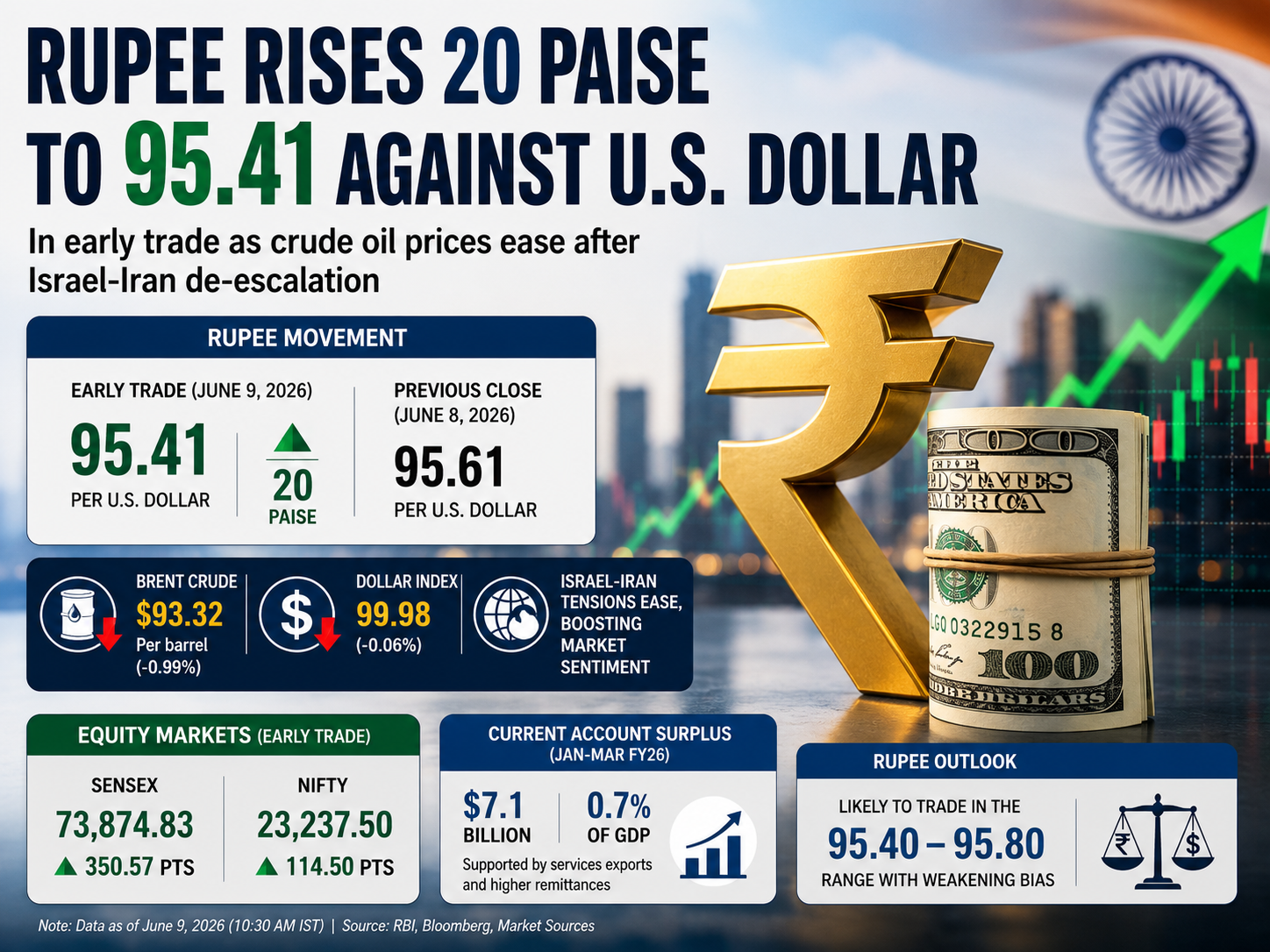
- Rupee appreciated 20 paise to 95.41 against the U.S. dollar in early trade.
- The currency had settled at 95.61 in the previous trading session.
- Brent crude oil prices fell nearly 1% to around $93.32 per barrel.
- The U.S. Dollar Index slipped below the 100-mark to 99.98.
- Israel and Iran signaled a willingness to de-escalate tensions, boosting market sentiment.
- Sensex gained over 350 points while Nifty advanced more than 114 points in early trade.
- India’s current account posted a $7.1 billion surplus in the January-March quarter of FY26.
Rupee Gains Ground Against Dollar as Oil Prices Retreat and Global Risk Sentiment Improves
Mumbai, June 9, 2026: The Indian rupee opened stronger on Tuesday, appreciating 20 paise against the U.S. dollar as easing geopolitical tensions in West Asia and a decline in global crude oil prices improved investor sentiment.
The domestic currency rose to 95.41 per U.S. dollar in early interbank foreign exchange trading, recovering from Monday’s close of 95.61, when it had suffered a sharp 43-paise decline amid concerns over escalating tensions between Israel and Iran.
Forex market participants attributed the rupee’s rebound to a combination of softer crude oil prices, a weaker U.S. dollar, and renewed optimism across global financial markets following reports of diplomatic efforts aimed at reducing hostilities in the Middle East.
Crude Oil Prices Ease
One of the key drivers behind the rupee’s recovery was the decline in international crude oil prices. Brent crude, the global benchmark, fell nearly 1% to around $93.32 per barrel during futures trading.
Oil markets had surged in recent weeks due to fears that conflict in West Asia could disrupt global energy supplies, particularly around key shipping routes. However, reports indicating a pause in military escalation between Israel and Iran helped reduce some of those concerns, leading to a pullback in oil prices.
For India, which imports more than 80% of its crude oil requirements, lower oil prices are generally supportive for the rupee because they reduce the country’s import bill and ease pressure on the current account balance.
Dollar Index Weakens
The U.S. dollar also showed signs of weakness, providing additional support to emerging-market currencies, including the rupee.
The Dollar Index (DXY), which measures the greenback’s strength against a basket of six major currencies, slipped 0.06% to 99.98, falling below the psychologically important 100 level.
Currency analysts noted that the combination of a weaker dollar and improving risk appetite encouraged investors to move back into emerging-market assets.
Equity Markets Join the Recovery
The positive sentiment was also reflected in India’s stock markets.
The BSE Sensex climbed more than 350 points in early trade to reach 73,874.83, while the Nifty 50 gained over 114 points to trade at 23,237.50.
Market participants viewed the improvement in geopolitical conditions as a temporary relief after weeks of uncertainty that had weighed on global equities, currencies, and commodities.
Current Account Data Offers Additional Support
Adding to the positive backdrop, recent data from the Reserve Bank of India showed that India recorded a current account surplus of $7.1 billion, equivalent to 0.7% of GDP, during the January-March quarter of FY26.
The surplus was supported by strong services exports and healthy remittance inflows from overseas Indians.
However, for the full fiscal year 2025-26, India reported a current account deficit of $25.2 billion, representing 0.6% of GDP, slightly higher than the previous fiscal year’s deficit of $22.9 billion.
Economists believe continued strength in services exports and remittance inflows could help cushion the economy against external shocks, including fluctuations in global commodity prices.
Outlook Remains Cautiously Positive
Despite Tuesday’s gains, analysts remain cautious about the rupee’s near-term trajectory.
According to market estimates, the currency is expected to trade within a 95.40-95.80 range, with risks remaining tied to developments in crude oil markets, geopolitical tensions, and foreign capital flows.
A key concern remains the behavior of foreign institutional investors (FIIs), who sold Indian equities worth ₹5,555.67 crore on a net basis during the previous trading session. Persistent foreign outflows could limit further gains for the rupee despite improving global sentiment.
Investors are also closely monitoring developments in West Asia, as any renewed escalation could quickly reverse the recent decline in oil prices and put fresh pressure on emerging-market currencies.
For now, however, easing geopolitical concerns, softer crude oil prices, and a weaker U.S. dollar have provided the rupee with much-needed support, helping it recover part of the losses recorded earlier this week.