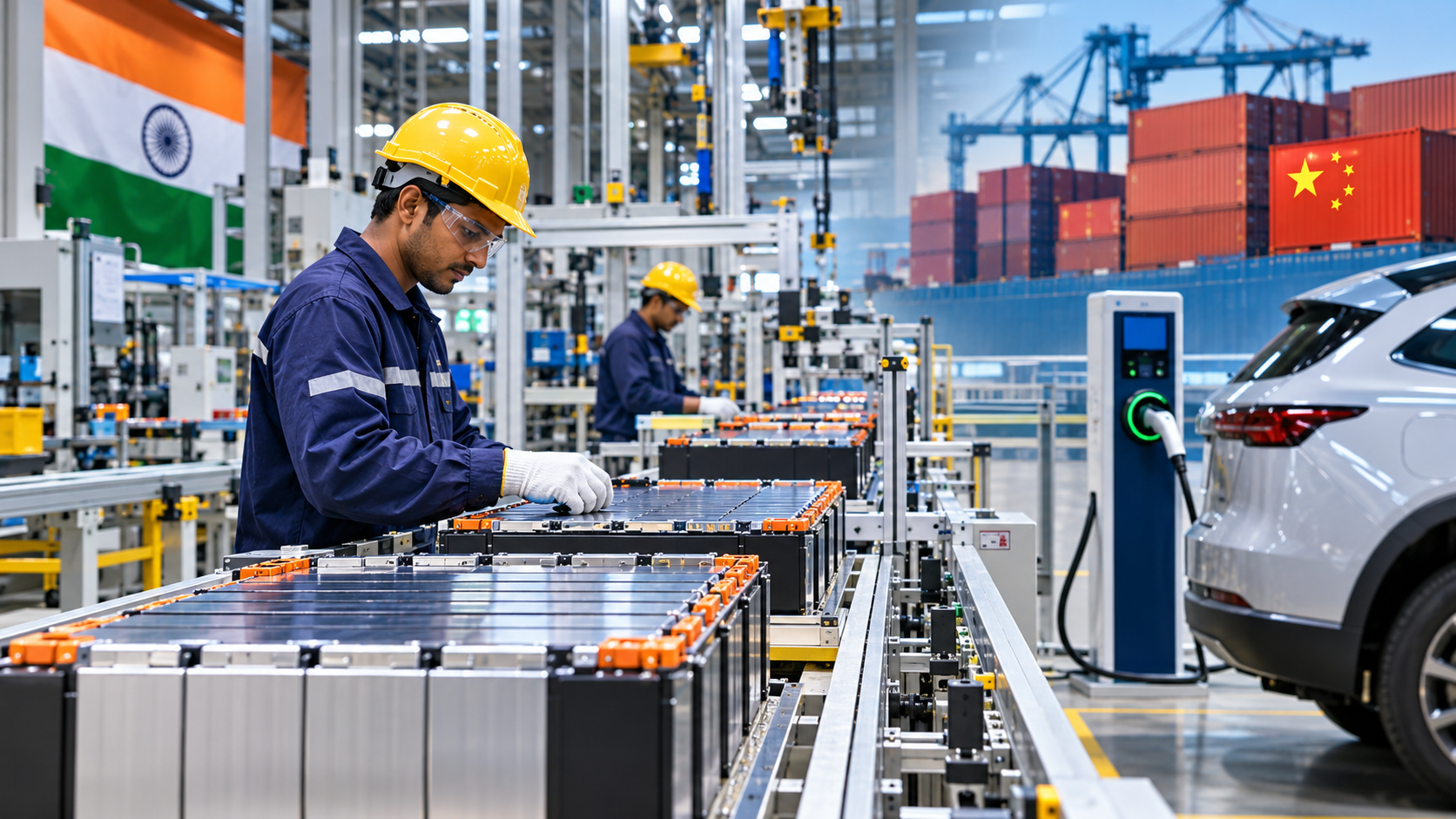
Indian battery component manufacturers are seeking substantial government support to overcome production costs that are reportedly 18–61% higher than China’s and strengthen the domestic electric vehicle supply chain.
Highlights
- India is planning a ₹12,000-crore battery component manufacturing scheme.
- Industry players are seeking capital subsidies of up to 50%.
- Domestic battery component production costs are reportedly 18–61% higher than China’s.
- The proposed incentives aim to attract investment in local manufacturing.
- The initiative could reduce India’s dependence on imported battery materials and components.
- Stronger domestic supply chains could support electric vehicles and energy storage industries.
India Plans ₹12,000-Crore Battery Component Scheme as Industry Seeks 50% Subsidy to Compete With China
New Delhi, November 3: India’s battery manufacturing industry is seeking capital subsidies of up to 50% as the government prepares a proposed ₹12,000-crore incentive scheme to strengthen domestic production of advanced battery components. The move aims to reduce dependence on Chinese imports and support India’s expanding electric vehicle and energy storage industries.
According to a Moneycontrol report published on November 2, the proposed scheme is currently under inter-ministerial consultation. Industry representatives have highlighted substantial cost disadvantages faced by Indian manufacturers compared with Chinese suppliers. Moneycontrol +1
Indian Battery Components Cost Up to 61% More
A report prepared by the Net-Zero Energy Transition Association (NETRA), in collaboration with IIT Madras and industry stakeholders, estimates that manufacturing battery components in India costs 18–61% more than importing comparable products from China.
The cost difference varies across components. Lithium iron phosphate cathode materials are estimated to cost 47% more, while nickel manganese cobalt cathode materials carry an 18% disadvantage. Natural and synthetic graphite anode materials are 51% and 61% more expensive, respectively.
Higher capital investment requirements, limited manufacturing scale and supply chain constraints contribute to the competitiveness gap. Moneycontrol
Industry Proposes Three Subsidy Models
Battery manufacturers have proposed three incentive structures to help establish a competitive domestic ecosystem.
The first combines a 25% capital expenditure subsidy with component-specific operating incentives. The second relies entirely on operational subsidies, while the third proposes capital subsidies of up to 50%, linked to actual investments.
Industry stakeholders have also recommended linking government support to domestic value addition, production capacity and sales performance.
Battery Demand Could Reach 236 GWh by 2032
India’s battery demand is projected to increase from 33 gigawatt-hours (GWh) in 2025 to 236 GWh by 2032 and nearly 600 GWh by 2037.
However, domestic component manufacturing capacity remains significantly below projected requirements.
The proposed scheme would support essential materials, including cathodes, anodes, electrolytes, separators and current collector foils.
Existing ₹18,100-Crore PLI Scheme
The proposed programme would complement India’s existing ₹18,100-crore Production Linked Incentive scheme for Advanced Chemistry Cell batteries.
The government has targeted 50 GWh of domestic battery manufacturing capacity under the existing programme. Of this, 40 GWh has already been awarded to four companies. Press Information Bureau
What Happens Next?
The proposed ₹12,000-crore scheme could help attract investments, develop domestic suppliers and strengthen India’s position in the global battery supply chain.
However, the subsidy structure, eligibility conditions and final financial allocation remain subject to government approval.
SEO Keywords: India Battery Manufacturing, Battery Component Subsidy, 12000 Crore Battery Scheme, EV Battery India, China Battery Competition, Battery Manufacturing PLI, ACC Battery Components, India Electric Vehicle Industry