Decoding India’s knitted fabric import dilemma

India’s textile industry grapples with rising fabric imports, reflecting dependence on foreign sources. Government initiatives like the PLI scheme hold promise but face challenges, including underutilized factories, inverted GST structures, and fabric influx, even as apparel exports continue to face severe challenges. 

IBT looks at the key drivers of the surge in imports, and how they are impacting the domestic industry.

Knitted fabric textile

India’s textile and apparel sector is witnessing strong competitive headwinds that seem to be impacting its trade performance. The country is ranked 7th among the top exporters of apparel (HS 62 and 63). These exports reached US$ 16.7 billion in 2022, with a 4-year CAGR of 2%, which is the lowest among the top 10 exporters along with (Germany and Viet Nam). In contrast, Bangladesh witnessed the highest CAGR of 10% to reach a value of US$ 57.6 billion.

In 2022-23, exports were recorded at US$ 16.2 billion, witnessing a meagre 1% growth. On the other hand, imports under these HS codes witnessed a sharp rise by 38.6% to reach US$ 1.75 billion. Furthermore, imports of knitted or crocheted fabrics (HS 60) have increased by 12.5% to US$ 757.7 million.
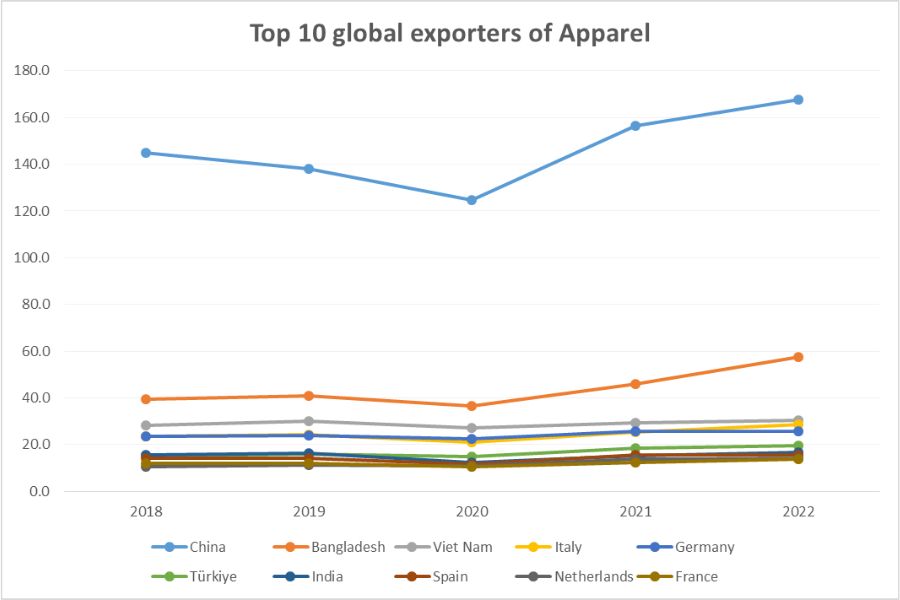
Top 10 exporters of apparel_TPCI

Source: ITC Trade Map, Data for HS 61 (Articles of apparel and clothing accessories, knitted or crocheted) and 62 (Articles of apparel and clothing accessories, not knitted or crocheted)  

With imports on the rise, India is consciously strategising a shift towards local production to meet its growing demand. In 2022-23, imports of Knitted Fabric reached US$ 757.67 million, showing a significant increase of 12.5% YoY. Furthermore, during the first quarter of 2023-24 (April – June), the country imported approximately 88,000 tons of Knitted fabric, amounting to US$ 129 million. This indicates a substantial daily import rate of 977 metric tons.
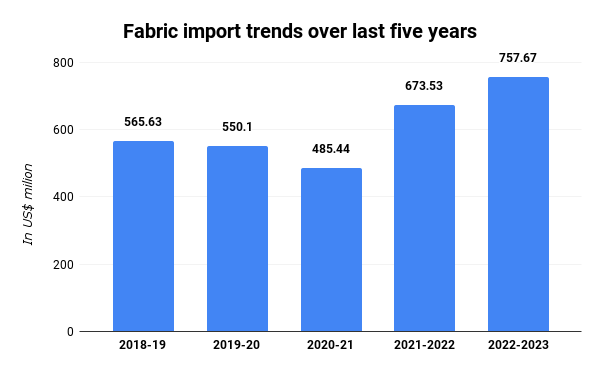
Fabric import trends over last five years

Source: Department of Commerce and Industry (HS Code 60)

In our trade analysis, we see that imports witnessed a decline in 2019-20 and 2020-21, primarily due to the disruptions caused by the COVID-19 pandemic. However, the subsequent increase in imports is being viewed with caution by the industry.

Prabhu Dhamodharan, Convenor of the Indian Texpreneurs Federation (ITF) based in Coimbatore, Tamil Nadu, aexpressed concern over the persistent increase in the import of dyed knitted fabrics, despite import duties. 

Dyed knitted fabrics are widely used in garment production. In the first five months of the current fiscal year, India imported knitted fabrics with a total value of US$ 276 million , primarily sourced from China. Notably, a single HS code accounts for 30% of these imports. This influx of dyed knitted fabrics has a direct impact on various sub-sectors within Tamil Nadu’s textile manufacturing industry, including spinning, knitting, and processing, according to Dhamodharan. 
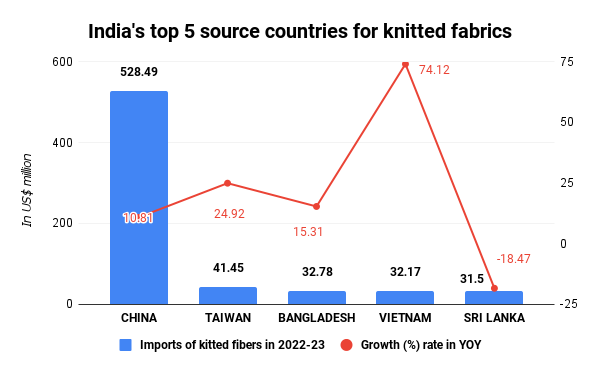
India's top 5 source countries for knitted fabrics

Source: Department of Commerce and Industry (HS Code 60)

China leads the way with an import value of US$ 528.49 million, marking a 10.81% growth and share of around 70%. It is followed by Taiwan, Bangladesh, Vietnam and Sri Lanka. Vietnam has seen maximum YoY growth of 74.12%, while Sri Lanka has witnessed a decline by 18.47% YoY. 


Read More: 


Drivers for increased imports 

The main challenge that the textile industry is facing is the influx of imported finished fabric, especially when it’s available at the same rate as yarn prices. This puts considerable pressure on the local industry given the current capabilities, infrastructure, and industry scenario. In reality, the domestic industry often ends up producing yarn at the same cost as the imported finished goods.

Many factories are already underutilized, hindering investment in schemes like PLI. Secondly, the inverted GST structure, where raw materials like yarn have a higher GST than the lower-taxed finished fabric, accumulates costs and capital shortages, discouraging further expansion.

Fluctuations in global currency exchange rates can lead to unpredictable shifts in the prices of raw materials crucial to the knitted fabric industry. This instability poses challenges in cost management and pricing strategies, impacting profit margins and overall financial stability.

Prabhu Dhamodharan mentioned that production of finished material worth Rs 50,000 crore (knitwear apparel for domestic and import market) relies on the availability of basic materials like yarn, fabric, and the necessary dyeing processing capacity in and around Tirupur. However, the direct entry of dyed knitted fabric into the market has adverse effects on various sectors, including spinning, dyeing processing, knitting, and compacting. Imported dyed fabric bypasses the processes carried out in and around Tirupur and Coimbatore, which involve multiple units.

A preliminary study indicates that a significant portion of imports is facilitated by traders who subsequently distribute the fabric to domestic garment manufacturers in key hubs such as Coimbatore and Tirupur.

When we discussed this with Mr. R. K. Vij, President of Textile Association of India, he added, “Our factories are basically sitting idle at the moment. You see, there are these traders who are importing goods, and we suspect they’re undervaluing their imports. The problem is, it’s really hurting our industry.

He also added, “We’ve got no shortage of fabric looms and raw materials here in India. But these traders are not declaring the true value of what they’re importing. They’re skipping out on GST and customs duties. As a result, we’ve got a flood of knitted fabric coming into the Indian market – over a crore meters every day. It’s affecting the whole value chain, from our raw materials like KMEG, fiber, and filament, all the way to our looms, which are just sitting idle. Some of these traders are even using unofficial channels to move money around.”

Government Measures to Mitigate Import Surges

The Production Linked Incentive (PLI) Scheme for Textiles aims to promote the development of sustainable enterprises and enhance India’s textile industry competitiveness. It focuses on improving the manufacturing of man-made fiber (MMF) apparel, fabrics, and technical textile products. This initiative is aimed at bolstering India’s textile industry globally, increase competitiveness, and create job opportunities. India’s goal is to reach US$ 250 billion in textile production and US$ 100 billion in exports by 2030.

The textile sector has unique needs and incentives compared to other industries. While the PLI scheme for textiles correctly focuses on enhancing the production of man-made fibers (MMF) and technical textiles, it does not encompass fabric, which continues to be a heavily imported category in the country.

The PLI scheme also excludes synthetic fabrics like viscose, polyester, and nylon, which are crucial inputs for apparel production, according to the industry. Following the initial challenges faced by the PLI scheme for textiles, specifically in regard to man-made fiber (MMF) apparel, MMF fabrics, and technical textiles products, the Indian government has reintroduced the scheme and is currently accepting new applications.

Previously, the government had approved 64 out of 67 applications for investment under the ₹100 crore and ₹300 crore categories. However, even after a two-year period, no manufacturing plants have been established, and several eligible companies withdrew their applications.

When we asked Mr. Sanjay Jain, Managing Director of TT Limited, about the reason why companies are resisting the PLI, he said, “PLI faces various challenges like limited to man-made fibers and favoring larger players. Solutions include diversifying materials, tailoring criteria for MSMEs, and exploring tiered investments. Addressing high minimum thresholds, proactively countering Chinese competition, and promoting Indian product competitiveness are essential.”

He added, “Streamlining Quality Control Orders and collaborating for cost-effective solutions are needed. To boost demand, focus on international collaborations and ‘Make in India’ initiatives. These measures encourage broader industry participation and competitiveness in the PLI program.”

But when we asked Mr. R.K Vij, about the success rate of relaunch of PLI, he said, “From my perspective, the relaunch of the PLI scheme won’t be very successful unless the government takes serious measures to restrict the import of finished fabric into India. The challenges we’re facing, such as underutilized factories and an inverted GST structure, need to be addressed first.” In the industry’s view, controlling the influx of fabrics is crucial to the success of such initiatives, considering that the industry is already sitting on idle capacity.


Latest articles: 


Previous Post
Next Post

Most Recent Posts

  • All Post
  • 8th Pay Commission
  • Aadhar
  • Aditya Birla Capital
  • Advertising Standards
  • Affordable Housing
  • Agriculture
  • Agriculture & Food
  • AI in Healthcare
  • AI Technology
  • Airlines
  • alcohol industry
  • Android
  • APEDA
  • Apple
  • Artificial Intelligence
  • Ashwini Vaishnaw
  • Asset Management
  • Atmanirbhar Bharat
  • Audio Devices
  • Audio Products
  • Auto Industry
  • Automobile
  • Automobiles
  • Automotive
  • Automotive Industry
  • Aviation
  • Bain Healthcare Report 2026
  • Bank
  • Banking
  • Banking Technology
  • Battery Industry
  • Beverage Industry
  • Beverages
  • Bihar
  • biotechnology
  • Bitcoin
  • BMW Group India
  • Brand Insight
  • BRICS
  • Bullion Market
  • Business
  • Business & Economy
  • Business & Trade
  • Business Leadership Post COVID-19
  • Business News
  • Business Terminology
  • Business Utilities
  • Buyback
  • Capital Goods
  • Capital Markets
  • CarsBusiness
  • CBIC
  • CCI
  • Child Investment
  • China
  • China technology news
  • Citizen Services
  • Clean Energy
  • Clean Technology
  • Cloud Computing
  • coal
  • Commerce
  • Commerce and Industry
  • Commercial Real Estate
  • Commercial Vehicles
  • Commodities
  • Communications
  • Companies
  • Competition Law
  • Compliance
  • Computer Accessories
  • connected cars
  • Consumer Affairs
  • Consumer Electronics
  • Consumer Finance
  • Consumer Goods
  • Consumer Health
  • Consumer Markets
  • Consumer News
  • Consumer Protection,
  • Consumer Rights
  • Consumer Spending
  • Consumer Trends
  • Content Creation
  • Copper
  • Corporate
  • corporate affairs
  • Corporate Earnings
  • Corporate Governance
  • Corporate News
  • Corporate Social Responsibility
  • Cost of Living
  • Country
  • CRED
  • Credit Cards
  • CREDIT RATING
  • Crude Oil
  • Cryptocurrency
  • CSR
  • Culture
  • Currency
  • Customs Duty
  • Cyber Security
  • Cybersecurity
  • Dairy Industry
  • Data & Analytics
  • Defence
  • Delhi Government
  • Delhi-NCR
  • Demographics
  • Derivatives
  • DGCA
  • DGFT
  • DigiLocker
  • Digital Assets
  • Digital Economy
  • Digital Health India
  • Digital Identity
  • Digital India
  • Digital Infrastructure
  • Digital passport for robots
  • Digital Payments
  • Digital Platforms
  • digital services
  • Diplomacy
  • Dixon Technologies
  • DPIIT
  • E Commerce
  • E-commerce
  • E-Governance
  • Ease of Doing Business
  • Economic Growth
  • Economy
  • Edible Oil Industry
  • Editor Choice
  • EdTech
  • Education
  • Electric Mobility
  • Electric Vehicles
  • Electronics
  • Employment
  • ENERGY
  • Engineering
  • Entertainment
  • Environment
  • EPFO
  • Ethanol Economy
  • EV Industry
  • EV Technology
  • Exports
  • EXTER
  • Farmers
  • Fashion
  • FINANCE
  • Finance Ministry,
  • Financial Marketing
  • Financial Markets
  • Financial News
  • Financial Planning
  • Financial Results
  • Financial Services
  • Fintech
  • FnTech
  • Food & Beverage
  • Food & Beverages
  • Food Exports
  • Food Industry
  • Food Manufacturing
  • Food Processing
  • Food Regulations
  • food safety
  • Foreign Exchange
  • Foreign Investment
  • Foreign Policy
  • Foreign Trade
  • Forex Reserves
  • fssai
  • FTA
  • Fuel
  • Fuel Prices
  • Future Energy
  • Gadgets
  • Gadgets & Apps
  • Gaming
  • GDP
  • Generative AI Healthcare
  • Geopolitics
  • GI Products
  • Global Brand Alliance
  • Global Economy
  • Global Markets
  • Global Politics
  • Global Tech
  • Global Trade Policy
  • Global Trends\
  • Gold
  • Gold Market
  • Gold Prices
  • Gols & Silver
  • Government
  • Government & Policy
  • Government Affairs
  • Government Bonds
  • Government Data
  • Government Initiatives
  • Government Policy
  • Government Policy & Regulation
  • Government Scheme
  • Government Schemes
  • Government Services
  • Green Energy
  • Green Mobility
  • GroupGlobal
  • GST
  • GST Council
  • GST Counsil
  • Hair Care
  • Hardware
  • Hatchback Segment
  • Health Supplements,
  • Horticulture
  • Housing
  • HSBC
  • Human Resources
  • humanoid robot market
  • Hyundai
  • IBT Infographics
  • iinvestment
  • Imports & Exports
  • Income Tax
  • India
  • India Auto Market
  • India Business News
  • India Inc
  • India News
  • India Retail
  • India-Canada Relations
  • India-China
  • India-Japan Relations
  • India-Russia Relations
  • India-South Korea Relations
  • India-US Relations
  • Indian Economy
  • Indian Navy
  • Industrial Pollution
  • Inflation
  • Infra
  • Infrastructure
  • Innovation
  • Instagram
  • Insurance
  • international
  • International Affairs
  • International Cooperation
  • International Relations
  • International Trade
  • Internet & Connectivity
  • Internet Policy
  • Internet Regulation
  • Interview
  • Investing
  • Investment News
  • Investments
  • iPhone News
  • IPO
  • IT Industry
  • Jewellery
  • Jio Platforms
  • JioBlackRock
  • Jobs & Careers
  • Joint Ventures
  • Kim Kardashian
  • Labour
  • Latest
  • Launches
  • Leadership
  • Leaderspeak
  • Lending
  • Lifestyle
  • Lifestyle Tech
  • List
  • Loans & Credit
  • Local News
  • Logistics
  • LPG
  • Luxury Cars
  • Machinery
  • Macroeconomics
  • Macroeconomy
  • maharashtra
  • Maharashtra News
  • Make in India
  • Makhana
  • Managed Workspaces
  • Manufacturing
  • Market Outlook
  • Markets
  • Maruti Suzuki
  • Mergers & Acquisitions
  • Meta
  • Microsoft
  • Middle East
  • Mobile Apps
  • Mobile Industry
  • Mobile Launch
  • Mobility
  • Monetary Policy
  • Monsoon
  • MoSPI
  • MSME
  • Mutual Funds
  • Nano Tech
  • National
  • National news
  • NEET 2026
  • NewsElectric
  • NewsTata
  • NPCI
  • NPS Vatsalya
  • Office Market
  • Oil & Gas
  • Oil and Gas
  • Others
  • OTT
  • Packaged Drinking Water
  • Packaged Foods
  • Packaging Industry
  • Packaging Innovation
  • Passenger Vehicles
  • Paytm
  • Pension & Retirement
  • Pensions
  • Personal Care
  • Personal Finance
  • Perspectives
  • Petroleum
  • PFRDA
  • Pharmaceuticals
  • PM Modi
  • PMAY-G
  • PMAY-U
  • PMAY,
  • PMI
  • policy
  • Population
  • PORTS
  • Positive News
  • PPF
  • Precious Metals
  • Pricing
  • Product Labeling
  • Product Labelling
  • Product Launch
  • Property Market
  • PSU
  • PSU Banks
  • Public Health
  • Public Policy
  • Public Safety
  • Public Sector
  • Public Services
  • Public Welfare
  • Quarterly Results
  • Railways
  • Rajasthan
  • Raksha Bandhan
  • Raksha Bandhan Gifts
  • Rare Earths
  • Ratings Agencies
  • RBI
  • Real Estate & Realty Sector
  • Recycling
  • Regulation
  • Regulatory Action
  • Regulatory Affairs
  • Regulatory Updates
  • REIT
  • Reliance Industries
  • Renewable Energy
  • RERA
  • Research
  • Retail
  • Retirement Planning
  • Road Infrastructure
  • Robotics & Automation
  • robotics standards
  • Rupee
  • Rural Development
  • Rural Housing
  • SAIL
  • Salaries
  • Samsung
  • Savings
  • Science & Technology
  • Sebi
  • Security
  • Semiconductor
  • Semiconductors
  • Services Sector,
  • SHIPPING
  • Silver Prices
  • Skill Development
  • Skills Development
  • Small Business
  • Smart Devices
  • Smart Home
  • Smart Mobility
  • Smartphones
  • Social Impact
  • Social Media
  • Society
  • Software Development
  • Solar Energy
  • Space Technology
  • Startups
  • Statistics
  • Steel Industry
  • Stock Market
  • stocks
  • streaming
  • Sugar Industry
  • Sukanya Samriddhi Yojana
  • Sustainability
  • SUV
  • Tamil Nadu Pollution Board
  • Tariffs
  • Tariffs & Duties
  • Tata Group
  • Tata Motors
  • Tata Sons
  • Tax Planning
  • Taxation
  • Tech
  • Tech Branding
  • Technology
  • Telecom & Technology
  • Telecom Industry
  • Top Story
  • Tourism
  • Trade
  • Trade Agreement
  • Trade Basket
  • Trade Partner
  • Trade Policy,
  • Transportation
  • Travel
  • Trending
  • Two-Wheelers
  • UIDAI
  • UPI
  • Urban Development
  • US-Iran Conflict Economic Impact
  • US–India Relations
  • Uttar Pradesh
  • Vaccines
  • VehiclesLuxury
  • vivo
  • Wastewater Management
  • Water Quality,
  • Wealth Management
  • Wearables
  • Wellness
  • WhatsApp
  • Wheat
  • Workplace
  • World
  • World News
  • Worldview
  • Yamaha
  • zLead Slider
    •   Back
    • Healthcare
    • Auto
    • Fmcg
    • Hospitality
    •   Back
    • Cash Crop
    • Organic
    • New Era Agri
    • Processed Food
    •   Back
    • Construction
    • Power
    • Mining
    • Telecom
    •   Back
    • ENERGY
    •   Back
    • Export/Import
    • Trade Deal
    • Trade Fair
    •   Back
    • Policies
    • Industry
    • Finance
    •   Back
    • Others technology
    • Mobile phone
    • Gadgets
    •   Back
    • Manufacturing
    • Services
    • Startup

India Business & Trade is a national media platform decoding the ideas, decisions and shifts shaping India’s growth story—across plicy, business, global commerce and a rapidly evolving marketplace.

Reach Us

India Business & Trade
M-62, Saket, New Delhi-110064, India

Subscribe To Newsletter

Stay ahead in the dynamic world of trade and commerce with India Business & Trade’s weekly newsletter.

Copyright © 2026 India Business & Trade. All Rights Reserved


Fatal error: Uncaught TypeError: Unsupported operand types: string * int in /var/www/sites/indiabusinesstrade.in/wp-content/plugins/royal-elementor-addons/admin/includes/wpr-templates-modal-popups.php:192 Stack trace: #0 /var/www/sites/indiabusinesstrade.in/wp-content/plugins/royal-elementor-addons/admin/includes/wpr-templates-modal-popups.php(128): WprAddons\Admin\Includes\WPR_Templates_Modal_Popups::get_template_settings() #1 /var/www/sites/indiabusinesstrade.in/wp-content/plugins/royal-elementor-addons/admin/includes/wpr-templates-modal-popups.php(106): WprAddons\Admin\Includes\WPR_Templates_Modal_Popups::render_popup_content() #2 /var/www/sites/indiabusinesstrade.in/wp-content/plugins/royal-elementor-addons/admin/includes/wpr-templates-modal-popups.php(64): WprAddons\Admin\Includes\WPR_Templates_Modal_Popups::display_popups_by_location() #3 /var/www/sites/indiabusinesstrade.in/wp-includes/class-wp-hook.php(341): WprAddons\Admin\Includes\WPR_Templates_Modal_Popups->render_popups() #4 /var/www/sites/indiabusinesstrade.in/wp-includes/class-wp-hook.php(365): WP_Hook->apply_filters() #5 /var/www/sites/indiabusinesstrade.in/wp-includes/plugin.php(522): WP_Hook->do_action() #6 /var/www/sites/indiabusinesstrade.in/wp-includes/general-template.php(3224): do_action() #7 /var/www/sites/indiabusinesstrade.in/wp-content/plugins/royal-elementor-addons/admin/templates/wpr-canvas.php(64): wp_footer() #8 /var/www/sites/indiabusinesstrade.in/wp-includes/template-loader.php(132): include('...') #9 /var/www/sites/indiabusinesstrade.in/wp-blog-header.php(19): require_once('...') #10 /var/www/sites/indiabusinesstrade.in/index.php(17): require('...') #11 {main} thrown in /var/www/sites/indiabusinesstrade.in/wp-content/plugins/royal-elementor-addons/admin/includes/wpr-templates-modal-popups.php on line 192