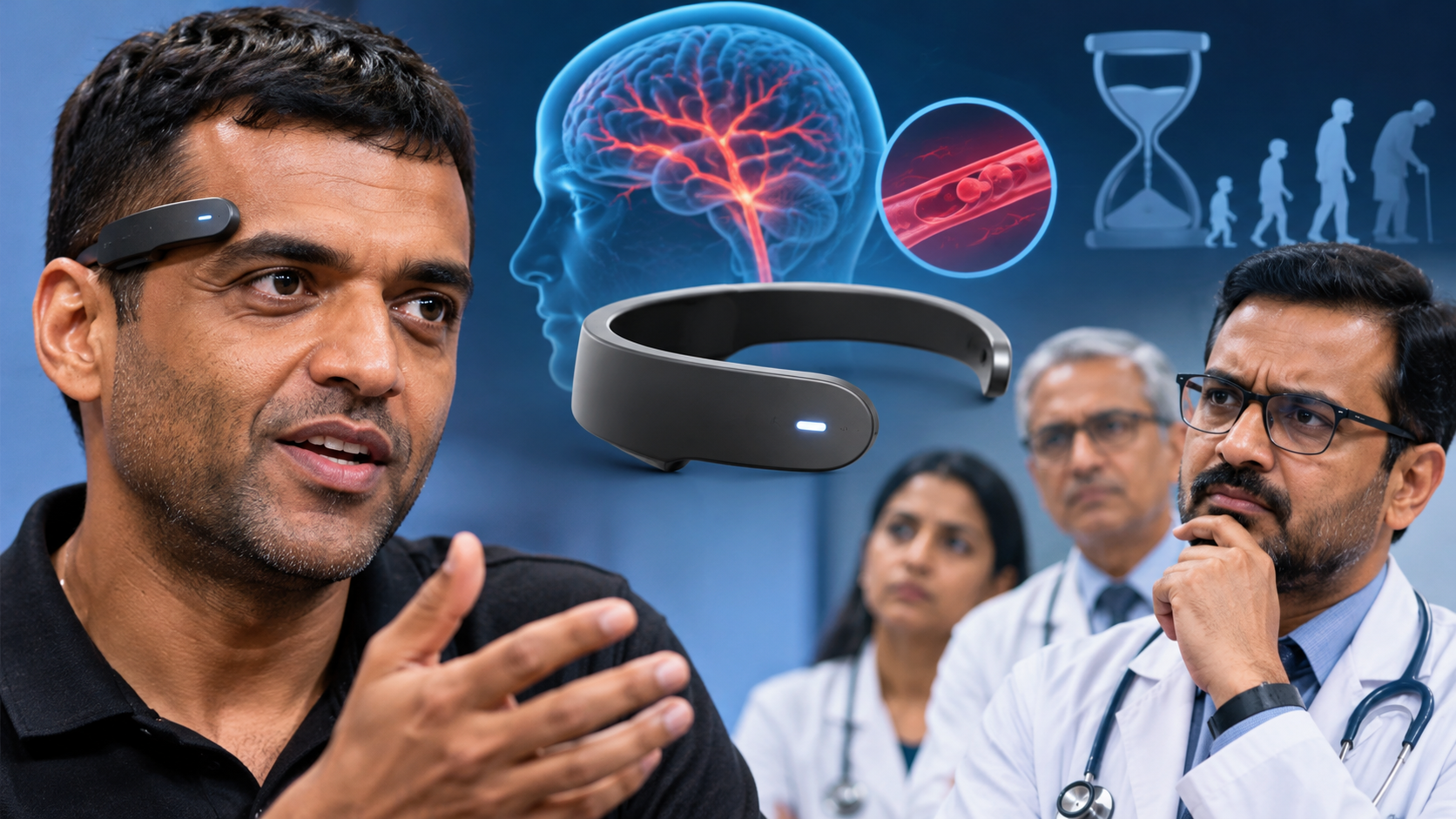
Medical experts have questioned the scientific evidence supporting Temple’s BrainFlow and Entropy metrics, while Goyal maintains that the forehead-worn gadget is a wellness tracker, not a medical device.
Highlights
- Deepinder Goyal’s Temple wearable is priced at ₹85,000 in India.
- Doctors have raised concerns over its brain blood flow monitoring claims.
- Temple uses two proprietary metrics called BrainFlow and Entropy.
- Two company-funded studies have yet to undergo peer review.
- Goyal says the product is a fitness and wellness tracker, not a medical device.
- Pre-orders opened on November 1, with deliveries expected in around three months.
Story
New Delhi, November 9: Zomato co-founder Deepinder Goyal’s wearable technology startup, Temple, has come under scientific scrutiny after medical experts questioned the evidence supporting its ₹85,000 forehead-worn device. The controversy centres on the gadget’s ability to monitor changes in brain blood circulation and generate physiological insights linked to health and ageing.
The debate intensified after prominent hepatologist Dr Cyriac Abby Philips, widely known as TheLiverDoc, challenged the scientific basis of Temple’s claims. Philips accused the company of promoting technology without sufficient clinical evidence, triggering a public exchange between Goyal and members of the medical community.
Goyal has defended the product, maintaining that Temple is designed as a fitness and wellness tracker rather than a medical device. He has also acknowledged that its proprietary measurements are awaiting clinical validation.
What Is Temple and How Does It Work?
Temple is a wearable device positioned near the temple on the side of the forehead. It uses optical sensors to continuously monitor physiological signals and generate insights into the body’s functioning.
The device primarily relies on two proprietary measurements: BrainFlow and Entropy.
BrainFlow is designed to track relative changes in blood circulation associated with the brain. Unlike conventional clinical measurements conducted periodically, Temple aims to monitor these changes continuously.
Entropy, which Goyal has identified as the product’s principal focus, is intended to estimate the physiological effort required by the body to maintain normal functioning.
Why Are Doctors Questioning the Technology?
Medical experts have questioned whether optical sensors positioned on the forehead can reliably distinguish changes in cerebral blood circulation from signals originating in surrounding tissues.
Two company-funded preprint studies suggest that Temple’s BrainFlow index can track changes associated with brain circulation under controlled conditions. However, neither study has undergone peer review or independent replication.
Experts argue that additional clinical research is necessary before such measurements can be considered reliable indicators of brain health or ageing.
Price, Pre-Orders and Availability
Temple opened for pre-orders in India on November 1 at ₹85,000, with deliveries expected to begin in approximately three months.
The product is not yet available for widespread public use. Early access has been restricted to a select group, including investors and individuals associated with Goyal.
The controversy highlights growing concerns over scientific validation in the expanding wearable technology market, particularly as companies introduce advanced health-monitoring features that extend beyond traditional fitness tracking.