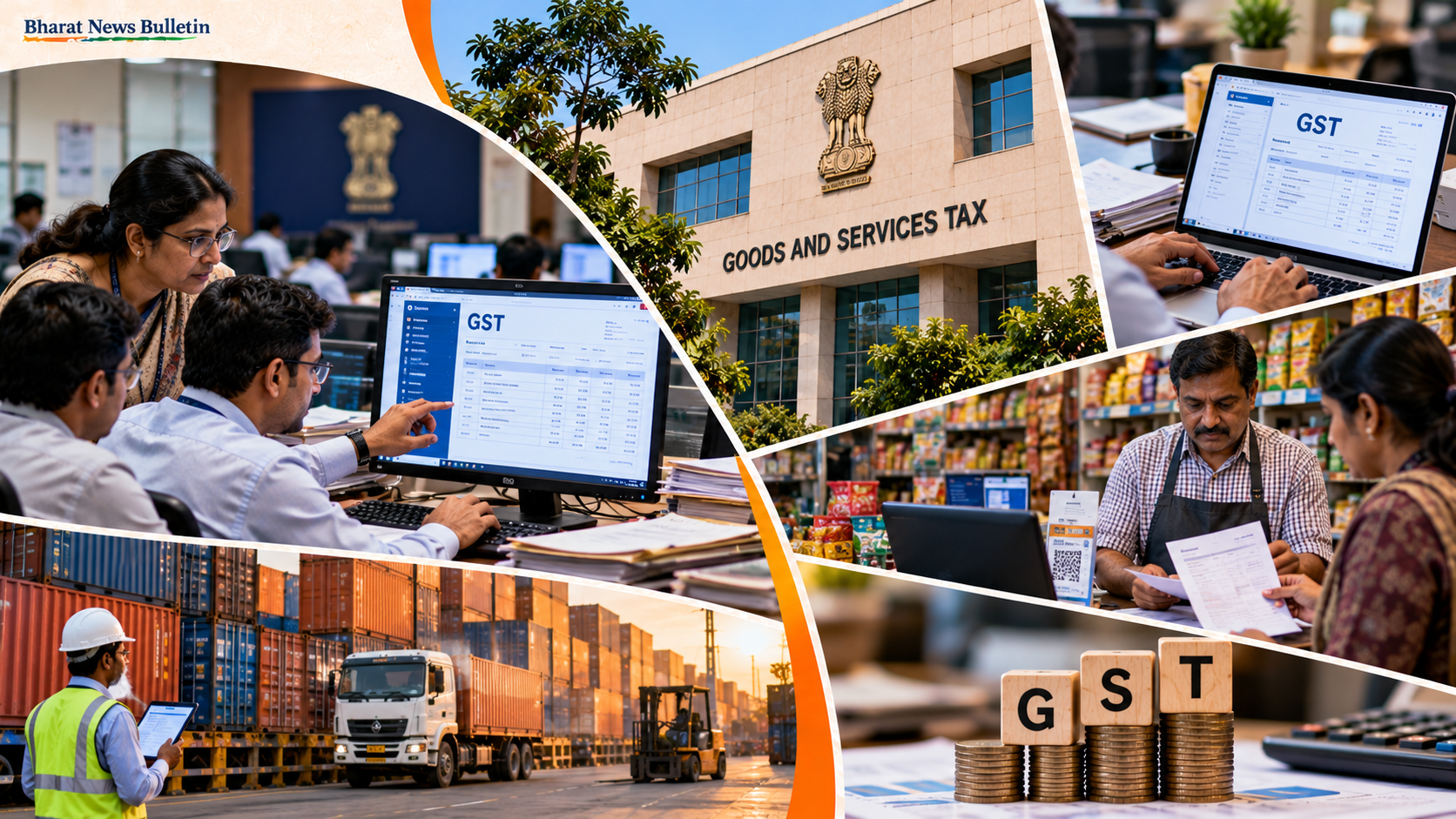
Centre and state tax officials are being encouraged to widen GST registration, increase cash tax collections and use data analytics to detect evasion, with voluntary B2C e-invoicing planned from April 2027.
The Centre and state governments have directed Goods and Services Tax (GST) officers to focus on expanding the taxpayer base, improving cash tax collections and using advanced data analytics to identify tax evasion. The move comes as GST rates and processes have largely stabilised after nine years of implementation.
According to officials, the tax administration is expected to adopt a more facilitative approach towards businesses rather than relying excessively on mandatory compliance measures. Officers have been asked to explain the benefits of compliance and use detailed transaction data to identify discrepancies.
India currently has approximately 1.68 crore registered GST taxpayers. Officials believe there is scope to increase registrations and strengthen tax collections through better outreach and improved monitoring.
Business-to-consumer (B2C) e-invoicing is planned to be introduced voluntarily from April 1, 2027, with the GST Network (GSTN) expected to support states in adopting the system. The initiative is intended to improve transaction visibility throughout the supply chain, including sales to final consumers.
Currently, businesses with an average annual turnover of ₹5 crore are required to generate e-invoices for business-to-business (B2B) sales. The GST Council had recommended a pilot for B2C e-invoicing in September 2024.
Officials said broader e-invoicing coverage could help identify cases where transactions are misrepresented to claim input tax credit (ITC) benefits. Greater access to detailed invoice data is expected to improve audit capabilities and help authorities detect irregularities.
The government is also considering procedural changes approved at the 57th GST Council meeting. Some reforms, including a ₹10,000 threshold for issuing notices, may be implemented through changes to existing rules.
Tax administration responsibilities are currently divided between central and state authorities according to turnover-based allocation rules. State administrations handle 90% of taxpayers with turnover below ₹1.5 crore, while the remaining 10% are managed by the Centre. Taxpayers above that threshold are divided equally between the two administrations.
Officials have also emphasised that businesses’ output tax liabilities and input tax credit claims should be examined for inconsistencies. The broader objective is to strengthen enforcement through intelligence and technology while making compliance simpler for taxpayers.