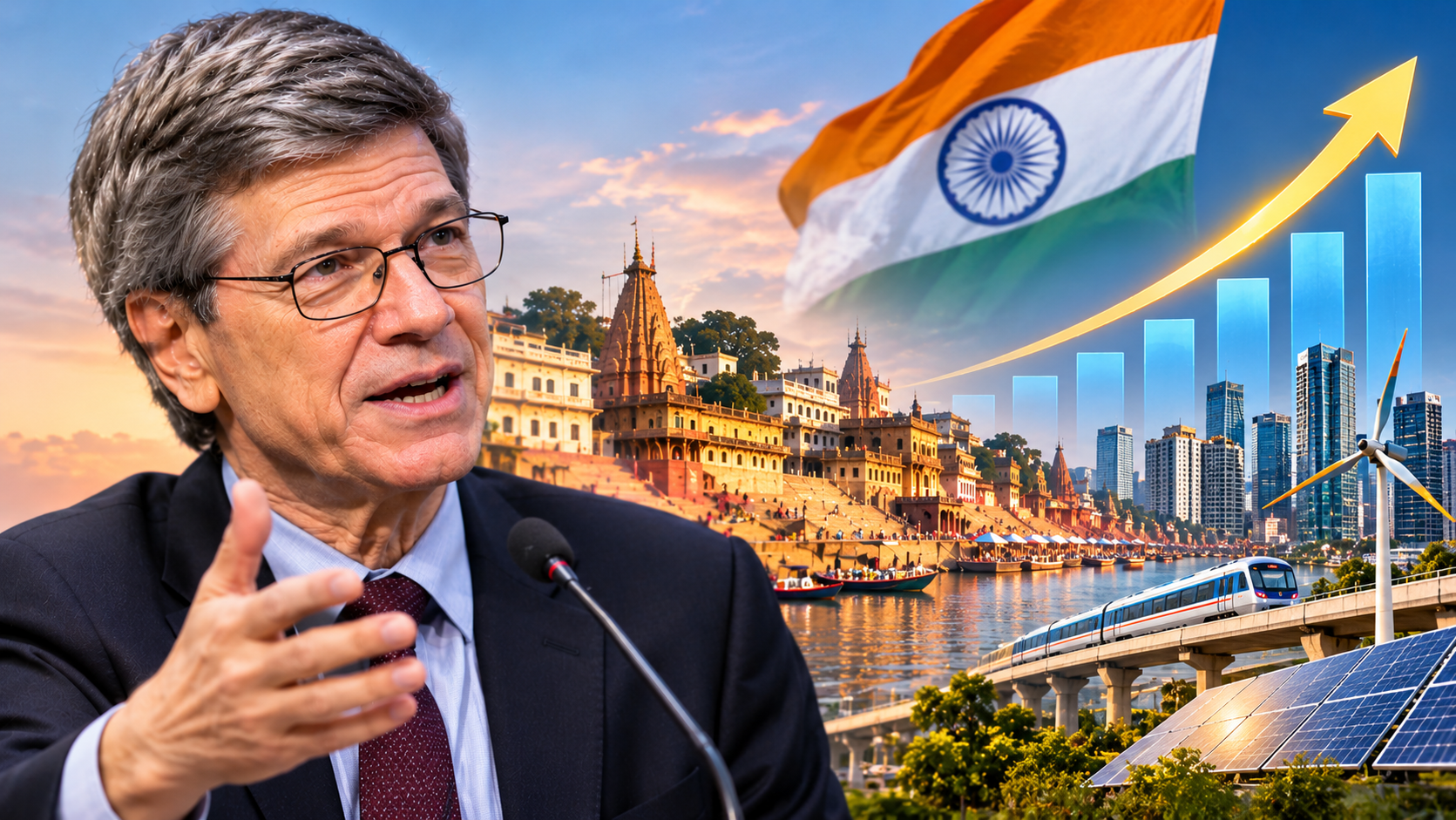
Renowned economist Jeffrey D. Sachs predicts India could emerge as the world’s largest economy by 2100, highlighting demographic changes and the rise of a multipolar global order during a symposium in Varanasi.
Highlights
- Jeffrey Sachs predicts India could become the world’s largest economy by 2100.
- India’s population could be twice that of China by the end of the century, according to Sachs.
- The economist says the world has entered a multipolar era.
- Sachs believes no single country or region will dominate the global order.
- He emphasised understanding different civilisations, cultures and historical identities.
- The remarks were made at the World Symposium on Ancient Wisdom for Modern Challenges in Varanasi.
India Could Become World’s Largest Economy by 2100, Says Jeffrey Sachs
New Delhi, November 3: India could emerge as the world’s largest economy by the end of the 21st century, surpassing major economic powers including China and the United States, according to renowned American economist Jeffrey D. Sachs. He also predicted that India’s population could be twice that of China by 2100, reflecting significant demographic changes across Asia.
Speaking at the World Symposium on “Ancient Wisdom for Modern Challenges” in Varanasi, Sachs said long-term population and economic trends indicate a major shift in global economic power towards Asia and Africa. WATCH +1
India Could Overtake China by 2100
Sachs explained that China’s population is expected to decline significantly over the coming decades, while India could maintain a much larger population.
He predicted that India could eventually become the world’s single largest economy as economic activity and demographic weight shift towards developing regions.
However, his remarks represent a long-term economic forecast rather than a guaranteed outcome. Future economic rankings will depend on productivity, technological development, investment and policy decisions.
Asia and Africa to Dominate Global Population
According to Sachs, approximately 75% of the world’s population could live in Asia and Africa by 2100.
Africa alone could account for nearly 30% of the global population, while Asia’s share could remain slightly below 50%.
These demographic changes could significantly influence global consumption, labour markets, infrastructure investment and international trade.
Sachs also highlighted Asia’s growing contribution to the global economy, arguing that the region is returning to a position of economic importance after centuries of Western dominance. NDTV Profit
World Entering a Multipolar Era
The economist said the international system is moving towards a multipolar structure in which economic and political influence is distributed across several major regions.
“No one region, no one country will dominate,” Sachs said.
He emphasised that countries must develop a deeper understanding of different civilisations, historical experiences and cultural identities to promote international cooperation.
India-China Cooperation Important
Sachs also encouraged greater cooperation between India and China, arguing that the two Asian economies could play an important role in building a more balanced international system.
He suggested that cooperation, rather than rivalry, could strengthen regional development and contribute to global stability.
Infrastructure Investment Key to India’s Growth
During his address, Sachs acknowledged the role of infrastructure development in India’s economic transformation.
He also credited the Adani Group with contributing to infrastructure expansion while emphasising that large businesses must balance commercial growth with broader social responsibilities. The Economic Times
India’s potential rise to the top of the global economy would depend on sustaining economic growth over several decades, improving productivity and expanding technological capabilities.
Sachs’s projections highlight India’s long-term economic potential, although the global economic landscape in 2100 remains highly uncertain