India’s merchandise exports recorded their fastest annual growth in five years, while strong services exports and higher petroleum earnings helped narrow the overall trade deficit.
Highlights
- India’s merchandise exports surged 45.06% to $49.47 billion.
- Petroleum product exports jumped 140.2% to $8.9 billion.
- Electronics exports increased 62.7% to $6.6 billion.
- Engineering goods exports grew 36% to $12.7 billion.
- Merchandise trade deficit narrowed to $39.9 billion.
- Combined goods and services exports reached $90 billion.
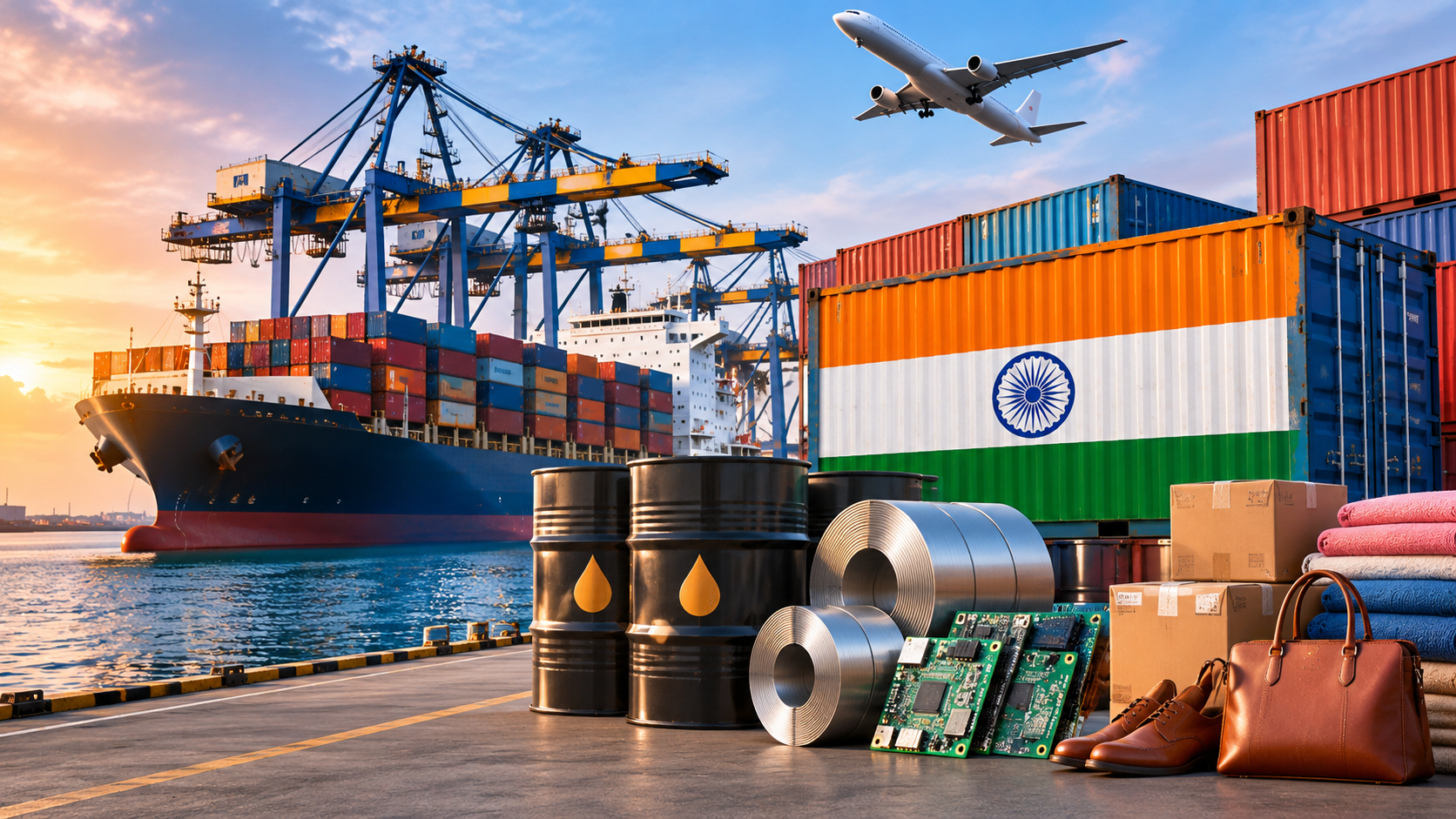
India’s merchandise exports touched an all-time high of $49.47 billion in October 2026, registering a year-on-year growth of 45.06%. This was the fastest annual growth in five years, despite geopolitical uncertainties and disruptions in global trade.
According to the Finance Ministry’s November Monthly Economic Review, petroleum products, engineering goods, electronics and labour-intensive industries contributed significantly to the country’s export performance.
Rising crude oil prices boost export earnings
Petroleum product exports recorded a sharp increase of 140.2% year-on-year to $8.9 billion in October. A significant factor behind this growth was the increase in international crude oil prices.
The Indian crude oil basket averaged $119.9 per barrel in October 2026, compared with $65.1 per barrel during the corresponding period last year, registering an increase of 84.2%.
However, expensive crude oil also increased India’s energy import expenditure. Petroleum and crude oil imports surged 54.3% to $22.8 billion. Higher export earnings, therefore, do not necessarily translate into an equivalent increase in shipment volumes or economic gains.
Electronics and engineering sectors register strong growth
India’s export growth was not limited to petroleum products. Exports excluding petroleum, gems and jewellery increased 36.5% year-on-year.
Sector-wise export growth
October 2026 | Year-on-year growth
Petroleum products
140.2%
Electronic goods
62.7%
Handicrafts
55.2%
Gems and jewellery
40.1%
Plastics and linoleum
36.3%
Chemicals
36.2%
Engineering goods
36%
Meat, dairy and poultry
34.9%
Cotton and handloom products
30%
Carpets
20.6%
Ready-made garments
20.3%
Leather
12.7%
Engineering goods remained a major contributor, with shipments reaching $12.7 billion, while electronics exports climbed to $6.6 billion. Strong growth in handicrafts, textiles, garments and leather products also highlighted improving export performance across employment-intensive industries.
India’s trade deficit narrows
Despite merchandise imports rising 16.5% to $89.4 billion, the merchandise trade deficit declined to $39.9 billion from $42.6 billion a year earlier.
India’s combined merchandise and services exports increased 29.9% to $90 billion, while overall imports reached $110.1 billion. Consequently, the overall trade deficit narrowed to $20.1 billion from $25.2 billion.
Services exports increased 15.2% to an estimated $40.5 billion, generating a surplus of $19.8 billion and offsetting nearly half of the merchandise trade deficit.
What lies ahead?
The Finance Ministry expects manufacturing incentives, improved logistics infrastructure, simplified trade procedures and free trade agreements to create additional opportunities for Indian exporters.
However, global demand, elevated crude oil prices and geopolitical uncertainties will remain critical factors in determining whether India can sustain its export growth momentum
Source: NDTV Profit, based on the Finance Ministry’s Monthly Economic Review. Figures are taken from the supplied report and have not been independently verified.