
India’s logistics costs decline to 7.97% of GDP in 2023-24

India’s logistics costs for 2023-24 have been estimated at 7.97% of GDP, down from 8.84% in 2022-23, according to a recent report by Department for Promotion of Industry and Internal Trade (DPIIT). The report, Assessment of Logistics Cost in India, is the first comprehensive official assessment, based on a robust NCAER framework and consultations with stakeholders. Government initiatives like PM GatiShakti, Dedicated Freight Corridors, Bharatmala, and LEEP have improved efficiency. 

Valued at US$ 215 billion in 2021, India’s logistics sector, with infrastructure status and technology-driven reforms, is poised for strong growth, enhancing export competitiveness, creating jobs, and supporting the US$ 5 trillion economy goal.

logistics - freepik

India’s logistics costs have been officially pegged at 7.97% of the country’s economic output for 2023-24 by the Department for Promotion of Industry and Internal Trade (DPIIT). This puts India in a favourable position when compared to advanced economies such as the US, Japan, Korea, and Europe. 

The report on the Assessment of Logistics Costs in India, was recently unveiled by Union Commerce and Industry Minister Piyush Goyal. Significantly, this is the first official estimate of logistics costs, derived from a comprehensive study that relied on extensive data collection and consultations with businesses, both users and service providers. 

The study highlights that logistics costs in India have been steadily declining over the past five years. For instance, the costs stood at 8.84% of Gross Domestic Product (GDP) in 2022-23 and 8.79% in 2021-22, indicating a consistent downward trend. These new figures also clarify the long-standing confusion caused by earlier widely cited estimates of 13-14% of GDP, which were based on fragmented datasets or external studies. Such inconsistencies often misled policymakers and international stakeholders.
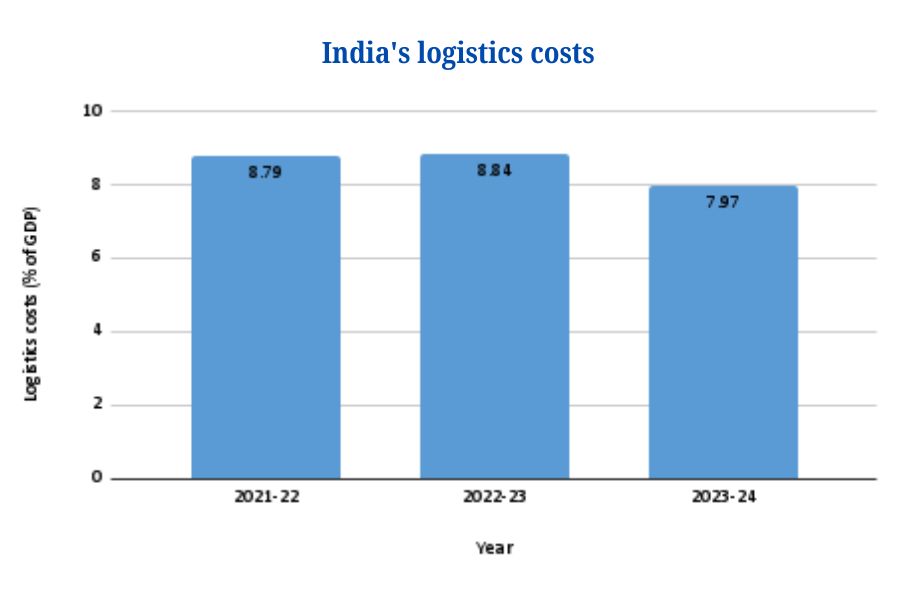
The present estimates were calculated using a robust framework developed by the National Council of Applied Economic Research (NCAER). This framework was finalised only after detailed deliberations with multiple ministries, industry bodies, and other stakeholders. 

Earlier, in 2023, NCAER, with support from the Asian Development Bank (ADB), had conducted a study based on secondary data. That exercise had suggested logistics costs ranging between 7.8% and 8.9%. Building on this, the new framework has expanded the scope and depth of assessment. DPIIT has announced plans to conduct similar surveys every two years, and the methodology could even serve as a reference for other countries.

Excluding services and considering only agriculture, mining, and manufacturing—the primary users of logistics—the costs are estimated at 9.09% in 2023-24. This marks a decline from 9.52% in 2022-23 and 9.61% in 2021-22. This underlines a gradual yet steady decline.

Government initiatives and transport costs

According to DPIIT, the consistent reduction in costs is largely the result of government initiatives aimed at enhancing efficiency. Key measures include; 

  • PM GatiShakti National Master Plan: A digital platform that integrates 16 ministries to coordinate and streamline infrastructure projects.
  • Dedicated Freight Corridors (DFC): Rail corridors designed to move bulk cargo from road to rail, reducing transit times and logistics costs.
  • Sagarmala Project: Focused on modernizing ports, boosting coastal shipping, and enhancing connectivity with the hinterland.
  • Integrated Check Posts (ICPs): Established at land borders to simplify cross-border trade and minimize delays.
  • Unified Logistics Interface Platform (ULIP): Facilitates real-time data sharing among supply chain stakeholders to eliminate inefficiencies.
  • Logistics Efficiency Enhancement Programme (LEEP): LEEP is designed to improve freight transport efficiency by addressing infrastructure gaps, reducing transportation time, and optimizing goods transfer processes through the use of technology and improved logistics practices.

Collectively, these projects have streamlined processes, improved infrastructure, and reduced inefficiencies.

The study also breaks down costs by mode of transport. Coastal waterway transport emerges as the cheapest option at ₹1.80 per kilometre per tonne (pkpt). This is followed by rail at ₹1.96; road at ₹3.78; while air transport, the fastest mode of freight transportation, is also the most expensive at ₹72, making it viable mainly for high-value, time-sensitive commodities.

The report comes at a time when India seeks a stronger role in global value chains, supported by initiatives like Make in India and Production-Linked Incentive (PLI) schemes. Cutting down the logistics costs is central to these goals, improving export competitiveness and manufacturing efficiency. For industries like textiles, pharmaceuticals, automotive, and electronics—where margins are highly sensitive to logistics—such reductions can significantly influence global order wins. 

Equally important, the report offers reliable cost benchmarks, helping private companies plan supply chain strategies with greater accuracy, replacing outdated or inflated estimates with data that reflects the current logistics landscape more effectively.

Significance and strategic role of logistics

In July 2017, the Department of Commerce established a dedicated logistics unit to oversee the Integrated Development of the Logistics Sector, highlighting its strategic importance to India’s economy. The logistics industry is a critical enabler of economic growth and trade, supporting sectors such as manufacturing, retail, e-commerce, and services by managing inventory, transportation, storage, warehousing, and distribution. By efficiently connecting producers to consumers both domestically and internationally, the sector plays a pivotal role in ensuring smooth supply chains.

India’s logistics sector was valued at US$ 215 billion in 2021 and is expected to grow at a robust compound annual growth rate (CAGR) of 10.7% until 2026. 

By granting infrastructure status to the logistics sector, the government has enabled access to affordable, long-term financing, akin to funding available for roads and railways, reinforcing its role in India’s growth trajectory. Simultaneously, efforts are underway to build a smart, technology-driven logistics system that facilitates the smooth and efficient movement of goods. 

Logistics goes beyond transportation—it fuels national progress by linking ambitions with opportunities. Rising consumer demand provides a key opportunity to expand the sector, generate employment, promote balanced regional growth, and help India achieve its US$ 5 trillion economy goal by 2027. A robust logistics network has the potential to transform trade, unlock new growth avenues, and enhance economic resilience, advancing India toward the vision of Viksit Bharat 2047.


Read more

Union Minister of Commerce and Industry, Shri Piyush Goyal launches report on Assessment of Logistics Cost in India

Logistics: India’s growth engine

Improving Logistics: Policy and technology advances drive freight expansion


FAQs

1. What are India’s official logistics costs for 2023-24?
India’s logistics costs have been officially estimated at 7.97% of GDP for 2023-24, showing a gradual decline from 8.84% in 2022-23 and 8.79% in 2021-22.

2. Which sectors incur the highest logistics costs?
When services are excluded, agriculture, mining, and manufacturing—the primary users of logistics—incur costs of 9.09% of GDP in 2023-24.

3. How do different transport modes compare in logistics costs?

In logistics, costs vary sharply by mode: coastal shipping is the cheapest at about ₹1.80 per tonne-km, followed closely by rail at ₹1.96. Road transport, though more flexible, costs nearly double at ₹3.78, while air is by far the most expensive at around ₹72 per tonne-km, reserved mainly for high-value or time-critical goods.

4. What government initiatives are reducing logistics costs?

Some of the key programs driving logistics transformation in India include the PM GatiShakti National Master Plan, Dedicated Freight Corridors (DFC), the Sagarmala Project, Integrated Check Posts (ICPs), the Unified Logistics Interface Platform (ULIP), and the Logistics Efficiency Enhancement Programme (LEAP).

5. Why is reducing logistics costs important for India?
Lower logistics costs improve export competitiveness, strengthen the supply chain, boost efficiency for industries like textiles, pharmaceuticals, automotive, and electronics, and help India achieve its US$ 5 trillion economy target by 2027.

6. What is the future growth potential of India’s logistics sector?
Valued at US$ 215 billion in 2021, the sector is expected to grow at a CAGR of 10.7% until 2026, driven by infrastructure status, technology adoption, and rising domestic and global demand.

Previous Post
Next Post

Most Recent Posts

  • All Post
  • 8th Pay Commission
  • Aadhar
  • Aditya Birla Capital
  • Advertising Standards
  • Affordable Housing
  • Agriculture
  • Agriculture & Food
  • AI in Healthcare
  • AI Technology
  • Airlines
  • alcohol industry
  • Android
  • APEDA
  • Apple
  • Artificial Intelligence
  • Ashwini Vaishnaw
  • Asset Management
  • Atmanirbhar Bharat
  • Audio Devices
  • Audio Products
  • Auto Industry
  • Automobile
  • Automobiles
  • Automotive
  • Automotive Industry
  • Aviation
  • Bain Healthcare Report 2026
  • Bank
  • Banking
  • Banking Technology
  • Battery Industry
  • Beverage Industry
  • Beverages
  • Bihar
  • biotechnology
  • Bitcoin
  • BMW Group India
  • Brand Insight
  • BRICS
  • Bullion Market
  • Business
  • Business & Economy
  • Business & Trade
  • Business Leadership Post COVID-19
  • Business News
  • Business Terminology
  • Business Utilities
  • Buyback
  • Capital Goods
  • Capital Markets
  • CarsBusiness
  • CBIC
  • CCI
  • Child Investment
  • China
  • China technology news
  • Citizen Services
  • Clean Energy
  • Clean Technology
  • Cloud Computing
  • coal
  • Commerce
  • Commerce and Industry
  • Commercial Real Estate
  • Commercial Vehicles
  • Commodities
  • Communications
  • Companies
  • Competition Law
  • Compliance
  • Computer Accessories
  • connected cars
  • Consumer Affairs
  • Consumer Electronics
  • Consumer Finance
  • Consumer Goods
  • Consumer Health
  • Consumer Markets
  • Consumer News
  • Consumer Protection,
  • Consumer Rights
  • Consumer Spending
  • Consumer Trends
  • Content Creation
  • Copper
  • Corporate
  • corporate affairs
  • Corporate Earnings
  • Corporate Governance
  • Corporate News
  • Corporate Social Responsibility
  • Cost of Living
  • Country
  • CRED
  • Credit Cards
  • CREDIT RATING
  • Crude Oil
  • Cryptocurrency
  • CSR
  • Culture
  • Currency
  • Customs Duty
  • Cyber Security
  • Cybersecurity
  • Dairy Industry
  • Data & Analytics
  • Defence
  • Delhi Government
  • Delhi-NCR
  • Demographics
  • Derivatives
  • DGCA
  • DGFT
  • DigiLocker
  • Digital Assets
  • Digital Economy
  • Digital Health India
  • Digital Identity
  • Digital India
  • Digital Infrastructure
  • Digital passport for robots
  • Digital Payments
  • Digital Platforms
  • digital services
  • Diplomacy
  • Dixon Technologies
  • DPIIT
  • E Commerce
  • E-commerce
  • E-Governance
  • Ease of Doing Business
  • Economic Growth
  • Economy
  • Edible Oil Industry
  • Editor Choice
  • EdTech
  • Education
  • Electric Mobility
  • Electric Vehicles
  • Electronics
  • Employment
  • ENERGY
  • Engineering
  • Entertainment
  • Environment
  • EPFO
  • Ethanol Economy
  • EV Industry
  • EV Technology
  • Exports
  • EXTER
  • Farmers
  • Fashion
  • FINANCE
  • Finance Ministry,
  • Financial Marketing
  • Financial Markets
  • Financial News
  • Financial Planning
  • Financial Results
  • Financial Services
  • Fintech
  • FnTech
  • Food & Beverage
  • Food & Beverages
  • Food Exports
  • Food Industry
  • Food Manufacturing
  • Food Processing
  • Food Regulations
  • food safety
  • Foreign Exchange
  • Foreign Investment
  • Foreign Policy
  • Foreign Trade
  • Forex Reserves
  • fssai
  • FTA
  • Fuel
  • Fuel Prices
  • Future Energy
  • Gadgets
  • Gadgets & Apps
  • Gaming
  • GDP
  • Generative AI Healthcare
  • Geopolitics
  • GI Products
  • Global Brand Alliance
  • Global Economy
  • Global Markets
  • Global Politics
  • Global Tech
  • Global Trade Policy
  • Global Trends\
  • Gold
  • Gold Market
  • Gold Prices
  • Gols & Silver
  • Government
  • Government & Policy
  • Government Affairs
  • Government Bonds
  • Government Data
  • Government Initiatives
  • Government Policy
  • Government Policy & Regulation
  • Government Scheme
  • Government Schemes
  • Government Services
  • Green Energy
  • Green Mobility
  • GroupGlobal
  • GST
  • GST Council
  • GST Counsil
  • Hair Care
  • Hardware
  • Hatchback Segment
  • Health Supplements,
  • Horticulture
  • Housing
  • HSBC
  • Human Resources
  • humanoid robot market
  • Hyundai
  • IBT Infographics
  • iinvestment
  • Imports & Exports
  • Income Tax
  • India
  • India Auto Market
  • India Business News
  • India Inc
  • India News
  • India Retail
  • India-Canada Relations
  • India-China
  • India-Japan Relations
  • India-Russia Relations
  • India-South Korea Relations
  • India-US Relations
  • Indian Economy
  • Indian Navy
  • Industrial Pollution
  • Inflation
  • Infra
  • Infrastructure
  • Innovation
  • Instagram
  • Insurance
  • international
  • International Affairs
  • International Cooperation
  • International Relations
  • International Trade
  • Internet & Connectivity
  • Internet Policy
  • Internet Regulation
  • Interview
  • Investing
  • Investment News
  • Investments
  • iPhone News
  • IPO
  • IT Industry
  • Jewellery
  • Jio Platforms
  • JioBlackRock
  • Jobs & Careers
  • Joint Ventures
  • Kim Kardashian
  • Labour
  • Latest
  • Launches
  • Leadership
  • Leaderspeak
  • Lending
  • Lifestyle
  • Lifestyle Tech
  • List
  • Loans & Credit
  • Local News
  • Logistics
  • LPG
  • Luxury Cars
  • Machinery
  • Macroeconomics
  • Macroeconomy
  • maharashtra
  • Maharashtra News
  • Make in India
  • Makhana
  • Managed Workspaces
  • Manufacturing
  • Market Outlook
  • Markets
  • Maruti Suzuki
  • Mergers & Acquisitions
  • Meta
  • Microsoft
  • Middle East
  • Mobile Apps
  • Mobile Industry
  • Mobile Launch
  • Mobility
  • Monetary Policy
  • Monsoon
  • MoSPI
  • MSME
  • Mutual Funds
  • Nano Tech
  • National
  • National news
  • NEET 2026
  • NewsElectric
  • NewsTata
  • NPCI
  • NPS Vatsalya
  • Office Market
  • Oil & Gas
  • Oil and Gas
  • Others
  • OTT
  • Packaged Drinking Water
  • Packaged Foods
  • Packaging Industry
  • Packaging Innovation
  • Passenger Vehicles
  • Paytm
  • Pension & Retirement
  • Pensions
  • Personal Care
  • Personal Finance
  • Perspectives
  • Petroleum
  • PFRDA
  • Pharmaceuticals
  • PM Modi
  • PMAY-G
  • PMAY-U
  • PMAY,
  • PMI
  • policy
  • Population
  • PORTS
  • Positive News
  • PPF
  • Precious Metals
  • Pricing
  • Product Labeling
  • Product Labelling
  • Product Launch
  • Property Market
  • PSU
  • PSU Banks
  • Public Health
  • Public Policy
  • Public Safety
  • Public Sector
  • Public Services
  • Public Welfare
  • Quarterly Results
  • Railways
  • Rajasthan
  • Raksha Bandhan
  • Raksha Bandhan Gifts
  • Rare Earths
  • Ratings Agencies
  • RBI
  • Real Estate & Realty Sector
  • Recycling
  • Regulation
  • Regulatory Action
  • Regulatory Affairs
  • Regulatory Updates
  • REIT
  • Reliance Industries
  • Renewable Energy
  • RERA
  • Research
  • Retail
  • Retirement Planning
  • Road Infrastructure
  • Robotics & Automation
  • robotics standards
  • Rupee
  • Rural Development
  • Rural Housing
  • SAIL
  • Salaries
  • Samsung
  • Savings
  • Science & Technology
  • Sebi
  • Security
  • Semiconductor
  • Semiconductors
  • Services Sector,
  • SHIPPING
  • Silver Prices
  • Skill Development
  • Skills Development
  • Small Business
  • Smart Devices
  • Smart Home
  • Smart Mobility
  • Smartphones
  • Social Impact
  • Social Media
  • Society
  • Software Development
  • Solar Energy
  • Space Technology
  • Startups
  • Statistics
  • Steel Industry
  • Stock Market
  • stocks
  • streaming
  • Sugar Industry
  • Sukanya Samriddhi Yojana
  • Sustainability
  • SUV
  • Tamil Nadu Pollution Board
  • Tariffs
  • Tariffs & Duties
  • Tata Group
  • Tata Motors
  • Tata Sons
  • Tax Planning
  • Taxation
  • Tech
  • Tech Branding
  • Technology
  • Telecom & Technology
  • Telecom Industry
  • Top Story
  • Tourism
  • Trade
  • Trade Agreement
  • Trade Basket
  • Trade Partner
  • Trade Policy,
  • Transportation
  • Travel
  • Trending
  • Two-Wheelers
  • UIDAI
  • UPI
  • Urban Development
  • US-Iran Conflict Economic Impact
  • US–India Relations
  • Uttar Pradesh
  • Vaccines
  • VehiclesLuxury
  • vivo
  • Wastewater Management
  • Water Quality,
  • Wealth Management
  • Wearables
  • Wellness
  • WhatsApp
  • Wheat
  • Workplace
  • World
  • World News
  • Worldview
  • Yamaha
  • zLead Slider
    •   Back
    • Healthcare
    • Auto
    • Fmcg
    • Hospitality
    •   Back
    • Cash Crop
    • Organic
    • New Era Agri
    • Processed Food
    •   Back
    • Construction
    • Power
    • Mining
    • Telecom
    •   Back
    • ENERGY
    •   Back
    • Export/Import
    • Trade Deal
    • Trade Fair
    •   Back
    • Policies
    • Industry
    • Finance
    •   Back
    • Others technology
    • Mobile phone
    • Gadgets
    •   Back
    • Manufacturing
    • Services
    • Startup

India Business & Trade is a national media platform decoding the ideas, decisions and shifts shaping India’s growth story—across plicy, business, global commerce and a rapidly evolving marketplace.

Reach Us

India Business & Trade
M-62, Saket, New Delhi-110064, India

Subscribe To Newsletter

Stay ahead in the dynamic world of trade and commerce with India Business & Trade’s weekly newsletter.

Copyright © 2026 India Business & Trade. All Rights Reserved


Fatal error: Uncaught TypeError: Unsupported operand types: string * int in /var/www/sites/indiabusinesstrade.in/wp-content/plugins/royal-elementor-addons/admin/includes/wpr-templates-modal-popups.php:192 Stack trace: #0 /var/www/sites/indiabusinesstrade.in/wp-content/plugins/royal-elementor-addons/admin/includes/wpr-templates-modal-popups.php(128): WprAddons\Admin\Includes\WPR_Templates_Modal_Popups::get_template_settings() #1 /var/www/sites/indiabusinesstrade.in/wp-content/plugins/royal-elementor-addons/admin/includes/wpr-templates-modal-popups.php(106): WprAddons\Admin\Includes\WPR_Templates_Modal_Popups::render_popup_content() #2 /var/www/sites/indiabusinesstrade.in/wp-content/plugins/royal-elementor-addons/admin/includes/wpr-templates-modal-popups.php(64): WprAddons\Admin\Includes\WPR_Templates_Modal_Popups::display_popups_by_location() #3 /var/www/sites/indiabusinesstrade.in/wp-includes/class-wp-hook.php(341): WprAddons\Admin\Includes\WPR_Templates_Modal_Popups->render_popups() #4 /var/www/sites/indiabusinesstrade.in/wp-includes/class-wp-hook.php(365): WP_Hook->apply_filters() #5 /var/www/sites/indiabusinesstrade.in/wp-includes/plugin.php(522): WP_Hook->do_action() #6 /var/www/sites/indiabusinesstrade.in/wp-includes/general-template.php(3224): do_action() #7 /var/www/sites/indiabusinesstrade.in/wp-content/plugins/royal-elementor-addons/admin/templates/wpr-canvas.php(64): wp_footer() #8 /var/www/sites/indiabusinesstrade.in/wp-includes/template-loader.php(132): include('...') #9 /var/www/sites/indiabusinesstrade.in/wp-blog-header.php(19): require_once('...') #10 /var/www/sites/indiabusinesstrade.in/index.php(17): require('...') #11 {main} thrown in /var/www/sites/indiabusinesstrade.in/wp-content/plugins/royal-elementor-addons/admin/includes/wpr-templates-modal-popups.php on line 192