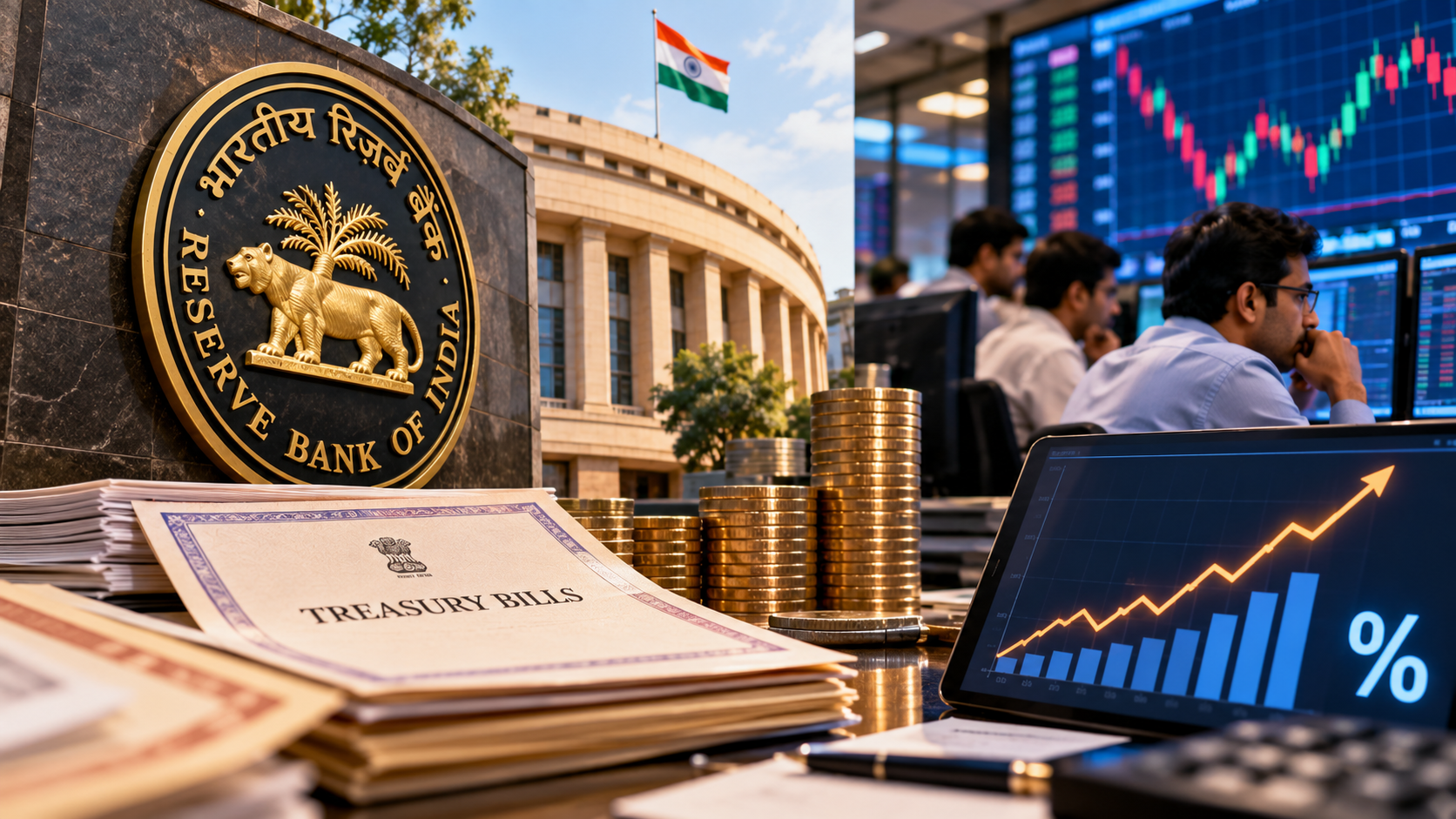
The Reserve Bank of India rejected all bids in its latest Treasury bill auction as investors sought higher yields, while tighter banking-system liquidity has pushed the central bank to step up short-term liquidity operations.
Mumbai, October 21 — The Reserve Bank of India (RBI) rejected all bids at its latest Treasury bill auction, signalling that the central bank was unwilling to accept the higher yields demanded by investors amid tightening liquidity conditions in the banking system.
The RBI had planned to raise ₹23,000 crore through 91-day, 182-day and 364-day Treasury bills.
At the previous week’s auction, yields had stood at 5.73% for 91-day T-bills, 6.29% for 182-day bills and 6.49% for 364-day bills.
A dealer at a private-sector bank said the RBI may have been uncomfortable with the higher yields demanded by market participants and may not have needed to raise funds at such elevated rates because of its cash position.
The development comes at a time when banking-system liquidity has tightened sharply, largely because of Goods and Services Tax-related outflows.
The system’s liquidity surplus declined to ₹48,304 crore on Tuesday, its lowest level in three months.
Average liquidity surplus during October stood at around ₹3.39 lakh crore, down significantly from ₹7.77 lakh crore in September.
The surplus had reached a record ₹11.16 lakh crore on September 6, supported by strong inflows through FCNR(B) deposits.
With liquidity becoming tighter and overnight borrowing rates moving above the marginal standing facility rate, the RBI has started conducting variable rate repo auctions to inject short-term funds into the banking system.
A seven-day VRR auction was conducted earlier in the week.
The RBI’s overnight VRR auction on Wednesday received strong demand, with banks submitting bids worth ₹93,241 crore against the notified amount of ₹50,000 crore.
Market participants said the demand reflected a growing need for short-term liquidity among banks.
One state-owned bank dealer said the current pressure on liquidity is mainly due to GST outflows and partly because of the Jio Platforms IPO, warning that the system could move into deficit if liquidity continues to fall at the same pace.
The RBI is expected to continue using VRR operations to keep overnight interest rates aligned with the 5.5% policy repo rate.
The weighted average call rate stood at 5.60% on Wednesday, compared with an average of 5.56% last week.
Market participants expect liquidity conditions to improve towards the end of the month as government spending increases.