PhonePe plans to deploy more than 20,000 frontline sales employees and five million payment devices over the next 12 months. The expansion will focus on smaller towns and rural India as MDR returns on specified UPI transactions.
Highlights
- PhonePe plans to hire over 20,000 frontline sales employees in the next 12 months.
- It will deploy 5 million payment devices during the same period.
- Around 50% of the devices will be installed in rural India, including tier-6 towns.
- The company will focus on smaller towns and villages following the introduction of MDR on specified UPI transactions.
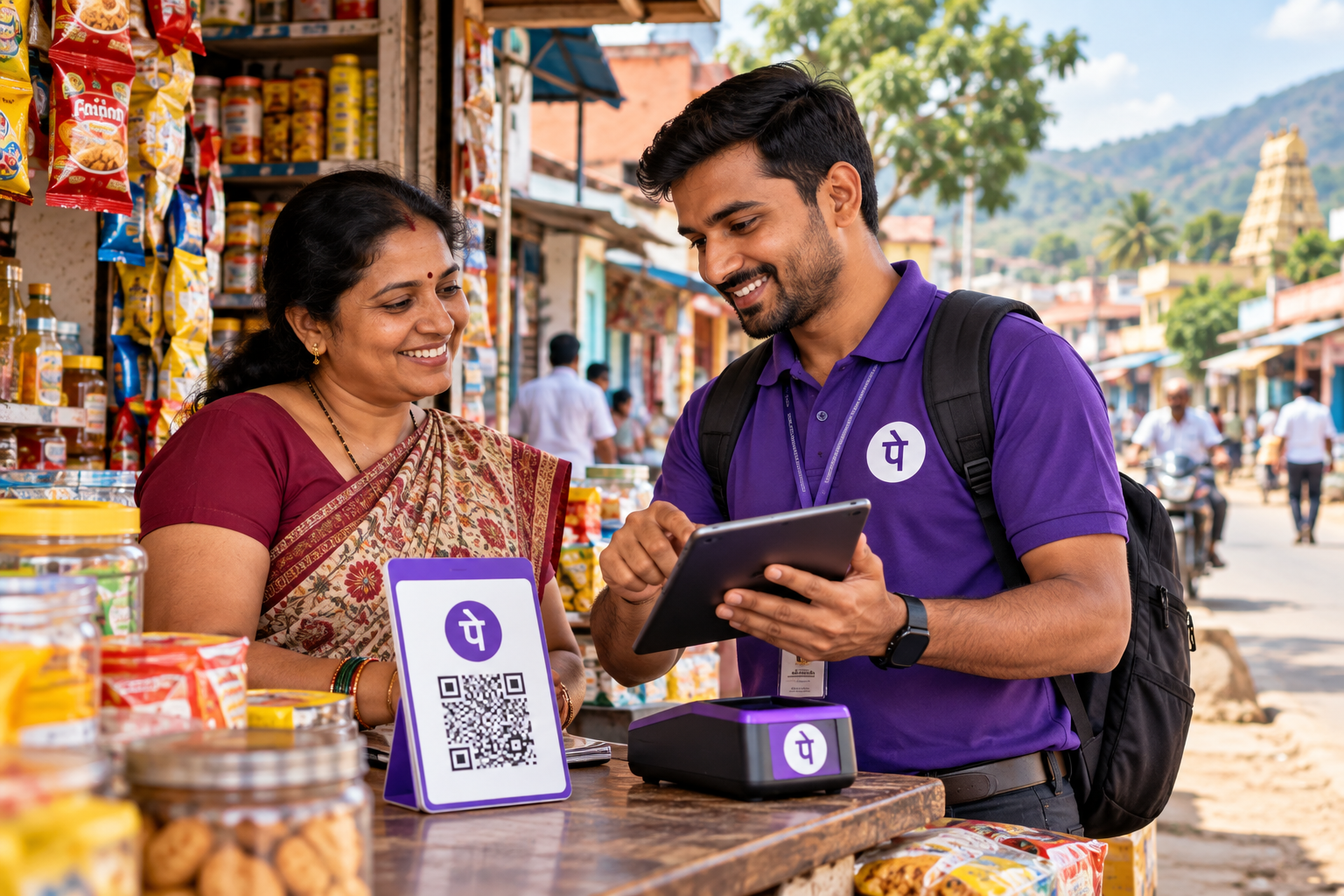
Bengaluru: PhonePe is preparing a major expansion of its merchant network in smaller towns and rural India, with plans to hire more than 20,000 frontline sales employees and deploy five million payment devices over the next 12 months.
The fintech company said the expansion follows the introduction of a merchant discount rate (MDR) on specified UPI transactions and will help it increase its presence among small merchants.
Around 50% of the new devices, including smart speakers and point-of-sale machines, will be deployed in rural India, covering locations as deep as tier-6 towns, according to the report.
The company said its new sales force will sign up merchants in smaller towns and villages, complete their KYC, install payment devices and provide ongoing support.
PhonePe also plans to establish a dedicated small-merchant fund, which will receive 5% of MDR collections. The fund is intended to support expansion into deeper rural geographies.
The structure of the fund will be finalised in consultation with the Reserve Bank of India within three months, the report said.
From October 15, a 0.4% MDR will apply to specified person-to-merchant (P2M) UPI transactions above ₹2,000, with the charge capped at ₹300 per transaction.
PhonePe said QR receipts below ₹75,000 a month will remain exempt, while roughly 4% of its QR accounts for about 65% of the total value of merchant payments.
The company expects the return of MDR to provide additional resources for payment firms and banks while supporting deeper merchant acquisition and payment infrastructure across smaller Indian towns.