In 2024, the United States exported US$ 159 billion in food and beverages, driven by 1,003 million acres of agricultural land and a focus on bulk raw commodities. In contrast, the Netherlands, with only 4.5 million acres, achieved US$ 111 billion in exports—nearly 70% of the us value—by capitalizing on technological innovation and processed food exports. This comparison highlights the us’s reliance on scale and volume, while the Netherlands thrives through efficiency, technology, and high-value output per acre, offering valuable insights into future agricultural trade strategies.

As global demand for food intensifies and natural resources become increasingly constrained, nations face a critical question: Is agricultural success defined by the expanse of land and output volume, or by the ability to produce more with less?
The United States and the Netherlands offer two compelling yet contrasting answers. The United States, with its vast tracts of arable land, has long pursued a model rooted in scale, emphasising large-scale commodity farming, mechanisation, and export volumes. In contrast, the Netherlands, one of the world’s most densely populated countries, has become the Third-largest agricultural exporter globally by value, not through land abundance, but through technological innovation, intensive cultivation, and strategic market orientation.
Comparing these two nations reveals deeper insights into how agricultural power can be exercised: one through traditional expansion, the other through optimisation and precision. This contrast provides a valuable lens to understand evolving patterns in global trade, resource use, and the strategic positioning of food-producing nations. It also highlights an emerging reality: future competitive advantage may lie less in the soil beneath our feet and more in the systems and thinking that drive production and export.
Two Countries, Two Models of Agriculture Trade
In 2024, the United States remains the world’s largest exporter of agricultural and F&B products, with exports reaching US$ 159 billion. This reflects a steady 5-year CAGR of 4.64%. Meanwhile, the Netherlands, despite its much smaller geographic size, has emerged as a formidable player in global F&B exports, recording US$ 111 billion in export value with a notably higher 5-year CAGR of 6.29%.
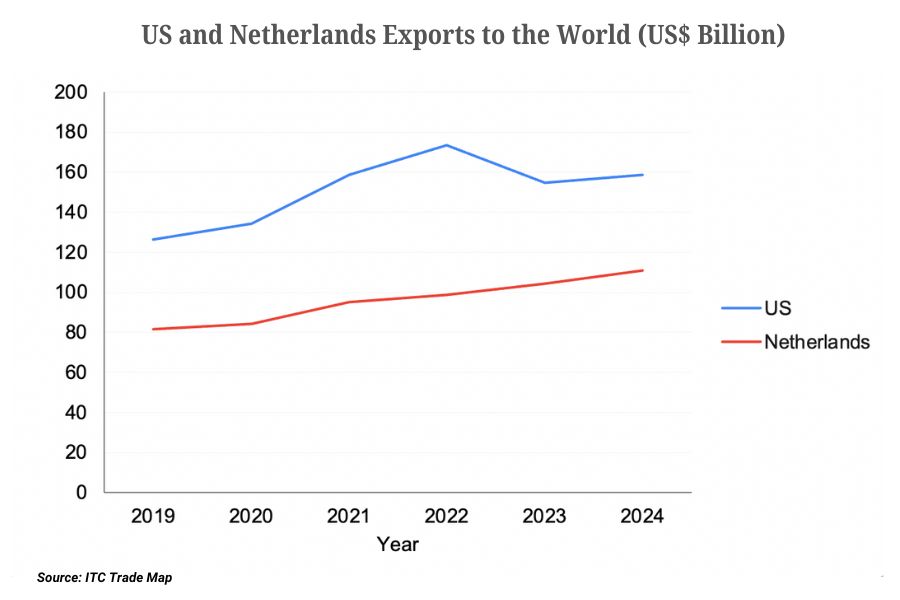
The US leads in scale, with its vast land, diverse agriculture, and well-established export networks driving its dominance in global F&B exports. In contrast, the Netherlands excels in agri-tech innovation, leveraging advanced technology, efficient supply chains, and sustainable farming practices to achieve rapid export growth despite its smaller size. While the US focuses on scale, the Netherlands is setting the pace through cutting-edge tech and efficiency.
Agricultural Metrics: Key Differences
The agricultural export performance of the United States and the Netherlands presents a compelling case of two divergent models achieving global competitiveness through distinct approaches. The United States possesses over 1,000 million acres of agricultural land, making it one of the most land-rich agri-economies in the world. In contrast, the Netherlands operates with just 4.5 million acres—approximately 0.45% of us agricultural land.
Despite this stark difference in land availability, the Netherlands reported food and beverage (F&B) exports valued at US$ 111 billion in 2024, which amounts to nearly 70% of the us export value (US$ 159 billion). This disparity underscores a critical distinction: while the us agricultural system is characterised by scale and volume, the Dutch model demonstrates efficiency, technological intensity, and high-value output per acre. Importantly, the Netherlands has overcome its land constraints by building a globally competitive edge in processed food exports, leveraging innovation, integration, and specialization to add value far beyond what its limited farmland would traditionally permit.
Table1: Agriculture metrics (US & Netherlands)
|
Metric |
United States |
Netherlands |
|
Total Agricultural Land |
1003 million acres |
4.5 million acres |
|
Agri land (% of total Land) |
45% |
53.6% |
|
Population (2023) |
334 million |
17 million |
|
F&B Exports in 2024 |
US$ 159 Billion |
US$ 111 Billion |
Source: World Bank, ITC Trade MAP
Furthermore, the Netherlands, with a population of just 17 million compared to the us’s 334 million, devotes a greater share of its national land area to agriculture (53.6% vs. 45%). This reflects a deliberate policy orientation wherein agriculture serves not only domestic needs but functions as a strategic export sector tightly integrated with global markets.
The Value Equation: Raw Materials vs. Processed Goods in F&B Trade
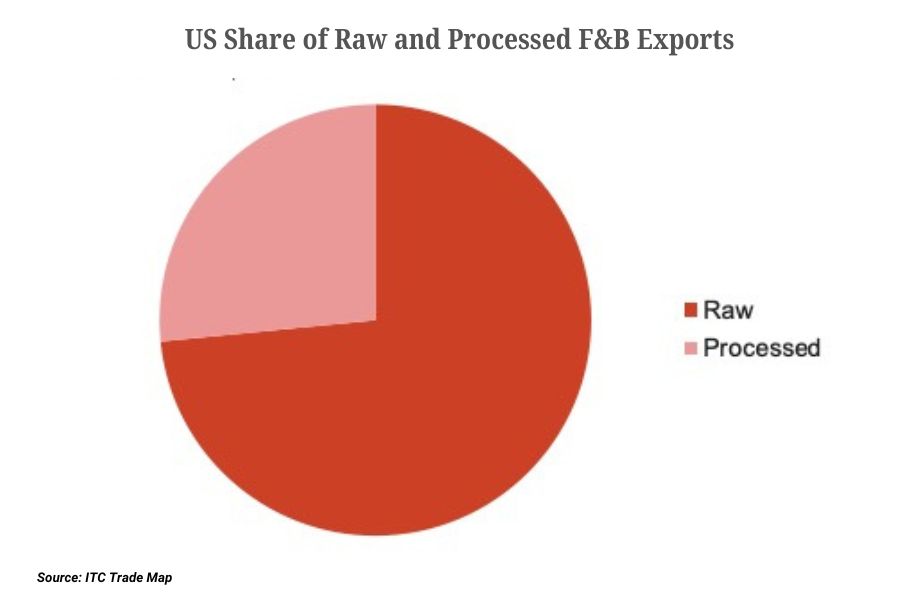
The export composition of the United States and the Netherlands reveals two distinct strategies in global food trade. In 2024, the United States exported US$ 116 billion in raw food and agricultural products, nearly 73% of its total F&B exports. This reflects a model heavily reliant on bulk commodities such as grains, oilseeds, and unprocessed meat, supported by vast agricultural land and high production volumes. In contrast, processed food exports accounted for only US$ 42 billion, indicating a limited emphasis on value addition prior to export. While this approach ensures dominance in global staple supply chains, it also ties us export revenues closely to commodity price fluctuations and volume-based trade.
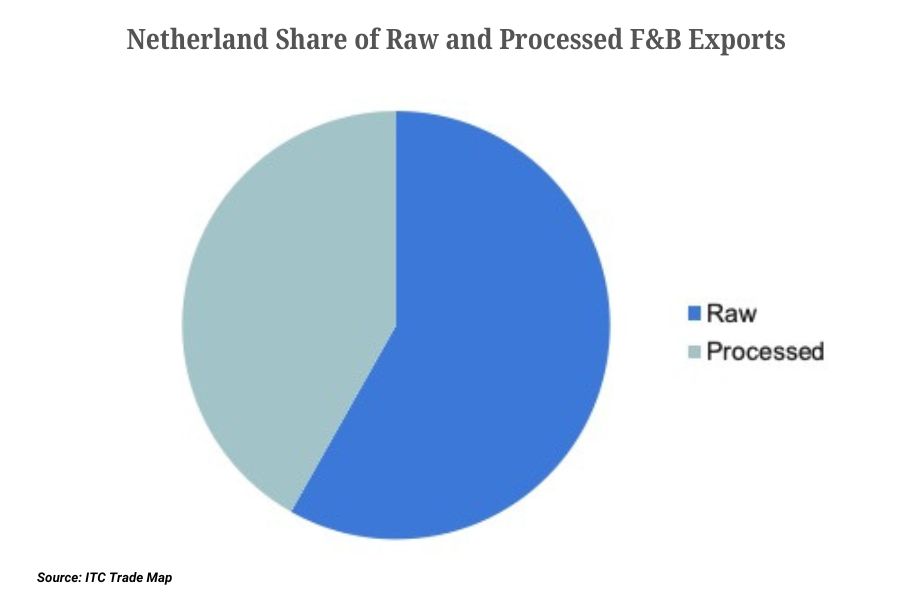
The Netherlands, with a much smaller land base, presents a sharper focus on value-added exports. It recorded US$ 46 billion in processed food exports—exceeding that of the United States—despite having less than 0.5% of US agricultural land. This performance places the Netherlands as the second-largest exporter of processed food globally, only behind Germany. Its raw exports stood at US$ 64 billion, reflecting a more balanced portfolio. Unlike the US, which exports more in quantity, the Dutch model emphasises quality, branding, and product transformation, enabling it to extract higher value per unit of agricultural production.
Export Basket: Raw vs Processed
In 2024, the United States exported US$ 116.6 billion in raw F&B products, with the top three categories—oilseeds (US$ 30B, 25.7%), cereals (US$ 24.4B, 20.9%), and meat (US$ 22.7B, 19.5%)—together accounting for over 66% of total raw exports. Other notable segments included fruits and nuts (US$ 16.4B, 14%), dairy and eggs (US$ 6.8B, 5.8%), and vegetables (US$ 5.9B, 5%), while fish, oils, spices, and other niche products contributed less than 10% combined. This composition reflects a clear dependence on land-intensive, bulk commodities with limited value addition at origin. While this model allows the US to lead in global food security and supply chain scale, it also suggests a narrower margin of export value per acre and less strategic emphasis on product transformation or branding. The export structure remains vulnerable to commodity price fluctuations, and unlike more diversified or value-driven agri-exporters like the Netherlands, it captures less economic value per unit of output.
On the other hand, the Netherlands exported US$ 64.2 billion in raw F&B products, showing consistent annual growth over the past five years. The export portfolio is notably diverse and value-rich, led by dairy and animal-based products (US$ 13.5B, 21%) and meat (US$ 11.8B, 18%), together making up nearly 40% of total raw exports. Other major contributors include vegetables (US$ 9.7B, 15%), fruits and nuts (US$ 9.4B, 14.7%), and fats and oils (US$ 6.8B, 10.6%). While cereals and oilseeds remain relatively minor, the Netherlands shows strength in high-quality, perishable categories supported by advanced cold chain logistics. Compared to the US, the Dutch raw export basket reflects higher unit value and greater specialisation, reinforcing its reputation for efficiency, freshness, and food quality even at the raw product stage.
Table 2: US vs. Netherlands – Raw F&B Export Approach
|
Aspect |
United States |
Netherlands |
|
Export Value (2024) |
US$ 116 Billion |
US$ 64 Billion |
|
Export Model |
Volume-focused, bulk commodity-driven |
Value-focused, quality and efficiency-driven |
|
Top Exports |
Oilseeds, cereals, and unprocessed meat |
Dairy, vegetables, meat, perishables |
|
Value Capture |
Lower value per unit, limited transformation |
Higher value per unit through quality and logistics |
|
Infrastructure Edge |
Bulk shipping, commodity logistics |
Cold chain, agri-tech, rapid delivery |
Source: ITC Trade Map, Web
In 2024, the United States processed F&B exports reached US$ 42.1 billion, marking a consistent growth from US$ 31.3 billion in 2020. The key categories driving this growth include miscellaneous edible preparations(US$ 11.3 billion), beverages, spirits, and vinegar (US$ 10.9 billion), and preparations of vegetables, fruits, and nuts (US$ 5.8 billion). Over the past five years, these categories have demonstrated steady expansion, reflecting the US’s broad-based strength in processed food exports. Notably, cocoa and cocoa preparations saw significant growth from US$ 1.7 billion in 2020 to US$ 3.3 billion in 2024, indicating increasing demand for premium processed products.
The Netherlands achieved US$ 46.6 billion in processed F&B exports, a significant increase from US$ 32.9 billion in 2020. The country’s top export categories include cocoa and cocoa preparations (US$ 10.6 billion), beverages (US$ 8.1 billion), and vegetable, fruit, and nut preparations (US$ 8.0 billion). This diverse export portfolio showcases the Netherlands’ strategic focus on high-value, niche products, particularly in cocoa and beverages, which are key drivers of growth. The steady year-on-year increases across most categories reflect the country’s strong emphasis on innovation, processing technology, and premium product development. With its advanced food processing capabilities, the Netherlands continues to leverage its expertise in value-added exports, solidifying its position as a global leader in processed F&B trade despite its limited agricultural land.
Table 3: US vs. Netherlands – Processed F&B Export
|
Aspect |
United States |
Netherlands |
|
Export Value (2024) |
US$ 42.1 billion |
US$ 46.6 billion |
|
Top Exports |
Edible preparations (US$ 11.3B), Beverages (US$ 10.9B) |
Cocoa (US$ 10.6B), Beverages (US$ 8.1B) |
Source: ITC Trade Map, Web
The Future of Agricultural Trade: Scale vs. Innovation
In conclusion, the agricultural export models of the United States and the Netherlands exemplify two distinct approaches to achieving global dominance. The US model thrives on sheer scale, leveraging its vast agricultural land and bulk commodity exports to dominate global food trade. However, this reliance on volume, with a significant focus on raw materials like oilseeds, cereals, and unprocessed meat, results in lower value capture per unit. Conversely, the Netherlands, with its much smaller land base, focuses on innovation, efficiency, and high-value processed food exports, achieving substantial success in categories such as cocoa, beverages, and vegetable preparations. Despite limited agricultural land, the Netherlands demonstrates that value-added exports, advanced technology, and strategic market positioning can drive substantial trade growth, even outperforming the US in processed food exports. As global demand for food intensifies and natural resources become constrained, the future of agricultural trade may shift towards more efficient, high-tech models that prioritise value addition over sheer volume, as illustrated by the Netherlands’ success.
In light of these contrasting models, one must ask: As global food demand rises and natural resources become more limited, will future agricultural trade success be defined by scale and volume, as in the US model, or by efficiency, innovation, and value-added production, as demonstrated by the Netherlands?