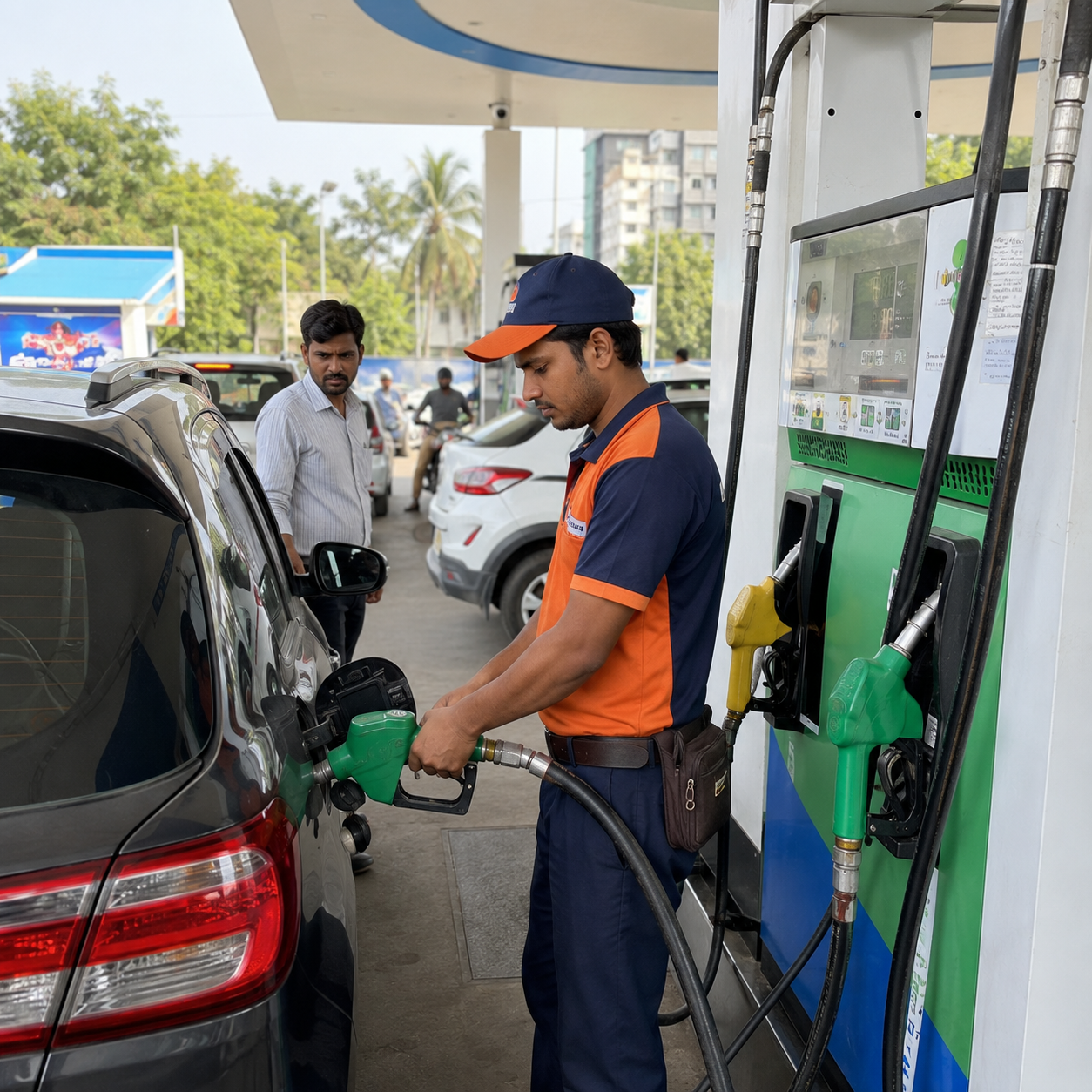
Industry leaders reassure consumers that E20 ethanol-blended petrol is safe, thoroughly tested and offers cleaner performance with only a marginal impact on fuel efficiency.
Key Highlights
- Government and auto industry jointly reaffirm confidence in E20 fuel.
- E20 introduced only after rigorous testing on older vehicles.
- Maruti Suzuki found no E20-related issues in over 1.5 crore older vehicles.
- Industry says mileage impact is limited to around 3–3.5%.
- E20 offers cleaner emissions and improved engine performance.
- Testing follows international UNECE standards.
- E20 fuel complies with BIS and BS-VI emission norms.
- Industry urges consumers not to worry about using E20 petrol.
The Ministries of Petroleum & Natural Gas, Heavy Industries and Road Transport & Highways held a joint press conference in New Delhi to address growing concerns over the use of E20 ethanol-blended petrol. Leading automobile manufacturers and industry experts assured consumers that E20 fuel is safe for vehicles and has undergone extensive scientific testing before being introduced nationwide.
Representatives from Toyota Kirloskar Motor, Maruti Suzuki, Hero MotoCorp, TVS Motor Company, Hyundai Motor India, Bajaj Auto and former Engineers India Limited (EIL) Chairperson Vartika Shukla participated in the briefing, highlighting that India’s ethanol blending programme has been implemented through a phased and evidence-based approach.
Toyota Kirloskar Motor’s Country Head Vikram Gulati said ethanol has been used globally for decades and is even utilised in Formula racing. He explained that India adopted E20 fuel only after comprehensive testing on older vehicles and clarified that recently introduced E85 fuel stations are exclusively meant for flex-fuel vehicles.
Responding to concerns about testing standards, Gulati said India follows internationally accepted UNECE testing protocols, with independent accredited agencies conducting vehicle certification. He stressed that these global standards ensure vehicle safety and cannot be compromised.
Maruti Suzuki’s Senior Executive Officer Rahul Bharti issued what he described as a “statement of confidence” for customers. He revealed that during FY 2025-26, the company serviced 2.84 crore vehicles, including more than 1.5 crore cars over three years old that were not originally E20-certified. According to the company, no cases of corrosion, excessive wear, engine damage or reduced component life linked to E20 fuel were reported.
Addressing concerns about mileage, Bharti explained that E20 has a slightly lower energy content than E10 petrol, resulting in an estimated 3–3.5% reduction in fuel efficiency. For a vehicle delivering 20 km per litre, the difference would be around 0.6 km per litre. However, he noted that everyday factors such as tyre pressure, driving habits, gear usage and vehicle maintenance have a much greater impact on mileage than ethanol blending.
He also highlighted that E20 provides benefits such as better acceleration, improved anti-knocking performance and significantly lower emissions, helping offset the slight reduction in mileage.
Former EIL Chairperson Vartika Shukla said the ethanol blending programme was developed after extensive consultation with industry stakeholders and scientific evaluation. She added that E20 fuel fully complies with BIS quality standards and BS-VI emission norms and is now available at fuel stations across the country.
Hero MotoCorp’s Chief Business Officer Ashutosh Varma said the company has analysed extensive service data and found no increase in damage or maintenance issues in two-wheelers using E20 fuel compared to conventional petrol.
The industry concluded by reaffirming its collective confidence in India’s E20 programme, stating that ethanol-blended fuel supports cleaner mobility, reduces dependence on imported crude oil and contributes to the country’s environmental and energy security goals.