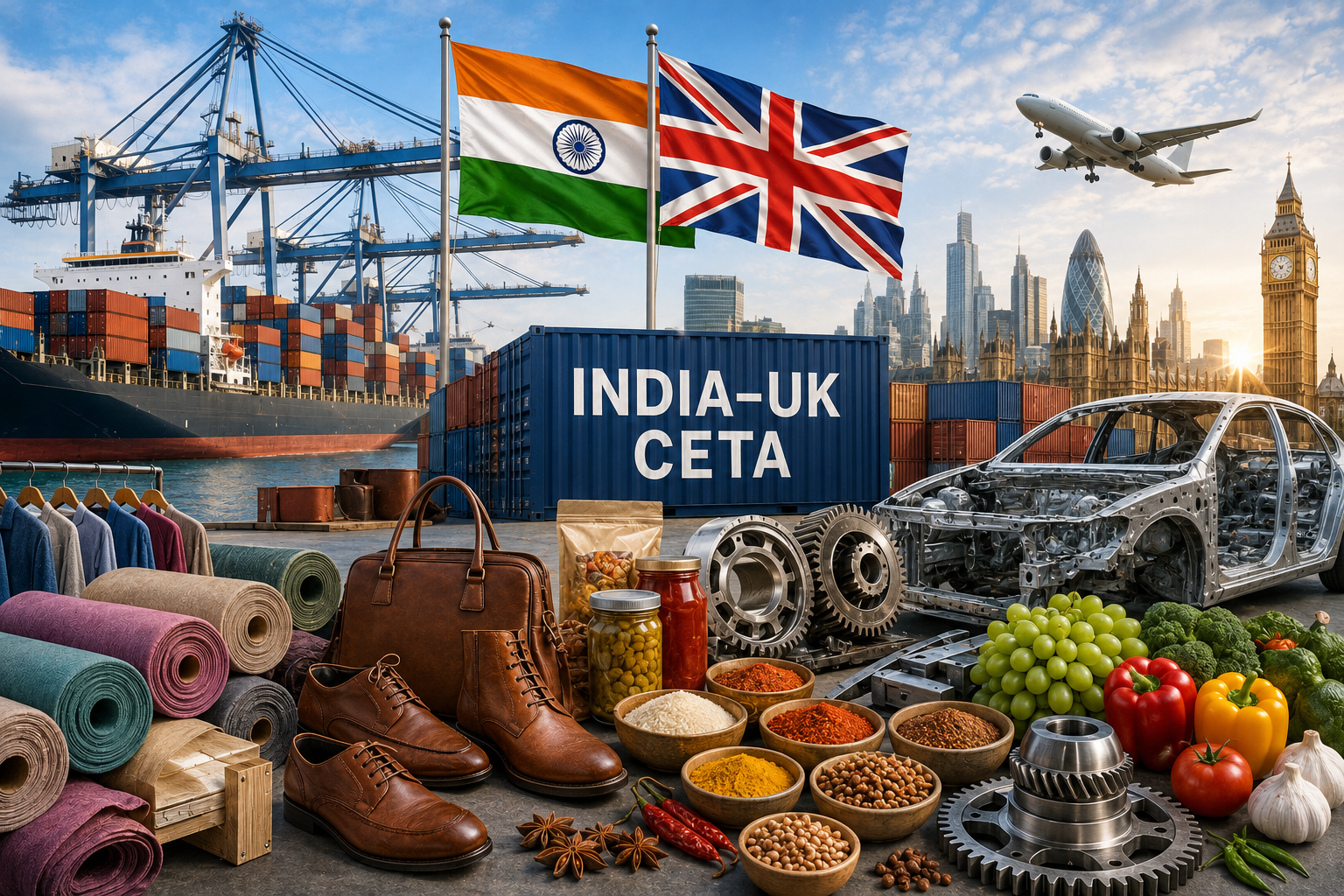
A GTRI analysis highlights which Indian sectors stand to benefit the most from the India-UK Comprehensive Economic and Trade Agreement, while cautioning that tariffs alone will not guarantee export growth.
Highlights
- GTRI classifies export opportunities into High, Medium and Low potential sectors.
- Garments, textiles, leather, footwear and processed foods emerge as top beneficiaries.
- Automobiles, machinery and electronics offer significant long-term growth potential.
- Pharmaceuticals and chemicals have opportunities, but regulations remain key hurdles.
- Steel, petroleum, alcohol and tobacco are expected to see limited CETA-led gains.
- Export success will depend on quality standards, certification and supply-chain integration.
By Ajay Srivastava
The India–UK Comprehensive Economic and Trade Agreement (CETA) opens new opportunities for Indian exporters, but gains will vary sharply by sector.
GTRI’s analysis finds the strongest prospects in labour-intensive goods, processed foods, seafood, automobiles and selected manufactures. Steel, petroleum and alcohol are less likely to gain significantly.
The numbers show substantial room to grow. In 2025, the UK imported US$928.9 billion of goods from the world but only US$15.2 billion from India. India’s share of UK imports was just 1.6%. The UK, meanwhile, bought only 3.4% of India’s US$445 billion global exports.
But low market share alone does not signal a big opportunity. Export potential depends on four factors: UK demand, India’s export capacity, its current UK market presence and the tariff advantage created by CETA. Standards, food-safety rules, safeguards, certification and supply-chain constraints can matter as much as tariffs.
GTRI therefore groups sectors into High, Medium and Low export potential. Sectors with less than US$1 million of UK imports from India in 2025 are excluded.
1. High Potential: Where Indian Strength Meets UK Demand
Garments are among the clearest winners. India exported US$16.3 billion globally in 2025, while the UK imported US$21.3 billion. India supplied US$1.3 billion, or 6.1% of UK imports. The UK already buys 8% of India’s global garment exports, showing established buyer relationships. Removal of high apparel tariffs can improve India’s position against preferential competitors and quickly generate new orders.
Textiles, leather and footwear also stand out. India supplied 7.8% of UK imports of textiles, fabrics, yarn and carpets, while its share was 7.3% in leather products and 4.8% in footwear. The UK already accounts for 10.2% of India’s global footwear exports. These sectors combine established commercial links with meaningful tariff cuts, making them among the most immediate CETA opportunities.
Processed foods offer another major opening. The UK imported US$33.4 billion globally but only US$354 million from India, giving India a market share of 1.1%. India’s global exports were US$10 billion. Large UK demand, low Indian penetration and tariff cuts create strong potential in ready-to-eat foods, bakery and confectionery products, sauces and ethnic foods. Food safety, labelling and traceability will remain critical.
Cereals, vegetables, fruits and spices also have strong potential. India exported US$25.6 billion globally, while UK imports were US$23.2 billion. Yet India supplied only US$716 million, or 3.1%. CETA can improve competitiveness in selected products, though SPS requirements and continued protection for some sensitive items will limit gains.
Fish, meat and processed products show a large market gap. India exported US$12.8 billion globally and the UK imported US$17.2 billion, but India supplied only US$126 million—just 0.7% of UK imports. Seafood offers especially strong potential. The main challenge is compliance with UK SPS rules, residue controls and traceability.
Automobiles, motorcycles and parts present perhaps the biggest numerical opportunity. The UK imported US$92.2 billion globally but only US$325 million from India, giving India a negligible 0.4% share. India’s global exports were US$25.1 billion. CETA tariff cuts can support vehicles, motorcycles and components, though rules of origin and technical standards will be decisive.
Machinery, electronics and fabricated metal products offer major structural opportunities. The UK imported US$106.2 billion of machinery but only US$1.34 billion from India, a 1.3% share. It also imported US$74.1 billion of telecom, computer and electronics products, with India supplying US$2.1 billion, or 2.8%. In base-metal products, India supplied only 2.1% of a US$17.9 billion UK market. Since tariffs are already low in many lines, growth will depend more on technology, standards, certification and supply-chain integration.
Ceramics, glass, stone and cement products also have good prospects. India exported US$6 billion globally against UK imports of US$7.3 billion and already held a 4.3% market share. India’s strength in ceramics, tiles and natural stone, combined with tariff savings, can support further growth.
2. Medium Potential: Room to Grow, but Tariffs Are Not the Main Barrier
Chemicals and pharmaceuticals have strong Indian supply capacity but limited CETA-led gains. India exported US$40 billion of chemicals globally but supplied only US$908 million of a US$35.2 billion UK market. In pharmaceuticals, India exported US$25.8 billion globally but supplied only US$1 billion, or 3.2%, of UK imports. The opportunity is real, but regulation, quality compliance, environmental rules and procurement matter more than tariffs.
Plastics and rubber products have moderate potential. India supplied only 1.9% of UK plastics imports and 3.4% of rubber-product imports. Tariff cuts can help selected goods, but environmental rules, technical standards and strong competition will limit gains.
Diamonds, gold and silver require caution. The UK imported US$178.5 billion globally but only US$1 billion from India. India’s 0.6% share appears to suggest enormous headroom, but the figure is heavily influenced by London’s role as a global bullion and precious-metals trading centre. The realistic opportunity is therefore much smaller than the headline data suggest.
Paper and wood products, railway-aircraft-ship products, artificial flowers and umbrellas, and edible oils also fall in the Medium category. Each has some room to grow, but freight costs, sustainability rules, certification, project-based procurement, intense competition or limited Indian export surpluses constrain gains.
3. Low Potential: CETA Cannot Overcome Structural Barriers
Iron and steel products show why an FTA does not automatically guarantee market access. India exported US$20.5 billion globally and supplied US$959 million to the UK, giving it a 5.2% share. Yet the UK’s tighter steel safeguard regime, reduced quotas and high above-quota tariffs can overwhelm CETA preferences. Trade remedies and future carbon costs add further risks.
Ores, minerals and petroleum also have limited CETA-led potential. India exported US$62.1 billion globally and supplied US$1.6 billion to the UK, but tariffs are generally low. Trade is driven mainly by global prices, refinery economics, resource availability and freight.
Alcohol and wines face a different problem. The UK imported US$10.9 billion globally but only US$7 million from India. India’s own global exports were just US$456 million. The gap reflects weak export scale, limited brand presence and strong global competition rather than tariffs.
Tobacco products also have Low potential. India exported nearly US$2 billion globally, but UK imports from India were only around US$1 million. High excise taxes, strict health rules and declining smoking demand sharply limit the opportunity.
Strategy: Focus Where CETA Can Convert into Orders
The biggest gains are likely where three conditions come together: India has strong export capacity, the UK has substantial demand and CETA removes a meaningful tariff disadvantage. That points most clearly to garments, textiles, leather, footwear, processed foods, seafood and selected farm products.
Automobiles offer a major longer-term opportunity because India’s UK market share is exceptionally small. Machinery, electronics and fabricated metal products can also grow strongly, but success will depend more on quality, standards, certification and integration into UK supply chains than on tariff cuts.
India therefore needs a sector-specific export strategy. Food exporters need better testing, traceability and compliance with UK sanitary and phytosanitary rules. Machinery and electronics firms need certification, technology and stronger buyer links. Automobile exporters must meet rules-of-origin and technical requirements. Garment, leather and footwear producers should move quickly to turn tariff savings into orders before competitors adjust.
CETA creates market access, not guaranteed exports. Without parallel work on standards, certification, logistics, regulatory approvals and buyer networks, much of the opportunity will remain on paper. The agreement opens the door; India must now convert access into exports.
(Author is founder of GTRI)
Keywords
India-UK CETA, GTRI, Exports, India UK FTA, Garments, Textiles, Processed Foods, Automobiles, UK Market, Trade Agreement