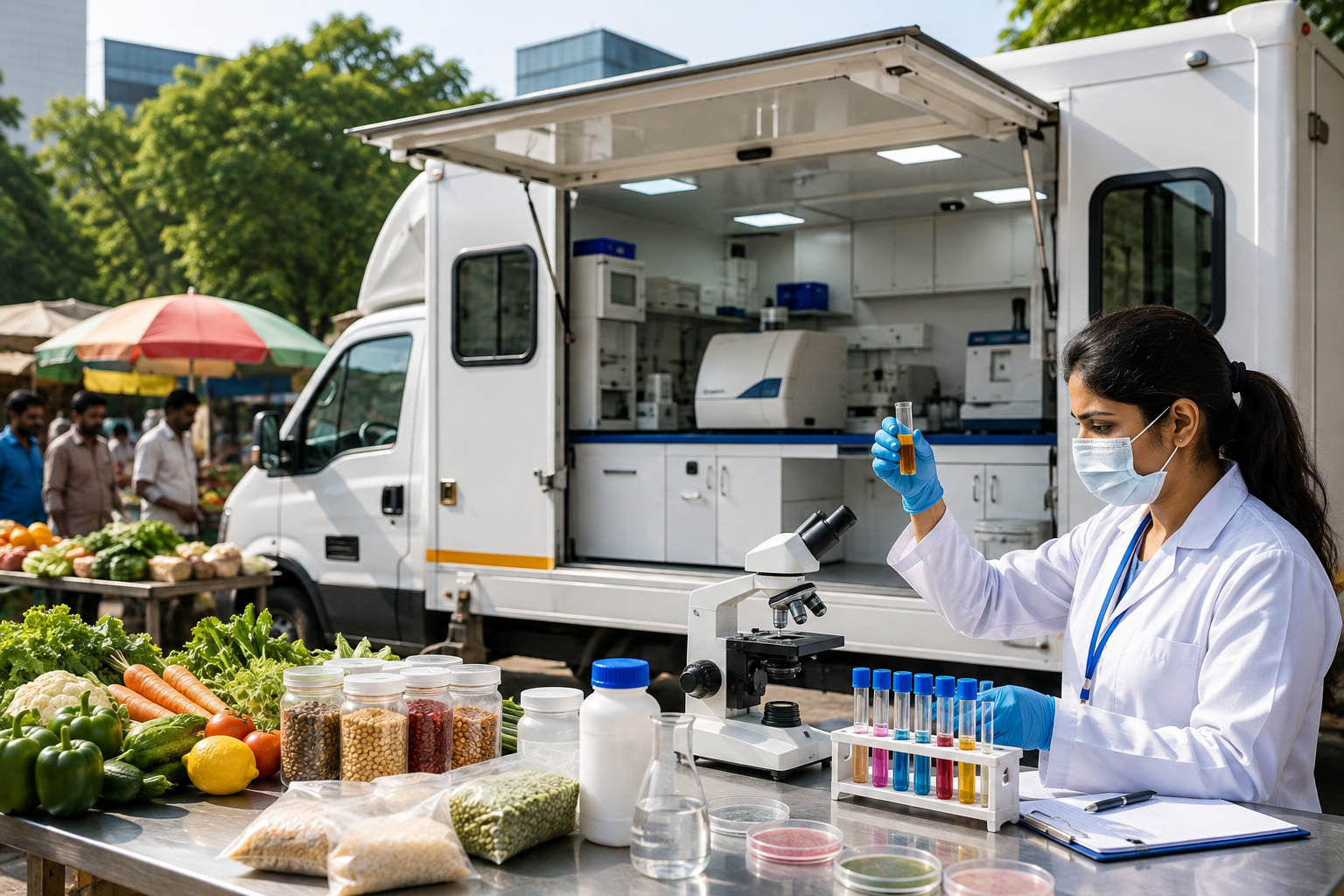
NABL has launched India’s first accreditation scheme for Mobile Food Testing Laboratories to expand access to reliable and quality-assured food testing.
The initiative is expected to strengthen food safety surveillance, enable faster regulatory action and improve consumer confidence.
Highlights
- NABL has launched India’s first accreditation scheme for Mobile Food Testing Laboratories.
- Mobile labs will provide quality-assured and internationally benchmarked food testing closer to communities.
- The initiative aims to strengthen food safety surveillance across India.
- Easier access to testing could support faster regulatory interventions.
- A multilateral MoU exchange will promote coordinated assessments and regulatory harmonisation.
- The framework aims to reduce duplication and improve ease of doing business while maintaining quality standards.
India has taken a new step towards expanding access to food safety testing with the launch of the country’s first accreditation scheme specifically designed for Mobile Food Testing Laboratories.
The National Accreditation Board for Testing and Calibration Laboratories (NABL), a constituent board of the Quality Council of India (QCI), launched the scheme under the Integrated Assessment Programme at the ‘Gunvatta Samanvaya – A Multilateral MoU Exchange Ceremony’ in New Delhi.
The accreditation framework is designed to take reliable and quality-assured food testing beyond conventional laboratories and closer to communities.
Under the new system, accredited mobile food testing laboratories will be able to provide testing services that meet quality standards and international benchmarks.
According to the Ministry of Commerce and Industry, extending accredited testing through mobile laboratories is expected to strengthen food safety surveillance and improve access to quality testing services.
The initiative could also support faster regulatory interventions when food quality or safety issues are identified. The government expects better access to credible testing facilities to enhance consumer confidence as well.
Alongside the launch of the accreditation scheme, participating organisations exchanged a multilateral Memorandum of Understanding to strengthen coordination between institutions operating under the Integrated Assessment Framework.
The collaboration aims to promote coordinated assessments and regulatory harmonisation while reducing duplication in assessment processes. It also seeks to encourage mutual recognition and improve regulatory efficiency.
The government said these measures could facilitate ease of doing business while maintaining high standards of quality and compliance.
DPIIT Secretary Amardeep Singh Bhatia stressed the importance of embedding quality throughout the value chain. He said initiatives such as Gunvatta Samanvaya would support India’s development journey towards 2047 by encouraging quality-led practices.
NABL Chairperson Dr Sandip Shah highlighted the role of collaborative assessment processes and credible institutions in supporting India’s development.
QCI Secretary General Chakravarthy T. Kannan also emphasised collaboration, convergence and mutual trust in creating a strong quality ecosystem.
The new mobile laboratory accreditation framework is ultimately aimed at bringing quality-assured food testing closer to people while strengthening India’s wider food safety and quality infrastructure.