The contribution of MSMEs to India’s merchandise exports has shown a downward trend in recent years, even as their export value has demonstrated a noteworthy increase. Moreover the current slowdown in trade is expected to enhance their working capital requirements. Are these companies prepared?

Image Source: Shutterstock
Micro small and medium industry (MSME) plays a crucial role in the Indian economy. This sector makes a significant contribution to India’s industrial production, exports, and employment. It also assists in the creation of a consumer base. The MSME share in overall exports covers various products such as textiles, leather goods, processed food, and gems and jewellery. Sectors like sports goods are nearly 100% export-oriented.
As of March 31, 2022, there were about 80.16 lakh registered MSME units in the country. The sector contributes around 45% to manufacturing output and about 40% to direct and indirect exports. It is also the second-largest employer after agriculture. However, MSME share in India’s exports in the recent past is reported to be shrinking.
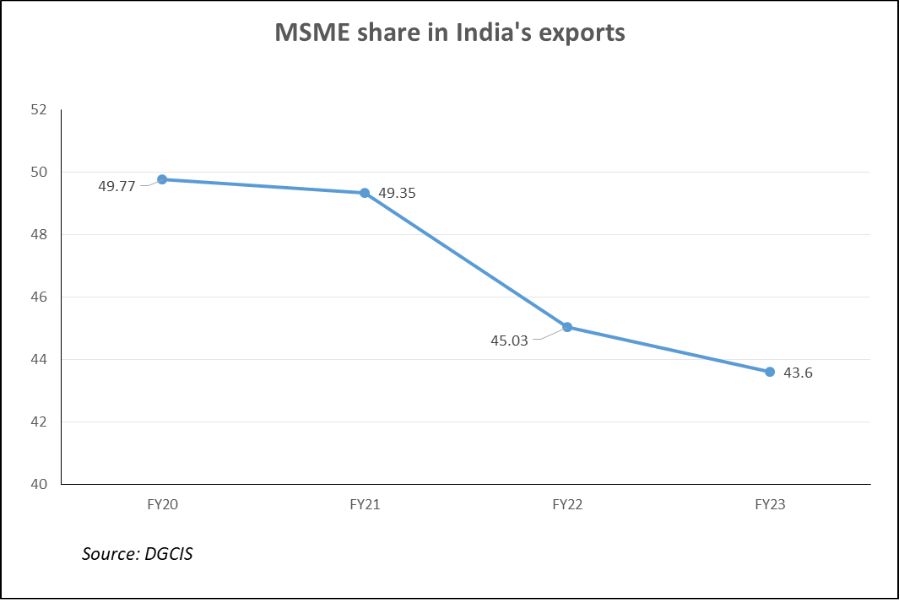
In FY 2022-23, although exports from India have grown by about 13.84%, share of MSME-specified goods in overall exports underwent contraction. According to the data from DGCIS, the share of the MSME-specified products in the exports was recorded at 43.6% in FY 2022-23, steadily declining from 49.77% in FY 2020. This is despite value of MSME exports increasing from US$ 154.8 billion in FY20 to US$ 190 billion in FY22.
The share of MSME Gross Value Added (GVA) in India’s GDP is also seen to be fluctuating over the last three years. During FY 2019-20, it was recorded at 30.5%. It fell to 27.2% in 2020-21 but again climbed to 29.2% in 2021-22.
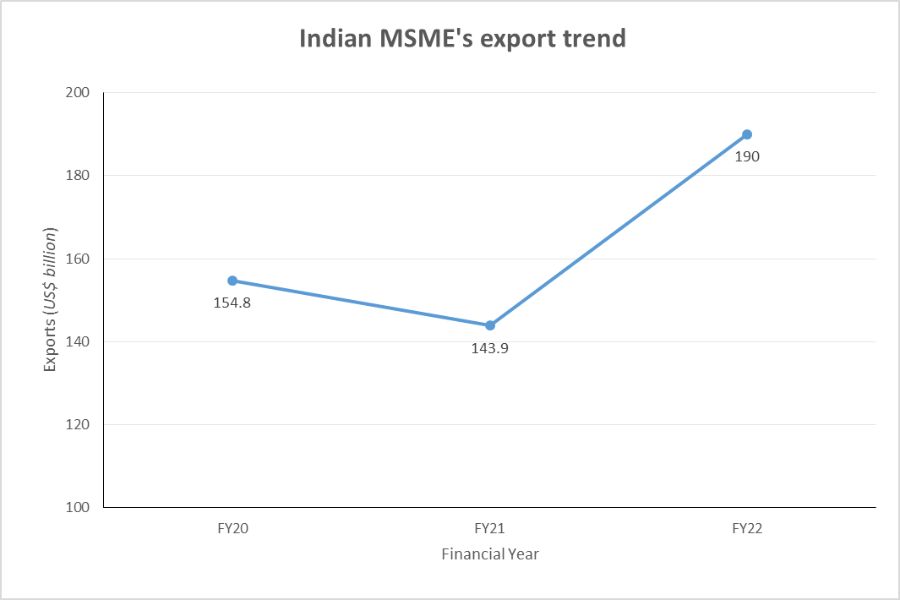
Source: Directorate General of Commercial Intelligence and Statistics (DGCIS)
However, the share of MSMEs manufacturing output in the overall Indian manufacturing output has been quite stable. The share was recorded at 36.6%, 36.9%, and 36.2% during the fiscal years 2019-20, 2020-21, and 2021-22, respectively.
Government has been making several interventions to support MSMEs, which include:
Refurbishing the MSMEs in view of emerging opportunities
The contribution of micro, small and medium enterprises to India’s economic growth is very crucial and well-established. To further elevate the growth and development of the MSME sector, the government has been implementing various schemes and programmes. These include:
- Rs. 5 lakh crore Emergency Credit Line Guarantee Scheme
- Rs. 50,000 crore equity infusion through the MSME Self-Reliant India Fund
- The inclusion of Retail and Wholesale trades as MSMEs
- An online portal Champions (Creation and Harmonious Application of Modern Processes for Increasing the Output and National Strength). It is a platform for resolution, redressal and remedies. It is a facility provided by the Ministry of Micro, Small and Medium Enterprises (MSME) for ensuring a speedy, convenient, and effective redressal of MSMEs grievances.
- Non-tax benefits for upward changes in MSME status
- The RAMP, (Raising and Accelerating MSME Performance Program)
The other important initiative of the government is the launch of the Udyam Assist Platform (UAP) in January 2023. This initiative aims to bring Informal Micro Enterprises (IMEs) under the gamut of formal MSMEs and enable MSMEs to avail benefits under Priority Sector Lending (PSL).
A number of challenges facing MSME firms have been identified by the government, including :
- Lack of awareness around products in demand
- Export promotion and assistance schemes
- Legal framework
- IPR issues
- Lack of access to affordable trade finance
- Low technology adoption leading to poor packaging, quality issues, cumbersome documentation process
- Digital disruption due to proliferation of Industry 4.0 technologies