India’s rising edible oil prices and the push for self-sufficiency

As India’s festive season unfolds, a sharp rise in edible oil prices is straining household budgets and raising costs for sectors like restaurants, hotels, and sweet shops. Last month, palm oil prices surged by 37%, with mustard oil following close behind at a 29% hike. This surge comes as retail inflation hits a nine-month peak, primarily fueled by climbing food and vegetable prices.

To ease this strain, the government has raised import tariffs on crude and refined edible oils, aiming to incentivize local farmers and encourage domestic oilseed production. By supporting local agriculture, the policy seeks to stabilize prices long-term and reduce the country’s dependence on costly imports.

oil_tpci_pixabay_Image Source: Pixabay

During the current festive season, edible oil prices have soared, placing immense strain on household budgets and increasing costs for restaurants, hotels, and sweet shops that rely heavily on these oils. According to the Times of India, palm oil prices alone have surged by 37% in the past month, while mustard oil, a household staple, has seen a 29% price hike over the same period. This spike in oil prices comes amid retail inflation hitting a nine-month high of 5.5% in September, primarily driven by rising vegetable and food costs.

This rise in prices reflects a deeper trend in India’s edible oil consumption. As per Prof. Venkateshwar from IIM Mumbai, “India has witnessed a dramatic rise in consumption of edible oils, from 17.70 kg per year in 2020 to 19.7 kg per year in 2023.” This increased demand has far outpaced domestic production, heightening India’s reliance on imports to satisfy both consumer and industrial needs. Despite significant growth in the area under cultivation over the last decade, the country continues to rely heavily on imports due to the challenges of low-yielding oilseeds and conventional farming methods, adds Prof. Venkateshwar.

Compounding these pressures, the kharif oilseed crops (June to October) are facing challenges this season. Soybean, the largest kharif oilseed, has been sown across over 12.5 million hectares—just above last year’s coverage. However, key production regions such as Madhya Pradesh and Maharashtra have experienced prolonged dry spells, impacting yield prospects. Groundnut crops in Gujarat and Karnataka are similarly struggling due to erratic rainfall. According to Gro Intelligence, a US-based agricultural data firm, similar conditions in 2017 led to a 24% decline in soybean production.

Edible Oil Imports

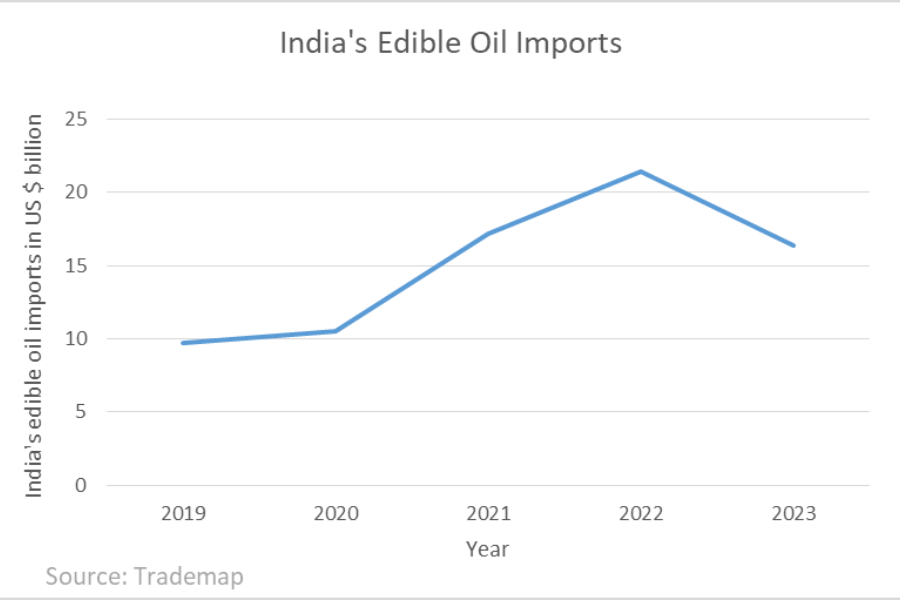
India’s edible oil imports witnessed a substantial increase of nearly 25% in 2022, reaching an import value of US$ 21.4 billion, up from US$ 17.2 billion in 2021. Palm oil remains the most imported edible oil, accounting for a significant 53% of total imports, followed by soybean oil at 24% and sunflower oil at 21%. This surge reflects rising domestic demand and the ongoing reliance on imports to meet the needs of one of the world’s largest edible oil markets. The increased import volume underscores the need for further investment in domestic oilseed production to reduce import dependency.
edible oil_imports

Drivers of High Imports

According to Prof. Mridul from IIM Kozhikode, “Technological constraints along with weather-related disruptions like droughts, affect the cultivation of oilseeds and increase its imports. We need to encourage technological breakthroughs, drip irrigation, and optimal water management for the crops in the oilseed sectors.” This observation highlights the key challenges facing India’s domestic oilseed production. Despite the country’s efforts to increase cultivation, various factors, both structural and technological, are holding back the sector from meeting its growing demand. As a result, India’s reliance on imported edible oils continues to rise. The main drivers behind these high imports are as follows:

Low Production: Farmers are hesitant to cultivate oilseeds due to the challenges posed by low-cost edible oil imports, which make it difficult for them to compete effectively in the market. Domestically produced oils like soya bean, mustard, and groundnut fulfill only 40% of the country’s demand. Additionally, the lack of robust price support mechanisms further discourages them from growing these crops, leaving them uncertain about the financial viability of oilseed farming.

High Demand: The demand for edible oils has surged, driven by factors such as rapid urbanization, a growing population, and rising income levels. As more people move to urban areas and have higher purchasing power, the consumption of edible oils has steadily increased, reflecting these socioeconomic shifts.

Low Oilseed Productivity: In India, oilseed productivity is significantly low, at less than half the global average of about one tonne per hectare. This gap is primarily due to limited access to advanced seed technology, which hinders farmers from maximizing their crop yields.

Traditional Farming Technology: The use of traditional farming methods by many farmers significantly affects productivity levels. These conventional practices often rely on outdated tools and techniques, limiting the potential for higher crop yields.

Government’s Support to Farmers

Last month, the government significantly raised import duties on crude soybean, palm, and sunflower oils, a move intended to increase the cost of imported edible oils and encourage domestic farmers to produce more oilseeds. The duty on crude oils has risen from 5.5% to 27.5%, and on refined oils from 13.7% to 35.7%, effective since September 14. This adjustment aims to support local agriculture by providing favorable prices for Indian farmers and incentivizing greater oilseed cultivation. Currently, India relies on imports for about 58% of its edible oil needs, positioning it as the world’s second-largest consumer and largest importer of vegetable oils.

With recent global price increases of around 10.6%, 16.8%, and 12.3% for crude palm, soybean, and sunflower oils respectively, the government’s policy seeks to create a competitive market for local producers. By prioritizing domestic production, this strategy aims to mitigate the impact of rising international prices, reduce import dependence, and help stabilize local edible oil prices. Ultimately, this approach is expected to make oilseed cultivation a more viable and profitable option for farmers, supporting them as they face global market pressures.

According to Professor Mridul, this policy shift offers temporary protection and import substitution opportunities for domestic farmers. However, he suggests additional measures, such as establishing floor prices to shield farmers from low-cost imports. Investments in technological advancements, he adds, would yield more durable benefits, enhancing consumer welfare and further supporting long-term self-sufficiency in edible oil production.

Previous Post
Next Post

Most Recent Posts

  • All Post
  • 8th Pay Commission
  • Aadhar
  • Aditya Birla Capital
  • Advertising Standards
  • Affordable Housing
  • Agriculture
  • Agriculture & Food
  • AI in Healthcare
  • AI Technology
  • Airlines
  • alcohol industry
  • Android
  • APEDA
  • Apple
  • Artificial Intelligence
  • Ashwini Vaishnaw
  • Asset Management
  • Atmanirbhar Bharat
  • Audio Devices
  • Audio Products
  • Auto Industry
  • Automobile
  • Automobiles
  • Automotive
  • Automotive Industry
  • Aviation
  • Bain Healthcare Report 2026
  • Bank
  • Banking
  • Banking Technology
  • Battery Industry
  • Beverage Industry
  • Beverages
  • Bihar
  • biotechnology
  • Bitcoin
  • BMW Group India
  • Brand Insight
  • BRICS
  • Bullion Market
  • Business
  • Business & Economy
  • Business & Trade
  • Business Leadership Post COVID-19
  • Business News
  • Business Terminology
  • Business Utilities
  • Buyback
  • Capital Goods
  • Capital Markets
  • CarsBusiness
  • CBIC
  • CCI
  • Child Investment
  • China
  • China technology news
  • Citizen Services
  • Clean Energy
  • Clean Technology
  • Cloud Computing
  • coal
  • Commerce
  • Commerce and Industry
  • Commercial Real Estate
  • Commercial Vehicles
  • Commodities
  • Communications
  • Companies
  • Competition Law
  • Compliance
  • Computer Accessories
  • connected cars
  • Consumer Affairs
  • Consumer Electronics
  • Consumer Finance
  • Consumer Goods
  • Consumer Health
  • Consumer Markets
  • Consumer News
  • Consumer Protection,
  • Consumer Rights
  • Consumer Spending
  • Consumer Trends
  • Content Creation
  • Copper
  • Corporate
  • corporate affairs
  • Corporate Earnings
  • Corporate Governance
  • Corporate News
  • Corporate Social Responsibility
  • Cost of Living
  • Country
  • CRED
  • Credit Cards
  • CREDIT RATING
  • Crude Oil
  • Cryptocurrency
  • CSR
  • Culture
  • Currency
  • Customs Duty
  • Cyber Security
  • Cybersecurity
  • Dairy Industry
  • Data & Analytics
  • Defence
  • Delhi Government
  • Delhi-NCR
  • Demographics
  • Derivatives
  • DGCA
  • DGFT
  • DigiLocker
  • Digital Assets
  • Digital Economy
  • Digital Health India
  • Digital Identity
  • Digital India
  • Digital Infrastructure
  • Digital passport for robots
  • Digital Payments
  • Digital Platforms
  • digital services
  • Diplomacy
  • Dixon Technologies
  • DPIIT
  • E Commerce
  • E-commerce
  • E-Governance
  • Ease of Doing Business
  • Economic Growth
  • Economy
  • Edible Oil Industry
  • Editor Choice
  • EdTech
  • Education
  • Electric Mobility
  • Electric Vehicles
  • Electronics
  • Employment
  • ENERGY
  • Engineering
  • Entertainment
  • Environment
  • EPFO
  • Ethanol Economy
  • EV Industry
  • EV Technology
  • Exports
  • EXTER
  • Farmers
  • Fashion
  • FINANCE
  • Finance Ministry,
  • Financial Marketing
  • Financial Markets
  • Financial News
  • Financial Planning
  • Financial Results
  • Financial Services
  • Fintech
  • FnTech
  • Food & Beverage
  • Food & Beverages
  • Food Exports
  • Food Industry
  • Food Manufacturing
  • Food Processing
  • Food Regulations
  • food safety
  • Foreign Exchange
  • Foreign Investment
  • Foreign Policy
  • Foreign Trade
  • Forex Reserves
  • fssai
  • FTA
  • Fuel
  • Fuel Prices
  • Future Energy
  • Gadgets
  • Gadgets & Apps
  • Gaming
  • GDP
  • Generative AI Healthcare
  • Geopolitics
  • GI Products
  • Global Brand Alliance
  • Global Economy
  • Global Markets
  • Global Politics
  • Global Tech
  • Global Trade Policy
  • Global Trends\
  • Gold
  • Gold Market
  • Gold Prices
  • Gols & Silver
  • Government
  • Government & Policy
  • Government Affairs
  • Government Bonds
  • Government Data
  • Government Initiatives
  • Government Policy
  • Government Policy & Regulation
  • Government Scheme
  • Government Schemes
  • Government Services
  • Green Energy
  • Green Mobility
  • GroupGlobal
  • GST
  • GST Council
  • GST Counsil
  • Hair Care
  • Hardware
  • Hatchback Segment
  • Health Supplements,
  • Horticulture
  • Housing
  • HSBC
  • Human Resources
  • humanoid robot market
  • Hyundai
  • IBT Infographics
  • iinvestment
  • Imports & Exports
  • Income Tax
  • India
  • India Auto Market
  • India Business News
  • India Inc
  • India News
  • India Retail
  • India-Canada Relations
  • India-China
  • India-Japan Relations
  • India-Russia Relations
  • India-South Korea Relations
  • India-US Relations
  • Indian Economy
  • Indian Navy
  • Industrial Pollution
  • Inflation
  • Infra
  • Infrastructure
  • Innovation
  • Instagram
  • Insurance
  • international
  • International Affairs
  • International Cooperation
  • International Relations
  • International Trade
  • Internet & Connectivity
  • Internet Policy
  • Internet Regulation
  • Interview
  • Investing
  • Investment News
  • Investments
  • iPhone News
  • IPO
  • IT Industry
  • Jewellery
  • Jio Platforms
  • JioBlackRock
  • Jobs & Careers
  • Joint Ventures
  • Kim Kardashian
  • Labour
  • Latest
  • Launches
  • Leadership
  • Leaderspeak
  • Lending
  • Lifestyle
  • Lifestyle Tech
  • List
  • Loans & Credit
  • Local News
  • Logistics
  • LPG
  • Luxury Cars
  • Machinery
  • Macroeconomics
  • Macroeconomy
  • maharashtra
  • Maharashtra News
  • Make in India
  • Makhana
  • Manufacturing
  • Market Outlook
  • Markets
  • Maruti Suzuki
  • Mergers & Acquisitions
  • Meta
  • Microsoft
  • Middle East
  • Mobile Apps
  • Mobile Industry
  • Mobile Launch
  • Mobility
  • Monetary Policy
  • Monsoon
  • MoSPI
  • MSME
  • Mutual Funds
  • Nano Tech
  • National
  • National news
  • NEET 2026
  • NewsElectric
  • NewsTata
  • NPCI
  • NPS Vatsalya
  • Office Market
  • Oil & Gas
  • Oil and Gas
  • Others
  • OTT
  • Packaged Drinking Water
  • Packaged Foods
  • Packaging Industry
  • Packaging Innovation
  • Passenger Vehicles
  • Paytm
  • Pension & Retirement
  • Pensions
  • Personal Care
  • Personal Finance
  • Perspectives
  • Petroleum
  • PFRDA
  • Pharmaceuticals
  • PM Modi
  • PMAY-G
  • PMAY-U
  • PMAY,
  • PMI
  • policy
  • Population
  • PORTS
  • Positive News
  • PPF
  • Precious Metals
  • Pricing
  • Product Labeling
  • Product Labelling
  • Product Launch
  • Property Market
  • PSU
  • PSU Banks
  • Public Health
  • Public Policy
  • Public Safety
  • Public Sector
  • Public Services
  • Public Welfare
  • Quarterly Results
  • Railways
  • Rajasthan
  • Raksha Bandhan
  • Raksha Bandhan Gifts
  • Rare Earths
  • RBI
  • Real Estate & Realty Sector
  • Recycling
  • Regulation
  • Regulatory Action
  • Regulatory Affairs
  • Regulatory Updates
  • REIT
  • Reliance Industries
  • Renewable Energy
  • RERA
  • Research
  • Retail
  • Retirement Planning
  • Road Infrastructure
  • Robotics & Automation
  • robotics standards
  • Rupee
  • Rural Development
  • Rural Housing
  • SAIL
  • Salaries
  • Samsung
  • Savings
  • Science & Technology
  • Sebi
  • Security
  • Semiconductor
  • Services Sector,
  • SHIPPING
  • Silver Prices
  • Skill Development
  • Skills Development
  • Small Business
  • Smart Devices
  • Smart Home
  • Smart Mobility
  • Smartphones
  • Social Impact
  • Social Media
  • Society
  • Software Development
  • Solar Energy
  • Space Technology
  • Startups
  • Statistics
  • Steel Industry
  • Stock Market
  • stocks
  • streaming
  • Sugar Industry
  • Sukanya Samriddhi Yojana
  • Sustainability
  • SUV
  • Tamil Nadu Pollution Board
  • Tariffs
  • Tariffs & Duties
  • Tata Group
  • Tata Motors
  • Tata Sons
  • Tax Planning
  • Taxation
  • Tech
  • Tech Branding
  • Technology
  • Telecom & Technology
  • Telecom Industry
  • Top Story
  • Tourism
  • Trade
  • Trade Agreement
  • Trade Basket
  • Trade Partner
  • Trade Policy,
  • Transportation
  • Travel
  • Trending
  • Two-Wheelers
  • UIDAI
  • UPI
  • Urban Development
  • US-Iran Conflict Economic Impact
  • US–India Relations
  • Uttar Pradesh
  • VehiclesLuxury
  • vivo
  • Wastewater Management
  • Water Quality,
  • Wealth Management
  • Wearables
  • Wellness
  • WhatsApp
  • Wheat
  • Workplace
  • World
  • World News
  • Worldview
  • Yamaha
  • zLead Slider
    •   Back
    • Healthcare
    • Auto
    • Fmcg
    • Hospitality
    •   Back
    • Cash Crop
    • Organic
    • New Era Agri
    • Processed Food
    •   Back
    • Construction
    • Power
    • Mining
    • Telecom
    •   Back
    • ENERGY
    •   Back
    • Export/Import
    • Trade Deal
    • Trade Fair
    •   Back
    • Policies
    • Industry
    • Finance
    •   Back
    • Others technology
    • Mobile phone
    • Gadgets
    •   Back
    • Manufacturing
    • Services
    • Startup

India Business & Trade is a national media platform decoding the ideas, decisions and shifts shaping India’s growth story—across plicy, business, global commerce and a rapidly evolving marketplace.

Reach Us

India Business & Trade
M-62, Saket, New Delhi-110064, India

Subscribe To Newsletter

Stay ahead in the dynamic world of trade and commerce with India Business & Trade’s weekly newsletter.

Copyright © 2026 India Business & Trade. All Rights Reserved


Fatal error: Uncaught TypeError: Unsupported operand types: string * int in /var/www/sites/indiabusinesstrade.in/wp-content/plugins/royal-elementor-addons/admin/includes/wpr-templates-modal-popups.php:192 Stack trace: #0 /var/www/sites/indiabusinesstrade.in/wp-content/plugins/royal-elementor-addons/admin/includes/wpr-templates-modal-popups.php(128): WprAddons\Admin\Includes\WPR_Templates_Modal_Popups::get_template_settings() #1 /var/www/sites/indiabusinesstrade.in/wp-content/plugins/royal-elementor-addons/admin/includes/wpr-templates-modal-popups.php(106): WprAddons\Admin\Includes\WPR_Templates_Modal_Popups::render_popup_content() #2 /var/www/sites/indiabusinesstrade.in/wp-content/plugins/royal-elementor-addons/admin/includes/wpr-templates-modal-popups.php(64): WprAddons\Admin\Includes\WPR_Templates_Modal_Popups::display_popups_by_location() #3 /var/www/sites/indiabusinesstrade.in/wp-includes/class-wp-hook.php(341): WprAddons\Admin\Includes\WPR_Templates_Modal_Popups->render_popups() #4 /var/www/sites/indiabusinesstrade.in/wp-includes/class-wp-hook.php(365): WP_Hook->apply_filters() #5 /var/www/sites/indiabusinesstrade.in/wp-includes/plugin.php(522): WP_Hook->do_action() #6 /var/www/sites/indiabusinesstrade.in/wp-includes/general-template.php(3224): do_action() #7 /var/www/sites/indiabusinesstrade.in/wp-content/plugins/royal-elementor-addons/admin/templates/wpr-canvas.php(64): wp_footer() #8 /var/www/sites/indiabusinesstrade.in/wp-includes/template-loader.php(132): include('...') #9 /var/www/sites/indiabusinesstrade.in/wp-blog-header.php(19): require_once('...') #10 /var/www/sites/indiabusinesstrade.in/index.php(17): require('...') #11 {main} thrown in /var/www/sites/indiabusinesstrade.in/wp-content/plugins/royal-elementor-addons/admin/includes/wpr-templates-modal-popups.php on line 192