The EU Opportunity: India’s next big trade frontier?

As global trade dynamics undergo a seismic shift, India finds itself at a strategic crossroads. With the United States currently its largest export destination, India’s trade profile remains deeply reliant on a single market. But as economic and geopolitical uncertainties cloud transatlantic commerce, the need for diversification has never been more pressing.

Enter the European Union—India’s second-largest trading partner and an economic powerhouse with a shared interest in resilient, rules-based trade. The ongoing Free Trade Agreement (FTA) negotiations between India and the EU, now in their decisive phase, signal more than just a diplomatic milestone. They represent a concrete opportunity for India to rebalance its trade architecture, expand high-value exports, and deepen integration into European value chains spanning pharmaceuticals, clean energy, textiles, and digital goods.

CATR’s latest report explores the contours of this pivotal partnership, delving into the sectors driving growth, the compliance hurdles India must overcome, and the strategic pathways to unlock the EU as India’s next big trade front.

India EU flag

India and the European Union concluded the 11th round of Free Trade Agreement (FTA) negotiations on May 16, 2025, marking a turning point in a long-delayed process that is now entering a decisive phase. With global trade uncertainties rising sharply this year, both sides have adopted a pragmatic, phased approach. The aim is to deliver an “early harvest” agreement focused on goods, services, and investments, while setting the stage for a broader and more ambitious pact by the end of 2025.

For the EU, priorities include deep tariff cuts on automobiles, medical devices, wines, meat, and stronger intellectual property protections. India, in turn, views the FTA as a strategic lever to enhance its export competitiveness in sectors such as pharmaceuticals, textiles, petroleum, steel, and electrical machinery.

It is the alignment of two economic powerhouses recalibrating their partnership across continents, supply chains, and converging strategic interests. On one side is India, one of the world’s fastest-growing major economies, increasingly central to global manufacturing and services. On the other hand stands the European Union, a regulatory and trade heavyweight, shaping the future of commerce through ambitious climate policy and digital regulation.
India-EU trade_TPCI

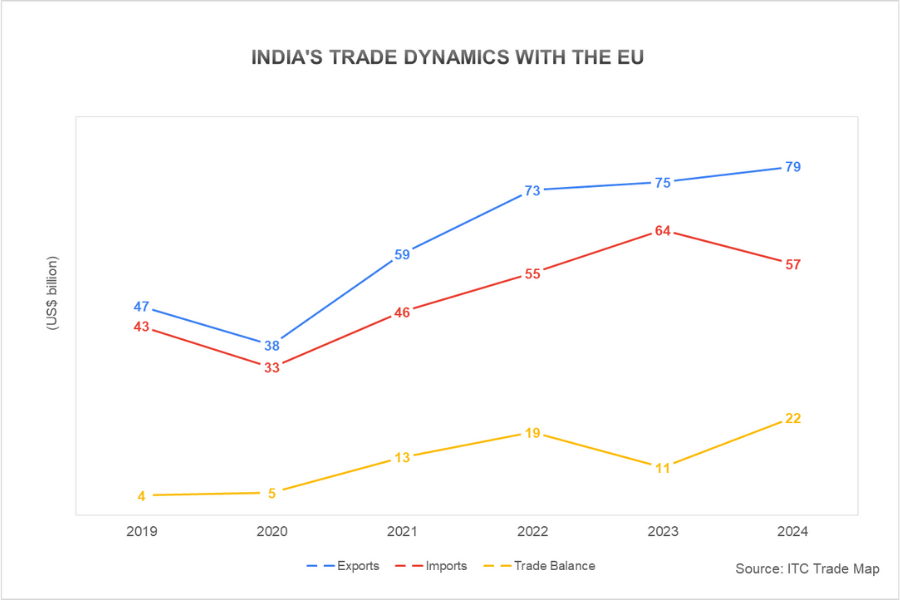
India’s exports to the EU have grown at a robust 5-year CAGR of 10.7%, outpacing the import growth rate of 5.8%, a sign of deepening synergy and India’s rising relevance in European value chains. As the FTA talks advance, the partnership promises not just expanded market access but a blueprint for resilient, sustainable, and forward-looking global trade. With bilateral trade touching US$ 136 billion in 2024, the stage is set for a deeper and more strategic economic partnership.

TPCI’s report titled “The EU Opportunity: India’s next big trade frontier?”, presents a clear and data-backed analysis of India-EU trade relations in light of the ongoing FTA negotiations. It looks at the possible outcomes of the agreement, highlights key areas of interest, and provides practical insights for businesses, policymakers, and other stakeholders in India’s trade sector.

India–EU trade: Moving up the value chain

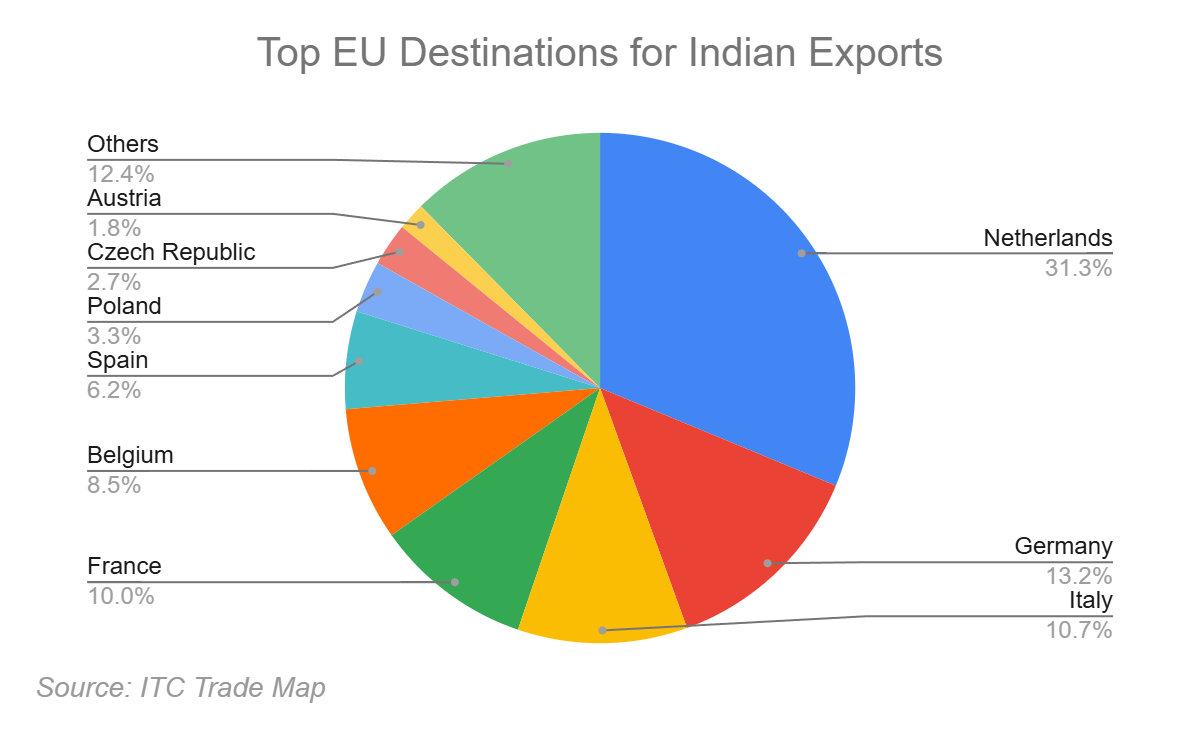
As of 2024, the European Union stands as India’s second-largest trading partner, accounting for nearly 18% of total exports. Within the bloc, the Netherlands, Germany, and Italy feature prominently among India’s top ten global export destinations. The Netherlands leads as India’s largest export market in the EU, followed by Germany and Italy, reflecting deepening trade linkages with core European economies.

In 2024, India’s top 10 export categories at the HS-2 digit level made up around 70% of total exports to the European Union, which stood at US$ 78.8 billion. This highlights both the concentration and strategic importance of key sectors in India-EU trade.
Top markets for India in the EU_TPCI

At the forefront, mineral fuels and oils (HS 27) constitute the largest share, contributing US$ 17.4 billion, or about 22% of exports. This sector demonstrates a strong growth trajectory with a 5-year CAGR of 14.3%, reflecting sustained European demand for energy-related commodities from India.

Electrical machinery and equipment (HS 85) follow closely, with exports worth US$ 11.3 billion and a 5-year CAGR of 6.3%. This signifies India’s growing foothold in the technology and industrial equipment sectors, driven by the EU’s advanced manufacturing ecosystem and demand for electronic components.

Machinery, boilers, and mechanical appliances (HS 84) and organic chemicals (HS 29) also contribute significantly, each accounting for around 6% of total exports to the EU. Their steady growth rates—5-year CAGR > 5%—indicate India’s competitive presence in industrial manufacturing and chemical products within the EU market.

Iron and steel (HS 72), pharmaceutical products (HS 30), and precious metals and stones (HS 71) are notable for their strategic value, representing a combined share of nearly 12% of India’s exports to the EU. These categories exhibit moderate but consistent 5-year CAGRs ranging from 2.9-3.6%.

The automotive sector, including vehicles and parts (HS 87), accounts for 2.9% of exports with a 5-year CAGR of 2.9%, indicating steady trade ties despite a competitive global auto industry.

Textile and apparel exports continue to be important pillars, with knitted (HS 61) and non-knitted apparel (HS 62) collectively making up over 5.6% of exports. Of particular interest is the knitted apparel segment, which exhibits a remarkable 5-year CAGR of 19.5%, signalling shifting consumer preferences within European markets.

A key observation is the high share of the EU in India’s global exports for several sectors. For example, iron and steel exports to the EU represent 38.2% of India’s global exports in this category, while electrical machinery and apparel sectors see EU shares above 27%. This underscores the importance of the EU as a major destination for India’s industrial and consumer goods. Such reliance highlights the need for maintaining strong trade relations and exploring opportunities for diversification to mitigate risks associated with market concentration.

Table 1:  India’s top 10 merchandise exports to the EU (2-Digit HS Code)

HS Code Product Description India’s exports to
the EU
(2024, US$ billion)
5-year CAGR (%)
TOTAL All products 78.8 22.11%
27 Mineral fuels, mineral oils and products of their distillation; bituminous substances; mineral 17.4 14.31%
85 Electrical machinery and equipment and parts thereof; sound recorders and reproducers, television . . . 11.3 6.34%
84 Nuclear reactors, boilers, machinery and mechanical appliances; parts thereof 5 6.30%
29 Organic chemicals 5 5.02%
72 Iron and steel 4 3.62%
30 Pharmaceutical products 2.9 3.37%
71 Natural or cultured pearls, precious or semi-precious stones, precious metals, metals clad . . . 2.7 2.91%
87 Vehicles other than railway or tramway rolling stock, and parts and accessories thereof 2.3 2.87%
62 Articles of apparel and clothing accessories, not knitted or crocheted 2.3 2.80%
61 Articles of apparel and clothing accessories, knitted or crocheted 2.2 19.52%

Source: ITC Trade Map

CATR’s comparative analysis of India’s exports to top destinations including Netherlands, Germany, France, Belgium, and Spain highlights the evolving depth and diversification of India-EU trade relations. The sharp rise in exports of telephone sets and electrical equipment signals India’s growing competitiveness in electronics manufacturing, supported by initiatives like Make in India and enhanced supply chain infrastructure.

Similarly, the steady increase in pharmaceutical products, intermediates, and speciality chemicals reflects India’s expanding capabilities in high-value manufacturing and its potential for closer integration with the EU’s health and chemical sectors. In metals and industrial goods, consistent growth in steel and related products points to strong industrial linkages, particularly in the EU’s automotive, construction, and machinery segments.

Meanwhile, traditional sectors such as diamonds, apparel, footwear, and seafood continue to demonstrate stable demand across these markets, with opportunities for value addition and quality enhancement. Together, these trends underscore India’s readiness to leverage broader market access under a comprehensive Free Trade Agreement with the European Union.

Non-Tariff Measures and Compliance Challenges

While the EU is emerging as one of India’s most promising markets, it is also among the harderst to crack. The EU, while maintaining some of the lowest average tariff rates globally, imposes a wide range of non-tariff measures (NTMs) that significantly impact Indian exporters. These include both technical and non-technical barriers such as standards, certifications, quotas, and subsidies. When these measures become overly complex or lack justification, they act as non-tariff barriers (NTBs).

According to the WTO’s I-TIP Goods Database, Indian exports to the EU are currently subject to 1,196 Technical Barriers to Trade (TBTs), 712 Sanitary and Phytosanitary (SPS) measures, 174 Tariff-Rate Quotas, and a combination of anti-dumping duties (77), countervailing measures (52), quantitative restrictions (15), and special safeguards (54). Beyond these, India faces a new generation of sustainability-linked NTBs.

The Carbon Border Adjustment Mechanism (CBAM) applies a carbon price to emissions-intensive goods like steel and aluminium; the EU Deforestation-Free Regulation (EUDR) restricts imports of products like coffee, rubber, and palm oil unless fully traceable to non-deforested land; and the Packaging and Packaging Waste Regulation (PPWR) mandates limits on single-use plastics and minimum recycled content from 2026. Similarly, the Ecodesign for Sustainable Products Regulation (ESPR) requires a Digital Product Passport (DPP) for goods such as textiles, steel, and furniture, while the Corporate Sustainability Due Diligence Directive (CSDDD) enforces supply chain audits for large companies, indirectly affecting Indian SMEs.

Traditional sectors are also under pressure: the EU has warned of restrictions on Indian animal product exports unless nearly 30 antibiotics are banned in livestock production. Compliance with REACH and RoHS regulations imposes strict chemical and product safety standards across sectors like textiles, electronics, and furniture. Meanwhile, digital exporters face hurdles under the General Data Protection Regulation (GDPR) and Digital Markets Act (DMA), which limit targeted advertising—a practice relied on by 83.5% of Indian MSMEs for acquiring international customers.

Together, these barriers represent a significant compliance burden and cost escalator, reinforcing the need for India to prioritize regulatory preparedness, mutual recognition frameworks, and targeted capacity-building within the ongoing India-EU FTA negotiations.

Key Areas of Negotiations and Strategic Recommendations

The India–EU Free Trade Agreement (FTA), currently targeted for conclusion by the end of 2025, marks a transformative moment in India’s external trade strategy. After years of stalled dialogue, the revived negotiations—now driven by strong political backing and a two-phase approach—offer a strategic pathway to elevate India’s engagement with one of its most significant trading partners. The proposed FTA is not merely about tariff liberalization; it encompasses 23 policy areas, including non-tariff barriers, digital trade, sustainability standards, and investment protection, making it one of India’s most comprehensive trade negotiations to date.

While the EU seeks extensive tariff elimination (95% of its exports), India has pursued calibrated liberalisation (around 90% market access) to balance growth opportunities with domestic sensitivities, especially in sectors like dairy and automobiles. Concurrently, India is also negotiating critical flexibilities—such as quota-based dairy access, phased auto tariff reductions, and mutual recognition of over 150 geographical indications (GIs)—to ensure reciprocal gains.

However, realising the benefits of the FTA will require significant preparatory action. Indian exporters, particularly MSMEs, face persistent challenges in navigating the EU’s complex and evolving regulatory landscape. These include fragmented standards across 27 member states, high costs of testing and certification, and limited awareness of sustainability-linked measures such as CBAM, EUDR, and ESPR. The digital economy adds another layer of complexity, with India’s quest for GDPR data adequacy currently stalled over concerns related to the Digital Personal Data Protection Act, 2023.

To address these barriers, the report recommends a comprehensive set of strategic interventions, some of which are:

  1. Enhancing Regulatory and Sustainability Compliance:
    Indian exporters need to align with EU ESG standards through awareness programs, sector-specific sustainability roadmaps, adoption of clean technologies, and access to green finance to ease the transition.
  2. Tailored Interventions for SMEs and New Exporters:
    Customised support, such as financial aid for CE certification, training on EU procedures, trade fair participation, and the development of regional export hubs, can help SMEs gain EU market access.
  3. Post-FTA Implementation and Monitoring:
    A dedicated facilitation task force, supported by KPIs and public–private dialogue platforms, is essential for monitoring FTA rollout, tracking compliance, and addressing exporter grievances effectively.

In sum, the India–EU FTA has the potential to unlock long-term export growth, deepen India’s presence in global value chains, and position the country as a reliable, sustainable trade partner to the EU. But its success will depend on how effectively India prepares its domestic ecosystem policy, infrastructure, industry, and institutions to engage with one of the world’s most demanding yet rewarding markets.


To view a copy of the report, click here.
Previous Post
Next Post

Most Recent Posts

  • All Post
  • 8th Pay Commission
  • Aadhar
  • Aditya Birla Capital
  • Advertising Standards
  • Affordable Housing
  • Agriculture
  • Agriculture & Food
  • AI in Healthcare
  • AI Technology
  • Airlines
  • alcohol industry
  • Android
  • APEDA
  • Apple
  • Artificial Intelligence
  • Ashwini Vaishnaw
  • Asset Management
  • Atmanirbhar Bharat
  • Audio Devices
  • Audio Products
  • Auto Industry
  • Automobile
  • Automobiles
  • Automotive
  • Automotive Industry
  • Aviation
  • Bain Healthcare Report 2026
  • Bank
  • Banking
  • Banking Technology
  • Battery Industry
  • Beverage Industry
  • Beverages
  • Bihar
  • biotechnology
  • Bitcoin
  • BMW Group India
  • Brand Insight
  • BRICS
  • Bullion Market
  • Business
  • Business & Economy
  • Business & Trade
  • Business Leadership Post COVID-19
  • Business News
  • Business Terminology
  • Business Utilities
  • Buyback
  • Capital Goods
  • Capital Markets
  • CarsBusiness
  • CBIC
  • CCI
  • Child Investment
  • China
  • China technology news
  • Citizen Services
  • Clean Energy
  • Clean Technology
  • Cloud Computing
  • coal
  • Commerce
  • Commerce and Industry
  • Commercial Real Estate
  • Commercial Vehicles
  • Commodities
  • Communications
  • Companies
  • Competition Law
  • Compliance
  • Computer Accessories
  • connected cars
  • Consumer Affairs
  • Consumer Electronics
  • Consumer Finance
  • Consumer Goods
  • Consumer Health
  • Consumer Markets
  • Consumer News
  • Consumer Protection,
  • Consumer Rights
  • Consumer Spending
  • Consumer Trends
  • Content Creation
  • Copper
  • Corporate
  • corporate affairs
  • Corporate Earnings
  • Corporate Governance
  • Corporate News
  • Corporate Social Responsibility
  • Cost of Living
  • Country
  • CRED
  • Credit Cards
  • CREDIT RATING
  • Crude Oil
  • Cryptocurrency
  • CSR
  • Culture
  • Currency
  • Customs Duty
  • Cyber Security
  • Cybersecurity
  • Dairy Industry
  • Data & Analytics
  • Defence
  • Delhi Government
  • Delhi-NCR
  • Demographics
  • Derivatives
  • DGCA
  • DGFT
  • DigiLocker
  • Digital Assets
  • Digital Economy
  • Digital Health India
  • Digital Identity
  • Digital India
  • Digital Infrastructure
  • Digital passport for robots
  • Digital Payments
  • Digital Platforms
  • digital services
  • Diplomacy
  • Dixon Technologies
  • DPIIT
  • E Commerce
  • E-commerce
  • E-Governance
  • Ease of Doing Business
  • Economic Growth
  • Economy
  • Edible Oil Industry
  • Editor Choice
  • EdTech
  • Education
  • Electric Mobility
  • Electric Vehicles
  • Electronics
  • Employment
  • ENERGY
  • Engineering
  • Entertainment
  • Environment
  • EPFO
  • Ethanol Economy
  • EV Industry
  • EV Technology
  • Exports
  • EXTER
  • Farmers
  • Fashion
  • FINANCE
  • Finance Ministry,
  • Financial Marketing
  • Financial Markets
  • Financial News
  • Financial Planning
  • Financial Results
  • Financial Services
  • Fintech
  • FnTech
  • Food & Beverage
  • Food & Beverages
  • Food Exports
  • Food Industry
  • Food Manufacturing
  • Food Processing
  • Food Regulations
  • food safety
  • Foreign Exchange
  • Foreign Investment
  • Foreign Policy
  • Foreign Trade
  • Forex Reserves
  • fssai
  • FTA
  • Fuel
  • Fuel Prices
  • Future Energy
  • Gadgets
  • Gadgets & Apps
  • Gaming
  • GDP
  • Generative AI Healthcare
  • Geopolitics
  • GI Products
  • Global Brand Alliance
  • Global Economy
  • Global Markets
  • Global Politics
  • Global Tech
  • Global Trade Policy
  • Global Trends\
  • Gold
  • Gold Market
  • Gold Prices
  • Gols & Silver
  • Government
  • Government & Policy
  • Government Affairs
  • Government Bonds
  • Government Data
  • Government Initiatives
  • Government Policy
  • Government Policy & Regulation
  • Government Scheme
  • Government Schemes
  • Government Services
  • Green Energy
  • Green Mobility
  • GroupGlobal
  • GST
  • GST Council
  • GST Counsil
  • Hair Care
  • Hardware
  • Hatchback Segment
  • Health Supplements,
  • Horticulture
  • Housing
  • HSBC
  • Human Resources
  • humanoid robot market
  • Hyundai
  • IBT Infographics
  • iinvestment
  • Imports & Exports
  • Income Tax
  • India
  • India Auto Market
  • India Business News
  • India Inc
  • India News
  • India Retail
  • India-Canada Relations
  • India-China
  • India-Japan Relations
  • India-Russia Relations
  • India-South Korea Relations
  • India-US Relations
  • Indian Economy
  • Indian Navy
  • Industrial Pollution
  • Inflation
  • Infra
  • Infrastructure
  • Innovation
  • Instagram
  • Insurance
  • international
  • International Affairs
  • International Cooperation
  • International Relations
  • International Trade
  • Internet & Connectivity
  • Internet Policy
  • Internet Regulation
  • Interview
  • Investing
  • Investment News
  • Investments
  • iPhone News
  • IPO
  • IT Industry
  • Jewellery
  • Jio Platforms
  • JioBlackRock
  • Jobs & Careers
  • Joint Ventures
  • Kim Kardashian
  • Labour
  • Latest
  • Launches
  • Leadership
  • Leaderspeak
  • Lending
  • Lifestyle
  • Lifestyle Tech
  • List
  • Loans & Credit
  • Local News
  • Logistics
  • LPG
  • Luxury Cars
  • Machinery
  • Macroeconomics
  • Macroeconomy
  • maharashtra
  • Maharashtra News
  • Make in India
  • Makhana
  • Manufacturing
  • Market Outlook
  • Markets
  • Maruti Suzuki
  • Mergers & Acquisitions
  • Meta
  • Microsoft
  • Middle East
  • Mobile Apps
  • Mobile Industry
  • Mobile Launch
  • Mobility
  • Monetary Policy
  • Monsoon
  • MoSPI
  • MSME
  • Mutual Funds
  • Nano Tech
  • National
  • National news
  • NEET 2026
  • NewsElectric
  • NewsTata
  • NPCI
  • NPS Vatsalya
  • Office Market
  • Oil & Gas
  • Oil and Gas
  • Others
  • OTT
  • Packaged Drinking Water
  • Packaged Foods
  • Packaging Industry
  • Packaging Innovation
  • Passenger Vehicles
  • Paytm
  • Pension & Retirement
  • Pensions
  • Personal Care
  • Personal Finance
  • Perspectives
  • Petroleum
  • PFRDA
  • Pharmaceuticals
  • PM Modi
  • PMAY-G
  • PMAY-U
  • PMAY,
  • PMI
  • policy
  • Population
  • PORTS
  • Positive News
  • PPF
  • Precious Metals
  • Pricing
  • Product Labeling
  • Product Labelling
  • Product Launch
  • Property Market
  • PSU
  • PSU Banks
  • Public Health
  • Public Policy
  • Public Safety
  • Public Sector
  • Public Services
  • Public Welfare
  • Quarterly Results
  • Railways
  • Rajasthan
  • Raksha Bandhan
  • Raksha Bandhan Gifts
  • Rare Earths
  • RBI
  • Real Estate & Realty Sector
  • Recycling
  • Regulation
  • Regulatory Action
  • Regulatory Affairs
  • Regulatory Updates
  • REIT
  • Reliance Industries
  • Renewable Energy
  • RERA
  • Research
  • Retail
  • Retirement Planning
  • Road Infrastructure
  • Robotics & Automation
  • robotics standards
  • Rupee
  • Rural Development
  • Rural Housing
  • SAIL
  • Salaries
  • Samsung
  • Savings
  • Science & Technology
  • Sebi
  • Security
  • Semiconductor
  • Services Sector,
  • SHIPPING
  • Silver Prices
  • Skill Development
  • Skills Development
  • Small Business
  • Smart Devices
  • Smart Home
  • Smart Mobility
  • Smartphones
  • Social Impact
  • Social Media
  • Society
  • Software Development
  • Solar Energy
  • Space Technology
  • Startups
  • Statistics
  • Steel Industry
  • Stock Market
  • stocks
  • streaming
  • Sugar Industry
  • Sukanya Samriddhi Yojana
  • Sustainability
  • SUV
  • Tamil Nadu Pollution Board
  • Tariffs
  • Tariffs & Duties
  • Tata Group
  • Tata Motors
  • Tata Sons
  • Tax Planning
  • Taxation
  • Tech
  • Tech Branding
  • Technology
  • Telecom & Technology
  • Telecom Industry
  • Top Story
  • Tourism
  • Trade
  • Trade Agreement
  • Trade Basket
  • Trade Partner
  • Trade Policy,
  • Transportation
  • Travel
  • Trending
  • Two-Wheelers
  • UIDAI
  • UPI
  • Urban Development
  • US-Iran Conflict Economic Impact
  • US–India Relations
  • Uttar Pradesh
  • VehiclesLuxury
  • vivo
  • Wastewater Management
  • Water Quality,
  • Wealth Management
  • Wearables
  • Wellness
  • WhatsApp
  • Wheat
  • Workplace
  • World
  • World News
  • Worldview
  • Yamaha
  • zLead Slider
    •   Back
    • Healthcare
    • Auto
    • Fmcg
    • Hospitality
    •   Back
    • Cash Crop
    • Organic
    • New Era Agri
    • Processed Food
    •   Back
    • Construction
    • Power
    • Mining
    • Telecom
    •   Back
    • ENERGY
    •   Back
    • Export/Import
    • Trade Deal
    • Trade Fair
    •   Back
    • Policies
    • Industry
    • Finance
    •   Back
    • Others technology
    • Mobile phone
    • Gadgets
    •   Back
    • Manufacturing
    • Services
    • Startup

India Business & Trade is a national media platform decoding the ideas, decisions and shifts shaping India’s growth story—across plicy, business, global commerce and a rapidly evolving marketplace.

Reach Us

India Business & Trade
M-62, Saket, New Delhi-110064, India

Subscribe To Newsletter

Stay ahead in the dynamic world of trade and commerce with India Business & Trade’s weekly newsletter.

Copyright © 2026 India Business & Trade. All Rights Reserved


Fatal error: Uncaught TypeError: Unsupported operand types: string * int in /var/www/sites/indiabusinesstrade.in/wp-content/plugins/royal-elementor-addons/admin/includes/wpr-templates-modal-popups.php:192 Stack trace: #0 /var/www/sites/indiabusinesstrade.in/wp-content/plugins/royal-elementor-addons/admin/includes/wpr-templates-modal-popups.php(128): WprAddons\Admin\Includes\WPR_Templates_Modal_Popups::get_template_settings() #1 /var/www/sites/indiabusinesstrade.in/wp-content/plugins/royal-elementor-addons/admin/includes/wpr-templates-modal-popups.php(106): WprAddons\Admin\Includes\WPR_Templates_Modal_Popups::render_popup_content() #2 /var/www/sites/indiabusinesstrade.in/wp-content/plugins/royal-elementor-addons/admin/includes/wpr-templates-modal-popups.php(64): WprAddons\Admin\Includes\WPR_Templates_Modal_Popups::display_popups_by_location() #3 /var/www/sites/indiabusinesstrade.in/wp-includes/class-wp-hook.php(341): WprAddons\Admin\Includes\WPR_Templates_Modal_Popups->render_popups() #4 /var/www/sites/indiabusinesstrade.in/wp-includes/class-wp-hook.php(365): WP_Hook->apply_filters() #5 /var/www/sites/indiabusinesstrade.in/wp-includes/plugin.php(522): WP_Hook->do_action() #6 /var/www/sites/indiabusinesstrade.in/wp-includes/general-template.php(3224): do_action() #7 /var/www/sites/indiabusinesstrade.in/wp-content/plugins/royal-elementor-addons/admin/templates/wpr-canvas.php(64): wp_footer() #8 /var/www/sites/indiabusinesstrade.in/wp-includes/template-loader.php(132): include('...') #9 /var/www/sites/indiabusinesstrade.in/wp-blog-header.php(19): require_once('...') #10 /var/www/sites/indiabusinesstrade.in/index.php(17): require('...') #11 {main} thrown in /var/www/sites/indiabusinesstrade.in/wp-content/plugins/royal-elementor-addons/admin/includes/wpr-templates-modal-popups.php on line 192