
Introduction :
Every sporting event, from a local tournament to a global championship is sustained by an invisible architecture of intellectual property rights. Trademarks protects team identities, copyrights govern broadcast transmissions, patents cover equipment innovations, and personality rights shield athlete personas. On the occasion of World IP Day 2026, whose theme is “IP and Sports: Winning with Creativity and Innovation,” it is timely to examine how the intellectual property law underpins the business, culture, and commerce of sport and what this means for India in particular.
The most visible intersection of IP and sport lies in trademark law. Sports teams, leagues, and governing bodies rely heavily on registered trademarks to protect their logos, team names, mascots, and merchandise. The commercial value generated through trademark licensing in sport is enormous. The global licensed sports merchandise market was valued at approximately USD 28 billion in 2023 and continues to grow by leaps and bounds.
In India, the Board of Control for Cricket in India (BCCI) holds registrations for the “BCCI” mark and the Indian cricket team’s logo, enforcing them rigorously against unauthorised merchandise. Similarly, the Indian Premier League (IPL) brand, franchise names, and tournament logos are registered trademarks that form the backbone of a multi-billion rupee commercial ecosystem .
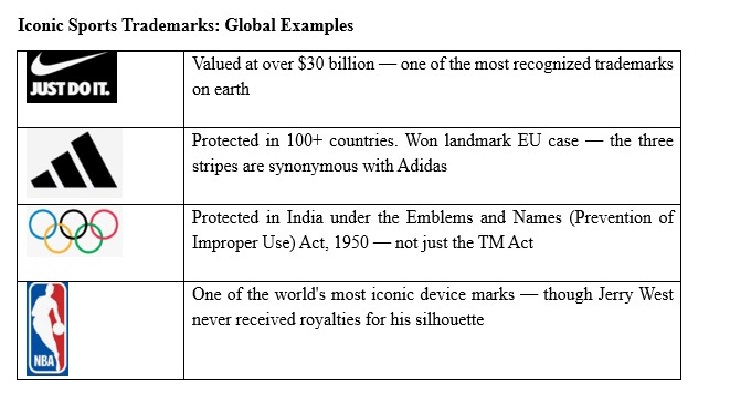
The protection of team colours, jersey designs, and even the distinctive sound marks associated with sporting events are increasingly being brought within the trademark framework globally. The English Premier League, for instance, has obtained trademark protection for its iconic lion logo and the “Premier League” wordmark across dozens of jurisdictions . Similarly, Formula One Management Limited and Formula One Licensing B.V. hold the exclusive commercial rights to the “F1” and “Formula 1” names and logos globally, licensing them to third parties such as PUMA for official merchandise a model that illustrates how a sporting brand can anchor an entire licensing ecosystem.
Trademark protection in Indian sport extends well beyond league logos. The Pro Kabaddi League has registered team names such as “Patna Pirates” and “Bengal Warriors” as trademarks, and accompanied its 2022 logo redesign with fresh filings across fifteen or more trademark classes. The Indian Super League has similarly registered team identities including Mohun Bagan SG and Mumbai City FC to prevent unauthorised merchandise.
Copyright: Broadcasting and Beyond
Broadcast rights represent the single largest revenue stream in professional sports globally. Copyright law is the instrument through which sporting organisations control the transmission, reproduction, and distribution of sporting events. Under the Copyright Act, 1957, cinematograph films which include live broadcasts enjoy copyright protection, giving rights holders the authority to license transmissions to broadcasters and streaming platforms.
The Supreme Court of India addressed broadcast reproduction rights in the landmark decision of ESPN Star Sports v. Global Broadcast News Ltd. , affirming the rights of broadcasters against unauthorised retransmission. More recently, the Hon’ble Delhi High Court granted an injunction restraining rogue websites from illegally streaming IPL matches, recognizing the significant commercial harm caused by piracy to rights holders.
Beyond broadcasts, copyright also protects the creative elements of sport, such as the choreography in figure skating and gymnastics, the musical compositions played at events, and the artistic works embedded in stadium design and sports photography.
Patents: Innovation on the Field
The equipment used in modern sport is the product of significant technological investment, and patents are the primary instrument for protecting those innovations. From aerodynamic swimwear and carbon-fibre bicycle frames to smart tennis rackets equipped with sensors, patents incentivise the research and development that continuously raises the standard of athletic performance.
The World Intellectual Property Organization (WIPO) has noted that patent filings in sports technology have grown steadily over the past decade, with innovations in wearable technology, sports analytics, and performance materials being among the most active areas . Companies such as Adidas, Nike, and Asics hold extensive patent portfolios covering footwear design, sole technology, and performance fabric. A particularly striking example is the Speedo LZR Racer swimsuit, developed in collaboration with NASA and launched at the 2008 Beijing Olympics.
In India, the Patents Act, 1970 provides protection for such innovations, and domestic sporting goods manufacturers, particularly in clusters such as Jalandhar and Meerut, which together supply a significant share of global sports equipment are increasingly recognising the value of patent protection for their product innovations.
Personality Rights and Athlete Image
Athlete image rights, which refers to the right of a sportsperson to control the commercial use of their name, likeness, voice, and persona occupies a distinct and rapidly evolving space in IP law. While there is no dedicated statute governing personality rights in India, Courts have recognised and protected them through a combination of trademark law, copyright law, and the common law tort of passing off.
The Delhi High Court’s decision in Shivaji Rao Gaikwad v. Varsha Productions , affirmed the right of a public figure to restrain the unauthorised commercial use of their identity. In the sporting context, this translates directly to the rights of cricketers, footballers, and athletes to control how their image is used in endorsements, video games, fantasy sports platforms, and merchandise.
Globally, the protection of athlete personality rights has been the subject of significant litigation. The Court of Arbitration for Sport (CAS) and the National courts in the EU and US have developed a substantial body of jurisprudence on the commercialisation and infringement of athlete image rights .
Design Protection: The Aesthetics of Sport
Industrial design protection is an often-overlooked dimension of IP in sport. The distinctive visual appearance of sports equipment, such as the shape of a cricket bat grip, the configuration of a football boot stud, the ornamental design of a trophy can be protected as a registered design under the Designs Act, 2000. Apparel brands invest heavily in the aesthetic design of jerseys, footwear, and accessories, and design registrations provide an important layer of protection against imitation.
In the context of the IPL and other domestic leagues, the distinctive visual identity of franchise jerseys- their colour combinations, graphic patterns, and ornamental features are protectable as industrial designs, supplementing the trademark protection afforded to team logos and wordmarks. Global examples reinforce this point: the iconic Air Jordan and Nike Vaporfly silhouettes are registered as industrial designs in multiple jurisdictions, as are the shapes of trophies such as the IPL trophy and the FIFA World Cup trophy — whose unique artistic forms enjoy design protection independent of the trademark rights subsisting in the tournament name and logo. Cricket helmet shapes, tennis racket frames, ski goggle profiles, and aerodynamic bicycle designs are further illustrations of the breadth of design protection available to the sporting industry.
Emerging Issues: Fantasy Sports, eSports, and the Digital Frontier
The rise of fantasy sports platforms, eSports, and sports-themed non-fungible tokens (NFTs) has opened new and complex questions for IP law. Fantasy sports platforms use player statistics, names, and images, raising questions about the extent to which athletes can control such use.
The Challenge of Counterfeiting in Sports
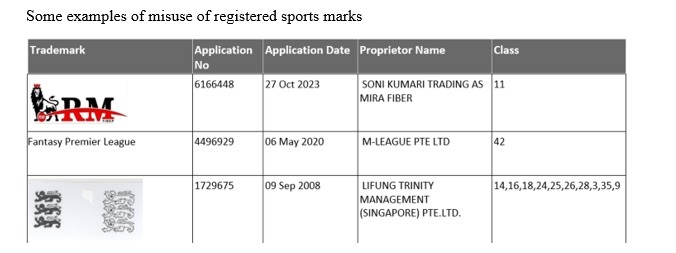
Counterfeiting presents a parallel and equally pressing challenge: the global counterfeit goods market exceeds USD 500 billion annually, and sports merchandise jerseys, shoes, and equipment is among the top five most counterfeited product categories worldwide. In India, fake IPL jerseys flood markets every season, costing teams, sponsors, and the broader economy significant revenue. The Indian legal framework provides remedies through Sections 103–104 of the Trade Marks Act, 1999, Section 29 (which provides civil remedies including damages and permanent injunctions), and the Customs (Intellectual Property Rights) Rules, 2007, which empower customs officials to seize counterfeit goods at ports of entry.
Conclusion
The relationship between intellectual property and sports is not incidental it is structural. IP rights are the legal foundation upon which the business of sports is built, and their effective protection and enforcement determines the commercial viability of teams, leagues, athletes, and the industries that orbit them. As India’s sporting ecosystem continues to grow driven by the expanding reach of cricket, the rise of football, kabaddi, badminton, and athletics, and the global ambitions of Indian sporting brands, the strategic use of IP will be an increasingly decisive factor in determining who wins, not only on the field, but in the marketplace.
World IP Day serves as an important annual reminder that creativity and innovation are not confined to laboratories and studios. They are alive on every pitch, court, and track and they deserve the full protection of the law.
Article is authored by Vikrant Rana, Managing Partner and Shilpi Saurav Sharan, Managing Associate, SS Rana & Co.