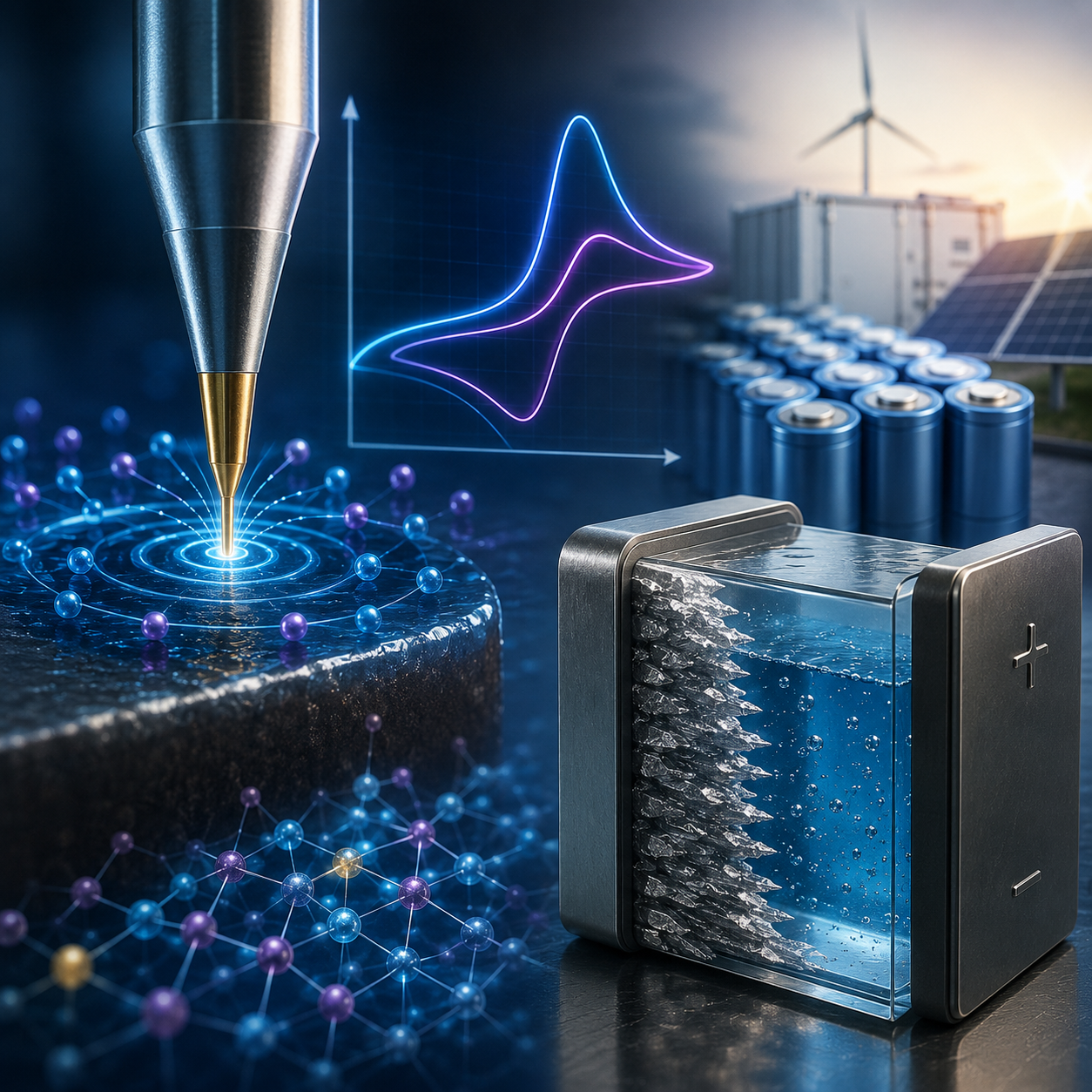
Scientists have uncovered fresh insights into zinc deposition using advanced electrochemical techniques, paving the way for safer, longer-lasting and more affordable rechargeable batteries.
Highlights
- • Researchers combined ultramicroelectrodes (UME) with fast-scan cyclic voltammetry (FSCV) to study zinc deposition.
- • The technique provides a clearer understanding of charge-transfer and mass-transfer processes during battery operation.
- • The findings could improve aqueous zinc-ion batteries (AZIBs) for renewable energy and grid-scale storage.
- • The research was led by Dr. Ramendra Sundar Dey of INST Mohali and published in ACS Electrochemistry.
- • The breakthrough may enhance battery safety, lifespan and overall performance while lowering maintenance costs.
A team of Indian researchers has developed a new approach to better understand how zinc is deposited inside rechargeable batteries, a breakthrough that could help create safer, longer-lasting and more affordable energy storage systems.
The study combines two advanced electrochemical techniques—ultramicroelectrodes (UME) and fast-scan cyclic voltammetry (FSCV)—to closely examine the behaviour of zinc during battery charging and discharging. The research was led by Dr. Ramendra Sundar Dey, Scientist E at the Institute of Nano Science and Technology (INST), Mohali, and has been published in the journal ACS Electrochemistry.
Ultramicroelectrodes are extremely small electrodes, measuring less than 50 micrometres. Because of their tiny size, the movement of ions changes from normal linear diffusion to radial or hemispherical diffusion, allowing scientists to perform experiments at much higher scan rates with greater precision.
The researchers combined this capability with fast-scan cyclic voltammetry, a technique that quickly tracks electrochemical reactions. This enabled them to observe how the charge-transfer process shifts to lower scan rates when special additives are introduced into the battery electrolyte.
Using this combined approach, the team directly investigated the charge-transfer and mass-transfer kinetics at the battery interface. These observations provided new insights into the fundamental mechanisms of zinc deposition, an important process that determines battery efficiency, stability and lifespan.
The findings are particularly significant for aqueous zinc-ion batteries (AZIBs), which are considered one of the most promising alternatives to conventional lithium-ion batteries. Zinc-based batteries are safer, more cost-effective and use abundant raw materials, making them attractive for large-scale energy storage applications.
The research could have a wide range of practical applications, including renewable energy storage, backup power systems and grid-scale electricity storage. A better understanding of zinc deposition can help reduce battery degradation, improve charging performance and extend battery life.
As the world increasingly relies on clean energy sources such as solar and wind power, efficient and reliable battery storage has become essential. This breakthrough offers valuable scientific knowledge that could support the development of next-generation rechargeable batteries capable of delivering higher safety, lower maintenance costs and improved long-term performance.