
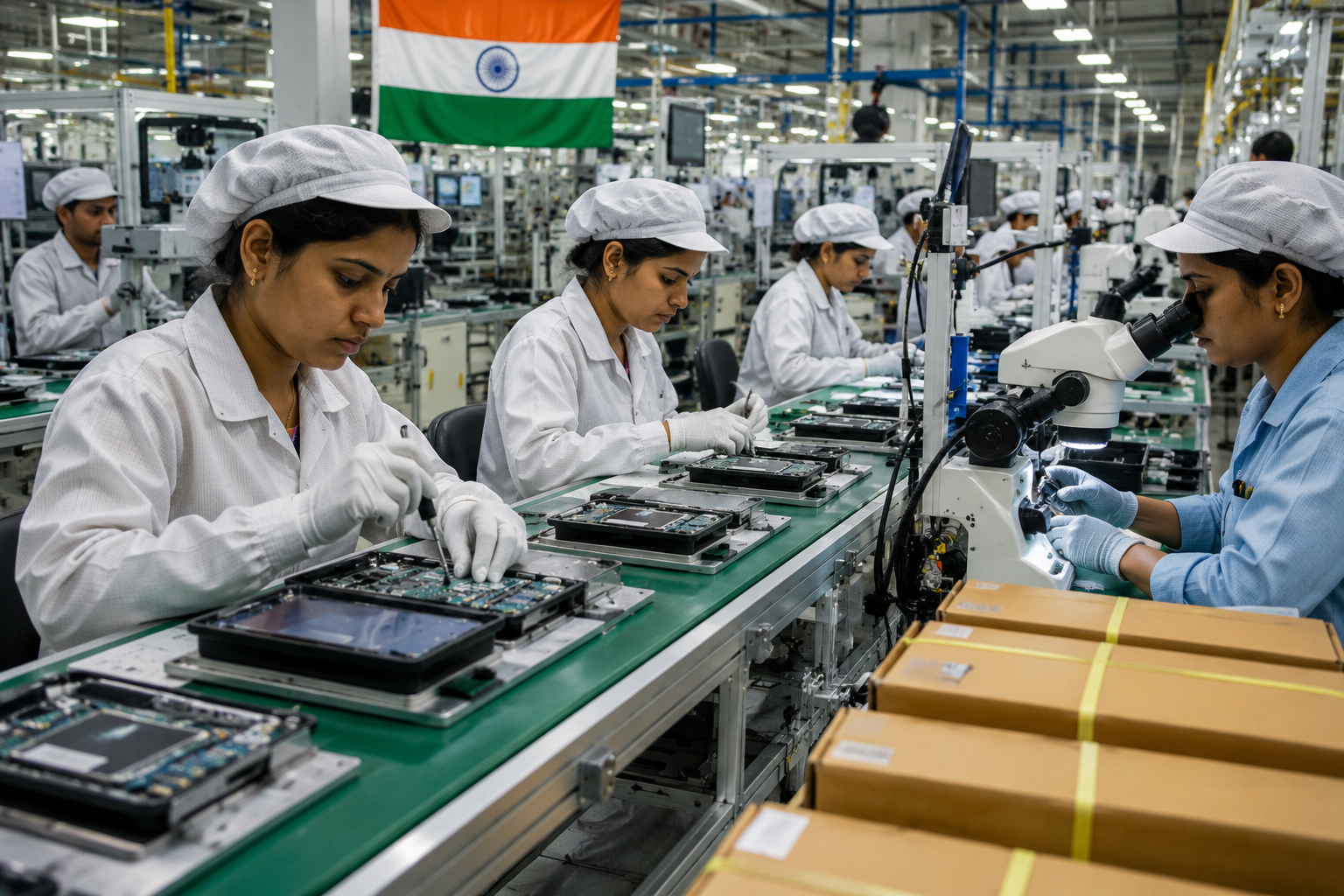
Production, exports and jobs witness record growth
Key Highlights
- Electronics production reached over ₹13.11 lakh crore in FY26.
- Electronics exports crossed ₹4.24 lakh crore, rising 11-fold in 12 years.
- Mobile phone production increased 33 times since FY15.
- India is now the world’s second-largest mobile phone manufacturer.
- Nearly 99.2% of mobile phones sold in India are made domestically.
- Electronics ecosystem supports around 25 lakh direct and indirect jobs.
- Women account for nearly 70% of workers in high-precision mobile manufacturing.
- Government approved 75 projects under the Electronics Component Manufacturing Scheme (ECMS).
- Semicon India Programme has approved 12 semiconductor projects worth ₹1.64 lakh crore.
- PLI schemes continue to boost investment, exports, value addition and employment.
India’s electronics manufacturing industry has emerged as one of the country’s biggest industrial success stories, with Production Linked Incentive (PLI) schemes significantly accelerating domestic production, exports, investment and employment over the past 12 years.
According to information shared in the Lok Sabha by Minister of State for Electronics and Information Technology Jitin Prasada, electronics production in India has increased more than seven-fold—from around ₹1.9 lakh crore in FY2014-15 to over ₹13.11 lakh crore in FY2025-26. During the same period, electronics exports surged eleven-fold to more than ₹4.24 lakh crore, highlighting India’s growing presence in global supply chains.
The mobile manufacturing segment has recorded even stronger growth. Mobile phone production expanded 33 times to ₹6.27 lakh crore, while exports jumped 165 times to approximately ₹2.59 lakh crore. Smartphones have now become India’s largest individual export commodity, overtaking petroleum products and gems & jewellery.
The government credited this transformation to a series of policy initiatives under the Make in India and Atmanirbhar Bharat programmes. These include the PLI Scheme for Large Scale Electronics Manufacturing (LSEM), PLI Scheme 2.0 for IT Hardware, the Electronics Component Manufacturing Scheme (ECMS), the Semicon India Programme, EMC 2.0, SPECS, and liberalised FDI norms allowing 100% foreign investment in the sector.
The PLI Scheme for Large Scale Electronics Manufacturing has significantly outperformed its original targets. Against a five-year investment target of ₹7,000 crore, the scheme has attracted cumulative investments of ₹20,587 crore by March 2026. Cumulative production reached ₹11.61 lakh crore, while exports stood at ₹6.43 lakh crore, both comfortably exceeding initial projections.
India has also become largely self-reliant in mobile manufacturing, with 99.2% of mobile phones sold domestically now being manufactured within the country. The nation has transformed from being a net importer of mobile phones into a major global exporter and is currently the world’s second-largest mobile phone manufacturer by volume.
To deepen the domestic supply chain, the government launched the Electronics Component Manufacturing Scheme (ECMS), which has already approved 75 applications covering 23 product categories. These projects are expected to attract investments of over ₹61,671 crore, generate production worth ₹4.51 lakh crore and create more than 65,000 direct jobs.
The semiconductor ecosystem is also expanding rapidly. Under the Semicon India Programme, 12 semiconductor projects with a combined investment commitment of ₹1.64 lakh crore have been approved, with three already entering commercial production. Building on this progress, the Union Cabinet recently approved Semicon 2.0 with an outlay of ₹1.27 lakh crore to further strengthen India’s chip manufacturing ecosystem.
Employment generation has remained a major outcome of the government’s electronics manufacturing strategy. The sector now supports nearly 25 lakh direct and indirect jobs, while the mobile manufacturing ecosystem alone employs around 12 lakh people. Notably, women comprise nearly 70% of the workforce in several high-precision manufacturing operations, making electronics manufacturing one of India’s fastest-growing sectors for inclusive industrial employment.
The government said continued investments in manufacturing, component production, semiconductors and research are expected to further strengthen India’s position as a trusted global electronics manufacturing hub while increasing domestic value addition and export competitiveness.