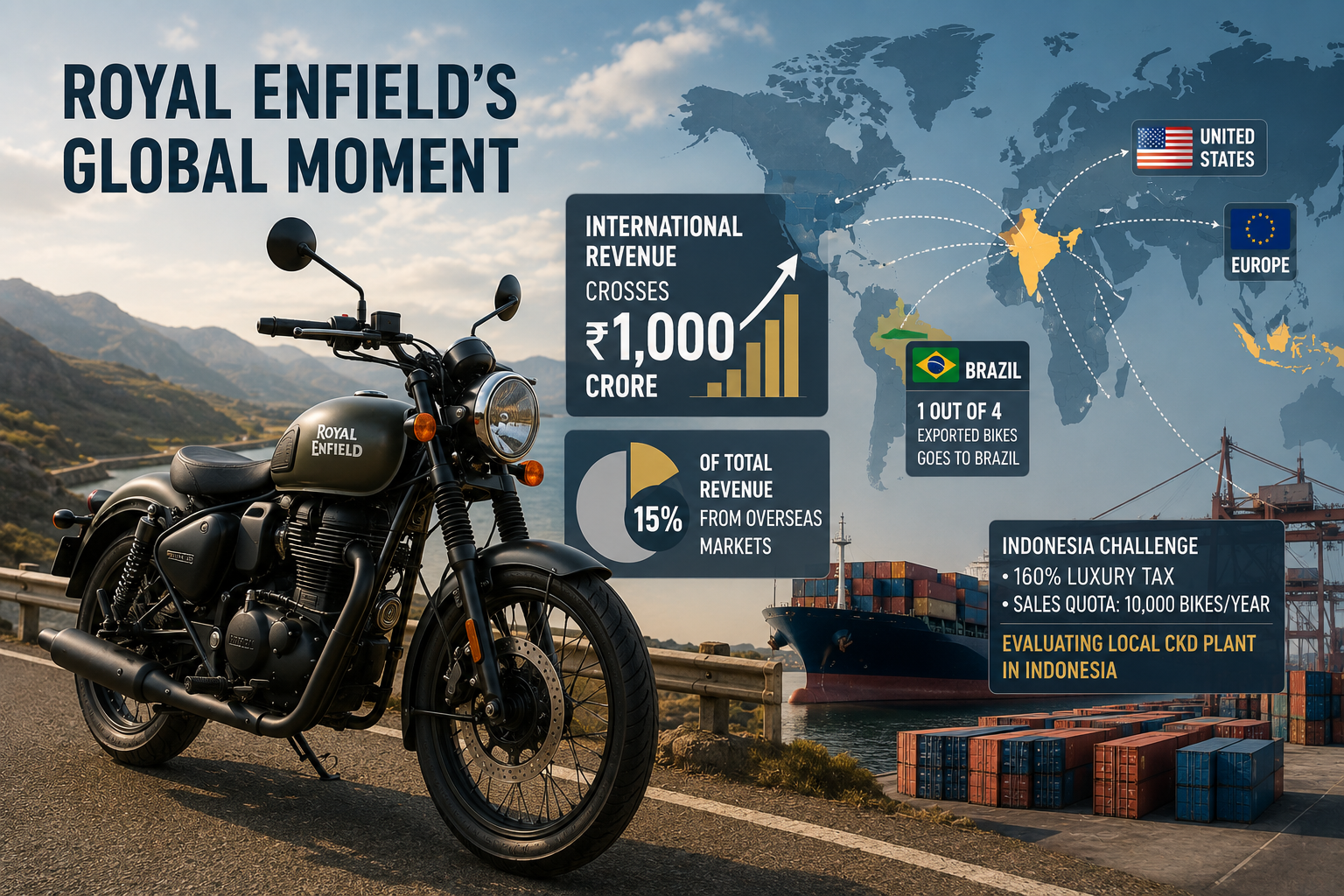
Royal Enfield has posted its best-ever international quarter, with overseas revenue crossing ₹1,000 crore and contributing 15% to total sales. However, a steep luxury tax and sales quota in Indonesia could slow its next phase of expansion.
Highlights
- Royal Enfield’s international revenue crossed ₹1,000 crore for the first time.
- Overseas business now contributes 15% to the company’s total revenue.
- International revenue has doubled over the past two years.
- One in every four exported Royal Enfield motorcycles now goes to Brazil.
- Indonesia’s 160% luxury tax remains a major expansion hurdle.
- The company is evaluating a local CKD assembly facility in Indonesia.
Royal Enfield has achieved a major milestone in its international business, with quarterly overseas revenue crossing ₹1,000 crore for the first time. The global business now contributes around 15% of the company’s total topline, highlighting the growing importance of international markets for the motorcycle maker.
During Eicher Motors’ Q1 FY27 earnings call, Royal Enfield Managing Director B. Govindarajan said the company’s international revenue had doubled over the past two years. Brazil has emerged as one of the strongest markets in this growth story.
Royal Enfield is now the second-largest player in Brazil’s middleweight motorcycle segment. Its retail volumes in the country have tripled over the past three years, and nearly one out of every four motorcycles exported by the company is shipped to Brazil.
To support further expansion, Royal Enfield is setting up its own completely knocked down, or CKD, facility in Brazil. This will allow motorcycles to be assembled locally and could help the company improve pricing, supply and market reach.
The brand is also witnessing strong momentum in other Latin American markets. Colombia is driving growth, while Royal Enfield holds the second position in Argentina’s middleweight segment. It is also building its presence in Mexico.
In the United States, demand remains slow, though the company is seeing early signs of recovery after a new trade agreement reduced tariffs on motorcycles.
Europe continues to remain under pressure due to weaker dealer and distributor conditions. However, Royal Enfield is strengthening its own distribution network and Riders Club, which has crossed 42,000 members.
Indonesia, however, remains a major challenge. Royal Enfield had expected its Thailand CKD facility to provide duty-free access to Indonesia under an ASEAN trade agreement. But Indonesia has retained a quota limiting sales to 10,000 vehicles annually.
The company has now identified a local assembly partner and is evaluating the possibility of setting up a CKD plant within Indonesia. A decision is expected during the current quarter.
The biggest obstacle is Indonesia’s luxury tax of around 160% on motorcycles above 250cc. The tax applies whether the motorcycles are imported as fully built units or assembled through CKD kits, making Royal Enfield’s products significantly more expensive.
Despite these hurdles, Royal Enfield continues to expand its global footprint and strengthen its position in key international motorcycle markets.