
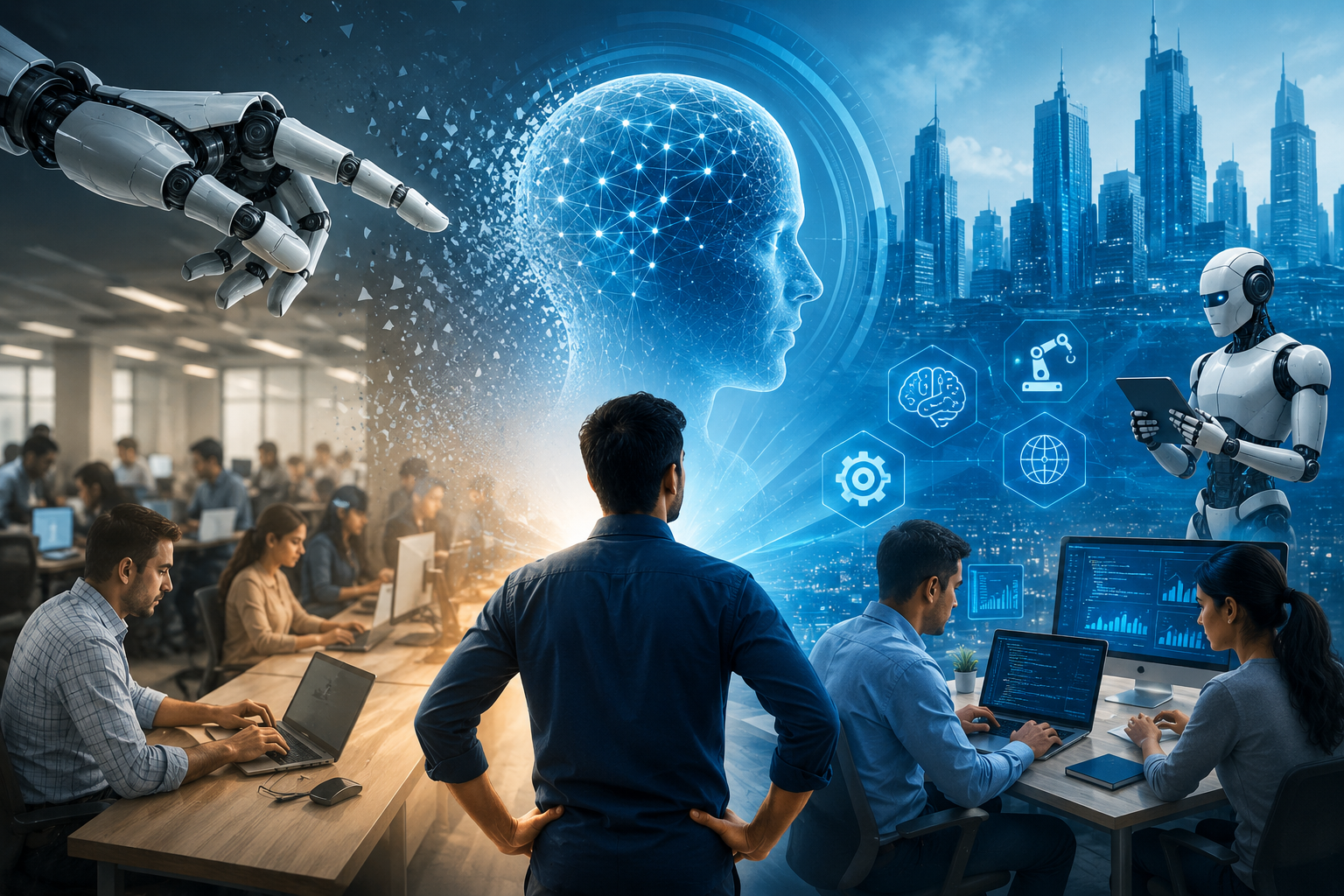
Artificial intelligence is changing how companies hire and what skills they expect from employees.
Routine roles face greater automation pressure, while AI-related and specialised jobs could create new opportunities.
Highlights
- AI is rapidly changing the nature of jobs across industries.
- Routine and repetitive work faces a higher risk of automation.
- Technology may transform many existing jobs rather than eliminate them completely.
- Demand could rise for workers with AI, data and digital skills.
- Employees will increasingly need to reskill and upskill to remain competitive.
- Human capabilities such as creativity, judgement and communication will continue to matter.
New Delhi: Artificial intelligence is emerging as one of the biggest forces reshaping the employment market, creating concerns over job losses while simultaneously opening opportunities for workers equipped with new-age skills.
As companies increasingly adopt AI tools to automate routine activities, the nature of several existing jobs is expected to change. Employees whose work involves repetitive processes, basic data handling or tasks that can easily be automated could face greater pressure.
However, the impact of AI is unlikely to be limited to replacing workers. In many industries, technology could instead change the way people perform their jobs, with AI taking over repetitive tasks while employees focus on work requiring judgement, creativity, problem-solving and human interaction.
This transition is also expected to generate demand for new skills. Companies adopting artificial intelligence will need professionals capable of developing, operating, monitoring and effectively using AI systems. Opportunities could consequently increase in areas such as AI, data analytics, cybersecurity, cloud computing and other digital technologies.
For Indian employees, reskilling and upskilling could become increasingly important. Workers who learn how to use AI tools alongside their existing domain expertise may be better positioned than those who treat artificial intelligence purely as a replacement threat.
The impact will also vary across industries and occupations. Jobs involving predictable and repetitive activities are generally easier to automate, while professions requiring complex decision-making, interpersonal communication and specialised expertise are more difficult to replace entirely.
Companies themselves will have to manage this transition carefully. Simply adopting AI technology will not be enough; businesses will also need employees capable of using these systems effectively and responsibly.
For India’s large young workforce, the AI transition presents both a challenge and an opportunity. Educational institutions, companies and workers will need to respond quickly as the skills demanded by employers evolve.
The key question, therefore, may not simply be whether AI will take away jobs. Instead, the bigger issue will be how quickly existing jobs change and whether workers can acquire the skills needed for the new employment landscape.