Govt Plans New Rural Growth Strategy
Key Highlights
- Union Minister Shivraj Singh Chouhan will administer a pledge to agriculture and rural development officials on August 18.
- The programme will be held at the Pusa complex in New Delhi.
- Officials, farmers, Lakhpati Didis, exporters and food processors will participate.
- Discussions will focus on departmental roadmaps and farmer and rural welfare.
- Expansion of the Lakhpati Didi scheme is expected to be a major focus.
- Three crore rural women have already achieved Lakhpati Didi status against the government’s six-crore target.
- The agriculture roadmap will align with the government’s Viksit Bharat 2047 vision.
- The Shakti ki Sapt Dhara framework prioritises agriculture, food production, food processing and global market access.
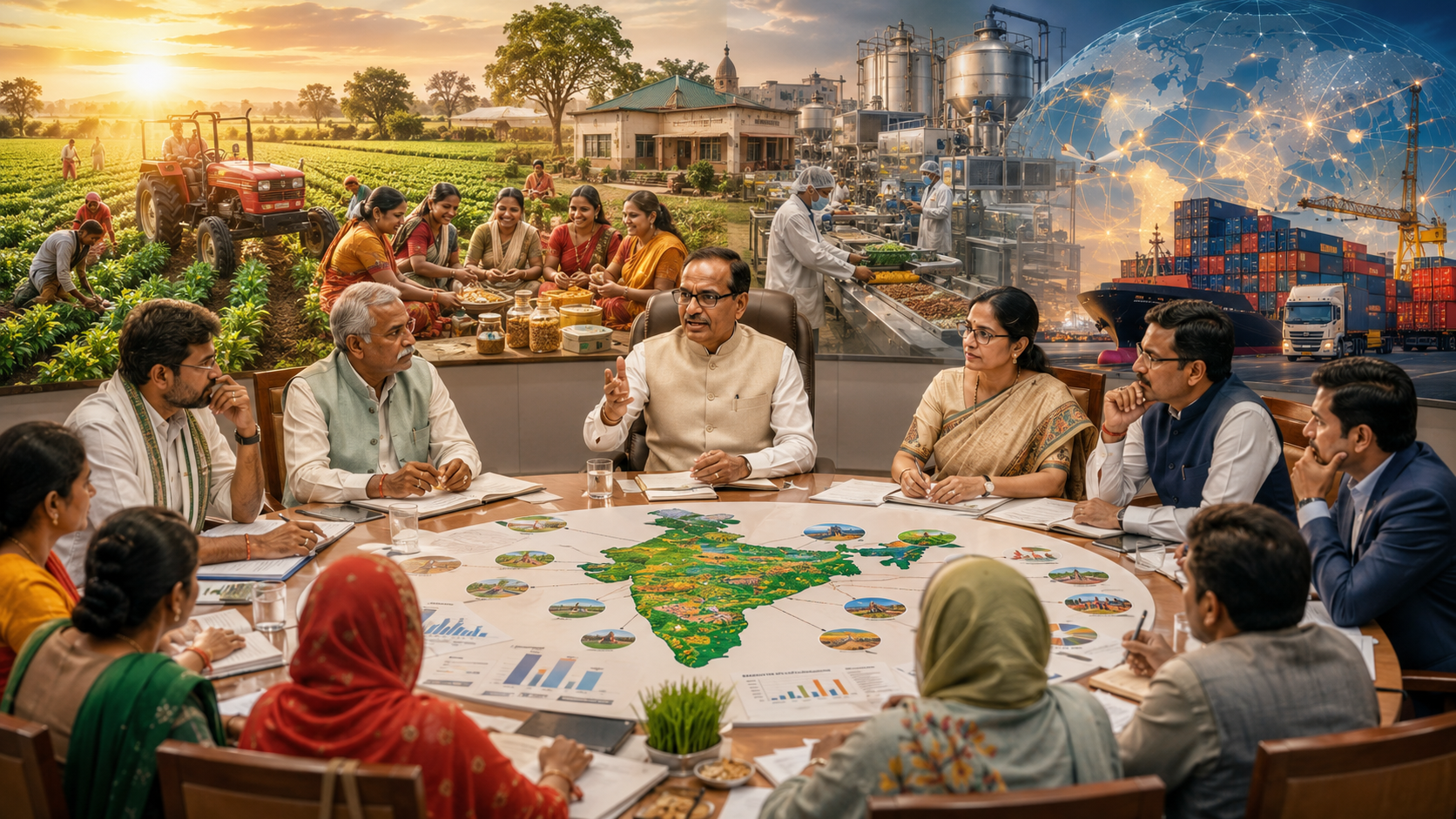
New Delhi, August 17: Union Minister for Agriculture and Farmers Welfare and Rural Development Shivraj Singh Chouhan will lead a high-level discussion on India’s agriculture and rural development roadmap on August 18, as the government moves to translate Prime Minister Narendra Modi’s “Shakti ki Sapt Dhara” framework into an action plan.
The programme will be held at the Pusa complex in New Delhi and will bring together officials and staff from the agriculture and rural development ministries along with farmers, Lakhpati Didis, exporters and food processors.
Agriculture Roadmap In Focus
The discussions will focus on departmental roadmaps and strategies for strengthening India’s agriculture and rural economy.
The government intends to align these plans with its broader Viksit Bharat 2047 vision, with emphasis on improving outcomes for farmers and rural communities.
Chouhan is expected to discuss decisions related to farmer welfare, rural development and the expansion of programmes aimed at improving livelihoods.
The initiative is part of the government’s effort to translate the seven-pronged framework announced by Prime Minister Modi into concrete programmes and measurable action.
Shakti Ki Sapt Dhara
The Shakti ki Sapt Dhara framework was announced by Prime Minister Narendra Modi during his Independence Day address from the Red Fort.
The framework identifies seven broad areas that India needs to strengthen over the coming years.
For agriculture and rural India, the priorities include strengthening agricultural production, expanding food processing and improving farmers’ access to global markets.
The government sees these areas as important for raising rural incomes, creating employment and making Indian agriculture more competitive internationally.
Lakhpati Didi Expansion
The Lakhpati Didi scheme is expected to be one of the key subjects of discussion during the programme.
Prime Minister Modi has set a target of creating six crore Lakhpati Didis, referring to rural women earning at least ₹1 lakh annually.
According to the agriculture ministry, around three crore rural women have already achieved Lakhpati Didi status.
Chouhan is expected to discuss a framework for scaling up the programme and helping more women in Self-Help Groups increase their household incomes.
The scheme provides women with skill development opportunities and financial support to help them build sustainable livelihoods.
Focus On Farmers And Rural Women
The government is seeking to place people-centric programmes at the centre of its rural development strategy.
Chouhan said the Shakti ki Sapt Dhara framework would be shaped through transparent monitoring, stronger implementation and programmes designed to deliver direct benefits to farmers and rural women.
The approach aims to connect government schemes with measurable improvements in income, productivity and economic opportunities.
Food Processing And Exports
Expanding India’s food-processing capabilities will also form an important part of the agriculture strategy.
The government wants to move beyond primary agricultural production and increase the value generated from farm output through processing and other downstream activities.
Improving export opportunities is another key priority.
The framework seeks to help Indian farmers access international markets while strengthening India’s position as a reliable supplier of agricultural and processed food products.
Fertiliser Security Remains Priority
The agriculture strategy also comes against the backdrop of global disruptions affecting fertiliser supplies.
Prime Minister Modi has reaffirmed the government’s commitment to keeping fertilisers available to farmers at subsidised prices despite international supply challenges.
The government has also highlighted efforts over the past decade to strengthen India’s self-reliance in fertilisers and fuel.
Maintaining affordable agricultural inputs will therefore remain an important component of the broader farmer-welfare strategy.
Roadmap For Viksit Bharat
The August 18 programme is expected to provide a platform for bringing together policymakers, farmers, rural women, exporters and food processors to discuss the next phase of India’s agricultural development.
By combining agricultural production, food processing, exports and rural livelihood programmes, the government aims to create a more integrated rural growth strategy.
The roadmap will ultimately be linked to the larger Viksit Bharat 2047 objective, with agriculture and rural development positioned as key pillars of India’s long-term economic transformation.