Flex-fuel vehicles in India: Market growth, challenges & roadmap

India’s automobile sector is gearing up for a transformative shift, with flex-fuel vehicles (FFVs) positioned as a practical bridge between petrol engines and cleaner alternatives. Backed by the government’s ambitious E20 blending target by 2025, the market is projected to touch US$ 855.77 billion, growing at a robust pace. Drawing lessons from Brazil and the US, India’s success will depend on scaling ethanol production, ensuring vehicle compatibility, upgrading fuel infrastructure, and winning consumer trust. If these elements align, FFVs could not only cut emissions and reduce fuel costs but also redefine the future of sustainable mobility in India.
flex fuel_tpci

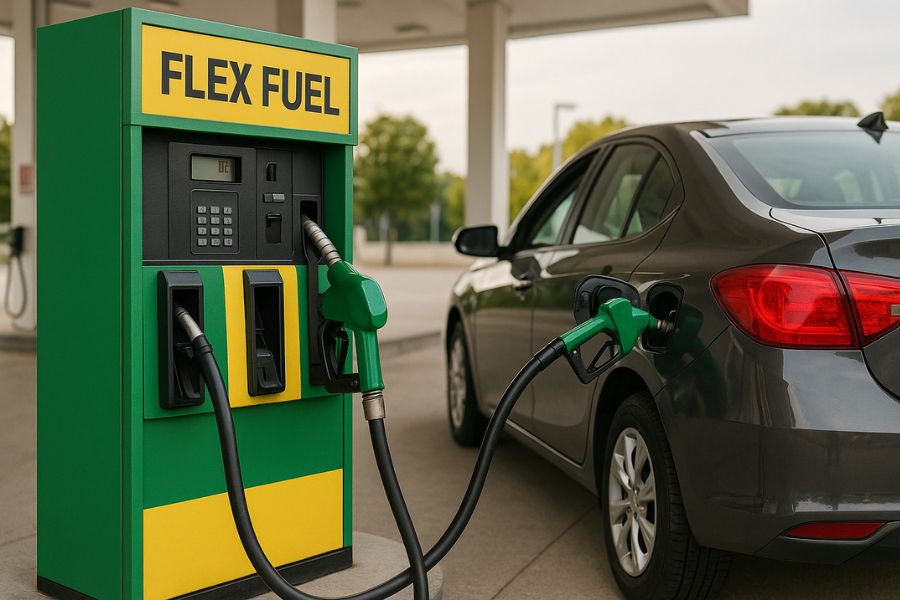
The automobile industry is entering a decisive phase where sustainability is shaping future mobility. Among the key innovations, flex-fuel vehicles (FFVs) have emerged as a practical bridge between conventional petrol engines and greener alternatives. Unlike traditional vehicles, FFVs can run on varying blends of petrol and ethanol—ranging from E10 (10% ethanol, 90% petrol) to E85 (85% ethanol, 15% petrol). This flexibility makes them a strong contender in India’s transition to low-emission transport.

Globally, flex-fuel technology has already proven successful. Brazil leads the way, with 94% of new cars being FFVs, supported by strong agri-tech and ethanol supply chains. The United States, too, has made significant progress through policy incentives and low-cost enzyme technologies. Drawing lessons from these models, India is accelerating its ethanol blending program, targeting 20% ethanol blending (E20) by 2025, with FFVs expected to play a crucial role in meeting this goal.

India’s flex-fuel vehicle (FFV) market is projected to be worth US$ 855.77 billion in 2025, expanding at a healthy CAGR of 15% between 2025 and 2030. Demand is set to rise sharply in key urban hubs such as Delhi, Mumbai, Bangalore, and Hyderabad, driven by a mix of policy incentives, technology advancements, and the urgency to curb emissions.
share of flex fuel _tpci

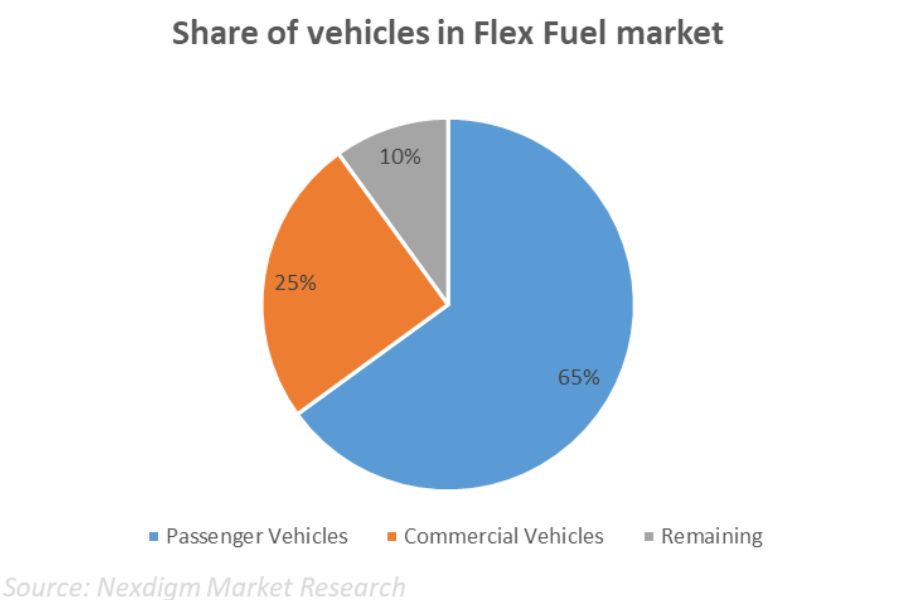
Passenger vehicles hold the lion’s share of this market, commanding about 65% of its value, followed by commercial vehicles at 25%, with the remaining 10% spread across other segments. In terms of fuel mix, the market is composed of 70% ethanol, 20% methanol, and 10% gasoline.

Automotive leaders like Tata Motors, Mahindra & Mahindra, Maruti Suzuki, and Hyundai are already making bold moves, investing in research and development to introduce models tailored for India’s ethanol-blending roadmap. With the government advancing its goal of 20% ethanol blending (E20) by the end of 2025, the next five years will determine how quickly India can align its vehicle ecosystem with this target.

Growth drivers

One of the strongest growth drivers for the market is environmental awareness. Ethanol produces significantly fewer carbon dioxide, nitrogen oxides, and sulphur oxides compared to petrol. According to NITI Aayog, sugarcane-based ethanol can reduce greenhouse gas emissions by up to 65%. This aligns with India’s broader climate commitments and its ambition to cut oil imports.

Cost advantage is another factor tilting the balance. Ethanol is generally 20–50% cheaper than petrol, offering immediate financial relief for price-sensitive consumers.

The development of advanced engine technologies is also accelerating adoption. New systems with corrosion-resistant materials, high-precision sensors, and optimized injection mechanisms are making ethanol compatibility more viable and reducing concerns about long-term wear and tear.

Experts point out that India can draw lessons from global leaders in this space. As Dr. Saleem remarked, “India can work following Brazil’s model, where 94% of new cars are FFVs. India can invest in FFV vehicles as we move towards higher ethanol blends.” Brazil’s success rests on strong agri-tech support, robust fuel distribution infrastructure, and policies mandating vehicle compatibility. The United States has also advanced with low-cost enzyme technology and supportive biofuel policy, demonstrating how innovation and regulation together can scale flex-fuel adoption.

India’s journey, however, is not without challenges. A key concern is vehicle compatibility. As Dr. Sanjukta Subudhi highlighted, “Vehicle compatibility is a major hurdle. Most existing vehicles are designed for E10 and are not fully compatible with E20. To bridge this gap, manufacturers like Maruti Suzuki, Tata Motors, and Hyundai are developing flex-fuel vehicles (FFVs) that can run on higher ethanol blends, with Maruti planning E20-compatible launches in 2025. Wider E20 adoption will also require an extensive rollout of compatible fuel across retail outlets and infrastructure upgrades in storage and dispensing systems. Ethanol’s chemical properties demand careful handling and robust quality control to ensure performance and safety.”

This indicates that India’s transition to E20 and beyond will require coordinated action, not just from automakers, but across fuel retailing, storage, and quality control domains. Without parallel infrastructure upgrades, vehicles built for higher ethanol blends may face performance issues, undermining consumer trust.

The question of readiness extends beyond vehicles and fuel stations. DS Mahal stressed the importance of systemic upgrades, noting that “India’s fleet compatibility is still below 5%, and depot readiness for E20/E30 needs major upgrades. India must now align vehicle policies (mandating E20 compatibility for all new petrol cars from April 2026), upgrade over 2,000 fuel depots and 30,000 tankers to E20 standards, and introduce pricing incentives (₹1.5–2.0/litre) to encourage consumer adoption.” Such measures are vital to ensure that flex-fuel vehicles are not just manufactured, but also supported by the supply chain and embraced by the market.

Another challenge lies in consumer perception and awareness. Many Indian car owners remain skeptical about ethanol’s effect on fuel efficiency and engine longevity. Studies indicate that E20 fuel may reduce efficiency by 2–5%, though technological improvements are expected to mitigate this over time. Automakers, policymakers, and fuel distributors must work together to communicate the benefits, clarify misconceptions, and assure consumers of long-term safety.

While obstacles exist, the momentum is undeniable. India’s ethanol production capacity is expanding rapidly, supported by surplus crops such as sugarcane and rice. Recently, the government redirected record rice stocks into ethanol production, underscoring how the biofuel push also provides an outlet for agricultural surplus while generating rural income. States like Gujarat are pioneering ethanol and compressed biogas (CBG) ventures, reinforcing the link between renewable fuels, rural entrepreneurship, and national energy security.

The future of India’s flex-fuel vehicle market will depend on how well the country harmonises technology, agriculture, energy policy, and consumer adoption. With major OEMs committing to ethanol-ready vehicles, a supportive policy framework, and growing infrastructure investment, India is positioning itself to follow in the footsteps of Brazil and the US. But unlike those countries, India must balance this transition with unique domestic challenges—such as infrastructure gaps, competing demands on crops, and high consumer price sensitivity.

What is clear is that compliance with blending targets alone will not secure success. For flex-fuel vehicles to take root, the entire ecosystem—vehicles, fuel infrastructure, pricing policy, and consumer trust—must evolve together. If these align, the flex-fuel revolution could emerge not just as an environmental solution, but as a defining chapter in India’s mobility future.

Previous Post
Next Post

Most Recent Posts

  • All Post
  • 8th Pay Commission
  • Aadhar
  • Aditya Birla Capital
  • Advertising Standards
  • Affordable Housing
  • Agriculture
  • Agriculture & Food
  • AI in Healthcare
  • AI Technology
  • Airlines
  • alcohol industry
  • Android
  • APEDA
  • Apple
  • Artificial Intelligence
  • Ashwini Vaishnaw
  • Asset Management
  • Atmanirbhar Bharat
  • Audio Devices
  • Audio Products
  • Auto Industry
  • Automobile
  • Automobiles
  • Automotive
  • Automotive Industry
  • Aviation
  • Bain Healthcare Report 2026
  • Bank
  • Banking
  • Banking Technology
  • Battery Industry
  • Beverage Industry
  • Beverages
  • Bihar
  • biotechnology
  • Bitcoin
  • BMW Group India
  • Brand Insight
  • BRICS
  • Bullion Market
  • Business
  • Business & Economy
  • Business & Trade
  • Business Leadership Post COVID-19
  • Business News
  • Business Terminology
  • Business Utilities
  • Buyback
  • Capital Goods
  • Capital Markets
  • CarsBusiness
  • CBIC
  • CCI
  • Child Investment
  • China
  • China technology news
  • Citizen Services
  • Clean Energy
  • Clean Technology
  • Cloud Computing
  • coal
  • Commerce
  • Commerce and Industry
  • Commercial Real Estate
  • Commercial Vehicles
  • Commodities
  • Communications
  • Companies
  • Competition Law
  • Compliance
  • Computer Accessories
  • connected cars
  • Consumer Affairs
  • Consumer Electronics
  • Consumer Finance
  • Consumer Goods
  • Consumer Health
  • Consumer Markets
  • Consumer News
  • Consumer Protection,
  • Consumer Rights
  • Consumer Spending
  • Consumer Trends
  • Content Creation
  • Copper
  • Corporate
  • corporate affairs
  • Corporate Earnings
  • Corporate Governance
  • Corporate News
  • Corporate Social Responsibility
  • Cost of Living
  • Country
  • CRED
  • Credit Cards
  • CREDIT RATING
  • Crude Oil
  • Cryptocurrency
  • CSR
  • Culture
  • Currency
  • Customs Duty
  • Cyber Security
  • Cybersecurity
  • Dairy Industry
  • Data & Analytics
  • Defence
  • Delhi Government
  • Delhi-NCR
  • Demographics
  • Derivatives
  • DGCA
  • DGFT
  • DigiLocker
  • Digital Assets
  • Digital Economy
  • Digital Health India
  • Digital Identity
  • Digital India
  • Digital Infrastructure
  • Digital passport for robots
  • Digital Payments
  • Digital Platforms
  • digital services
  • Diplomacy
  • Dixon Technologies
  • DPIIT
  • E Commerce
  • E-commerce
  • E-Governance
  • Ease of Doing Business
  • Economic Growth
  • Economy
  • Edible Oil Industry
  • Editor Choice
  • EdTech
  • Education
  • Electric Mobility
  • Electric Vehicles
  • Electronics
  • Employment
  • ENERGY
  • Engineering
  • Entertainment
  • Environment
  • EPFO
  • Ethanol Economy
  • EV Industry
  • EV Technology
  • Exports
  • EXTER
  • Farmers
  • Fashion
  • FINANCE
  • Finance Ministry,
  • Financial Marketing
  • Financial Markets
  • Financial News
  • Financial Planning
  • Financial Results
  • Financial Services
  • Fintech
  • FnTech
  • Food & Beverage
  • Food & Beverages
  • Food Exports
  • Food Industry
  • Food Manufacturing
  • Food Processing
  • Food Regulations
  • food safety
  • Foreign Exchange
  • Foreign Investment
  • Foreign Policy
  • Foreign Trade
  • Forex Reserves
  • fssai
  • FTA
  • Fuel
  • Fuel Prices
  • Future Energy
  • Gadgets
  • Gadgets & Apps
  • Gaming
  • GDP
  • Generative AI Healthcare
  • Geopolitics
  • GI Products
  • Global Brand Alliance
  • Global Economy
  • Global Markets
  • Global Politics
  • Global Tech
  • Global Trade Policy
  • Global Trends\
  • Gold
  • Gold Market
  • Gold Prices
  • Gols & Silver
  • Government
  • Government & Policy
  • Government Affairs
  • Government Bonds
  • Government Data
  • Government Initiatives
  • Government Policy
  • Government Policy & Regulation
  • Government Scheme
  • Government Schemes
  • Government Services
  • Green Energy
  • Green Mobility
  • GroupGlobal
  • GST
  • GST Council
  • GST Counsil
  • Hair Care
  • Hardware
  • Hatchback Segment
  • Health Supplements,
  • Horticulture
  • Housing
  • HSBC
  • Human Resources
  • humanoid robot market
  • Hyundai
  • IBT Infographics
  • iinvestment
  • Imports & Exports
  • Income Tax
  • India
  • India Auto Market
  • India Business News
  • India Inc
  • India News
  • India Retail
  • India-Canada Relations
  • India-China
  • India-Japan Relations
  • India-Russia Relations
  • India-South Korea Relations
  • India-US Relations
  • Indian Economy
  • Indian Navy
  • Industrial Pollution
  • Inflation
  • Infra
  • Infrastructure
  • Innovation
  • Instagram
  • Insurance
  • international
  • International Affairs
  • International Cooperation
  • International Relations
  • International Trade
  • Internet & Connectivity
  • Internet Policy
  • Internet Regulation
  • Interview
  • Investing
  • Investment News
  • Investments
  • iPhone News
  • IPO
  • IT Industry
  • Jewellery
  • Jio Platforms
  • JioBlackRock
  • Jobs & Careers
  • Joint Ventures
  • Kim Kardashian
  • Labour
  • Latest
  • Launches
  • Leadership
  • Leaderspeak
  • Lending
  • Lifestyle
  • Lifestyle Tech
  • List
  • Loans & Credit
  • Local News
  • Logistics
  • LPG
  • Luxury Cars
  • Machinery
  • Macroeconomics
  • Macroeconomy
  • maharashtra
  • Maharashtra News
  • Make in India
  • Makhana
  • Manufacturing
  • Market Outlook
  • Markets
  • Maruti Suzuki
  • Mergers & Acquisitions
  • Meta
  • Microsoft
  • Middle East
  • Mobile Apps
  • Mobile Industry
  • Mobile Launch
  • Mobility
  • Monetary Policy
  • Monsoon
  • MoSPI
  • MSME
  • Mutual Funds
  • Nano Tech
  • National
  • National news
  • NEET 2026
  • NewsElectric
  • NewsTata
  • NPCI
  • NPS Vatsalya
  • Office Market
  • Oil & Gas
  • Oil and Gas
  • Others
  • OTT
  • Packaged Drinking Water
  • Packaged Foods
  • Packaging Industry
  • Packaging Innovation
  • Passenger Vehicles
  • Paytm
  • Pension & Retirement
  • Pensions
  • Personal Care
  • Personal Finance
  • Perspectives
  • Petroleum
  • PFRDA
  • Pharmaceuticals
  • PM Modi
  • PMAY-G
  • PMAY-U
  • PMAY,
  • PMI
  • policy
  • Population
  • PORTS
  • Positive News
  • PPF
  • Precious Metals
  • Pricing
  • Product Labeling
  • Product Labelling
  • Product Launch
  • Property Market
  • PSU
  • PSU Banks
  • Public Health
  • Public Policy
  • Public Safety
  • Public Sector
  • Public Services
  • Public Welfare
  • Quarterly Results
  • Railways
  • Rajasthan
  • Raksha Bandhan
  • Raksha Bandhan Gifts
  • Rare Earths
  • RBI
  • Real Estate & Realty Sector
  • Recycling
  • Regulation
  • Regulatory Action
  • Regulatory Affairs
  • Regulatory Updates
  • REIT
  • Reliance Industries
  • Renewable Energy
  • RERA
  • Research
  • Retail
  • Retirement Planning
  • Road Infrastructure
  • Robotics & Automation
  • robotics standards
  • Rupee
  • Rural Development
  • Rural Housing
  • SAIL
  • Salaries
  • Samsung
  • Savings
  • Science & Technology
  • Sebi
  • Security
  • Semiconductor
  • Services Sector,
  • SHIPPING
  • Silver Prices
  • Skill Development
  • Skills Development
  • Small Business
  • Smart Devices
  • Smart Home
  • Smart Mobility
  • Smartphones
  • Social Impact
  • Social Media
  • Society
  • Software Development
  • Solar Energy
  • Space Technology
  • Startups
  • Statistics
  • Steel Industry
  • Stock Market
  • stocks
  • streaming
  • Sugar Industry
  • Sukanya Samriddhi Yojana
  • Sustainability
  • SUV
  • Tamil Nadu Pollution Board
  • Tariffs
  • Tariffs & Duties
  • Tata Group
  • Tata Motors
  • Tata Sons
  • Tax Planning
  • Taxation
  • Tech
  • Tech Branding
  • Technology
  • Telecom & Technology
  • Telecom Industry
  • Top Story
  • Tourism
  • Trade
  • Trade Agreement
  • Trade Basket
  • Trade Partner
  • Trade Policy,
  • Transportation
  • Travel
  • Trending
  • Two-Wheelers
  • UIDAI
  • UPI
  • Urban Development
  • US-Iran Conflict Economic Impact
  • US–India Relations
  • Uttar Pradesh
  • VehiclesLuxury
  • vivo
  • Wastewater Management
  • Water Quality,
  • Wealth Management
  • Wearables
  • Wellness
  • WhatsApp
  • Wheat
  • Workplace
  • World
  • World News
  • Worldview
  • Yamaha
  • zLead Slider
    •   Back
    • Healthcare
    • Auto
    • Fmcg
    • Hospitality
    •   Back
    • Cash Crop
    • Organic
    • New Era Agri
    • Processed Food
    •   Back
    • Construction
    • Power
    • Mining
    • Telecom
    •   Back
    • ENERGY
    •   Back
    • Export/Import
    • Trade Deal
    • Trade Fair
    •   Back
    • Policies
    • Industry
    • Finance
    •   Back
    • Others technology
    • Mobile phone
    • Gadgets
    •   Back
    • Manufacturing
    • Services
    • Startup

India Business & Trade is a national media platform decoding the ideas, decisions and shifts shaping India’s growth story—across plicy, business, global commerce and a rapidly evolving marketplace.

Reach Us

India Business & Trade
M-62, Saket, New Delhi-110064, India

Subscribe To Newsletter

Stay ahead in the dynamic world of trade and commerce with India Business & Trade’s weekly newsletter.

Copyright © 2026 India Business & Trade. All Rights Reserved


Fatal error: Uncaught TypeError: Unsupported operand types: string * int in /var/www/sites/indiabusinesstrade.in/wp-content/plugins/royal-elementor-addons/admin/includes/wpr-templates-modal-popups.php:192 Stack trace: #0 /var/www/sites/indiabusinesstrade.in/wp-content/plugins/royal-elementor-addons/admin/includes/wpr-templates-modal-popups.php(128): WprAddons\Admin\Includes\WPR_Templates_Modal_Popups::get_template_settings() #1 /var/www/sites/indiabusinesstrade.in/wp-content/plugins/royal-elementor-addons/admin/includes/wpr-templates-modal-popups.php(106): WprAddons\Admin\Includes\WPR_Templates_Modal_Popups::render_popup_content() #2 /var/www/sites/indiabusinesstrade.in/wp-content/plugins/royal-elementor-addons/admin/includes/wpr-templates-modal-popups.php(64): WprAddons\Admin\Includes\WPR_Templates_Modal_Popups::display_popups_by_location() #3 /var/www/sites/indiabusinesstrade.in/wp-includes/class-wp-hook.php(341): WprAddons\Admin\Includes\WPR_Templates_Modal_Popups->render_popups() #4 /var/www/sites/indiabusinesstrade.in/wp-includes/class-wp-hook.php(365): WP_Hook->apply_filters() #5 /var/www/sites/indiabusinesstrade.in/wp-includes/plugin.php(522): WP_Hook->do_action() #6 /var/www/sites/indiabusinesstrade.in/wp-includes/general-template.php(3224): do_action() #7 /var/www/sites/indiabusinesstrade.in/wp-content/plugins/royal-elementor-addons/admin/templates/wpr-canvas.php(64): wp_footer() #8 /var/www/sites/indiabusinesstrade.in/wp-includes/template-loader.php(132): include('...') #9 /var/www/sites/indiabusinesstrade.in/wp-blog-header.php(19): require_once('...') #10 /var/www/sites/indiabusinesstrade.in/index.php(17): require('...') #11 {main} thrown in /var/www/sites/indiabusinesstrade.in/wp-content/plugins/royal-elementor-addons/admin/includes/wpr-templates-modal-popups.php on line 192