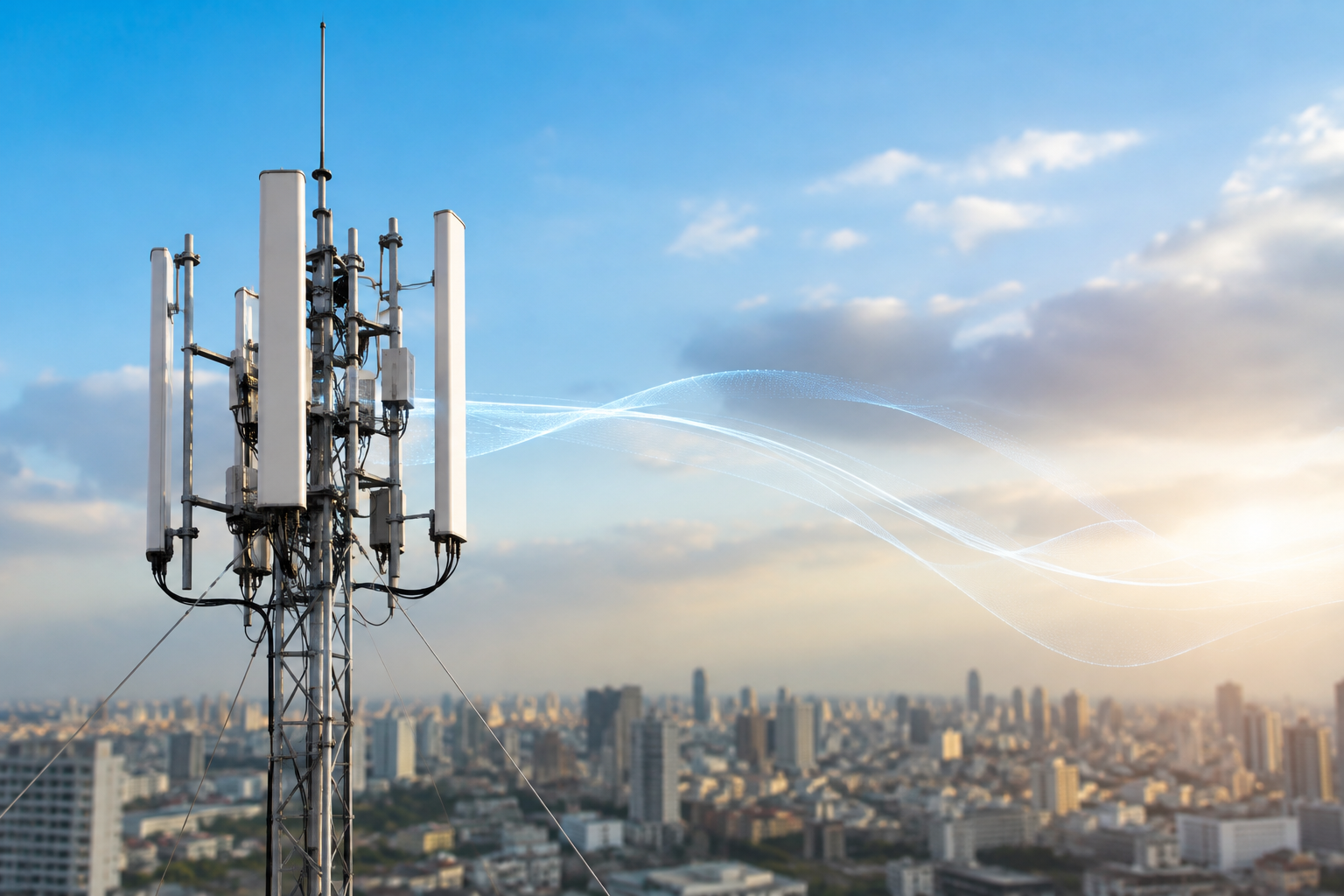
The revised EMF norms will raise the permitted power density for 5G base stations to 10 watts per square metre from 5 watts.
The change is expected to help telecom operators expand coverage with fewer towers and lower costs.
Highlights
- Government has relaxed electromagnetic field limits for mobile networks.
- Permitted power density for 5G towers will double to 10 watts per square metre.
- The revised norms are expected to come into effect next month.
- Higher limits could allow mobile signals to travel longer distances.
- Telecom operators may require fewer towers to expand 5G coverage.
- The new limit is aligned with international ICNIRP recommendations.
- Reliance Jio, Bharti Airtel and Vodafone Idea are expected to benefit.
The government has relaxed electromagnetic field, or EMF, limits for mobile networks in a move aimed at improving 5G coverage and reducing network expansion costs for telecom operators.
According to a Business Standard report citing the Economic Times, the revised rules will double the permitted power density for a 5G base transceiver station from the current 5 watts per square metre to 10 watts per square metre. The new norms are expected to come into effect next month.
The higher limit will allow mobile signals to travel longer distances, enabling operators to cover a larger geographical area from each tower. This could reduce the number of additional sites required for expanding networks and help telecom companies lower capital expenditure.
The telecom industry had been seeking relaxation in the EMF limits for a long time. Operators argued that India’s stricter radiation norms were making efficient deployment of 5G networks more difficult, particularly as mobile data traffic continues to increase.
India had earlier followed a power density limit of just 1 watt per square metre. It was increased to 5 watts per square metre last year. The latest revision to 10 watts brings India in line with standards recommended by the International Commission on Non-Ionizing Radiation Protection (ICNIRP).
Around 135 countries follow ICNIRP guidelines, while the 10-watt limit is reportedly used in nearly 137 countries, including several European Union nations, the UK, Australia, Japan, South Korea and Singapore.
The change is expected to particularly help Vodafone Idea, which is still expanding its 5G network and can now plan deployment under the revised limits. Reliance Jio and Bharti Airtel, which have already rolled out 5G across much of the country, could also benefit through more efficient use of existing tower sites and lower incremental network investment.
Telecom companies have maintained that radiation limits designed around earlier 2G, 3G and 4G networks were not fully suited to the technical requirements of 5G.