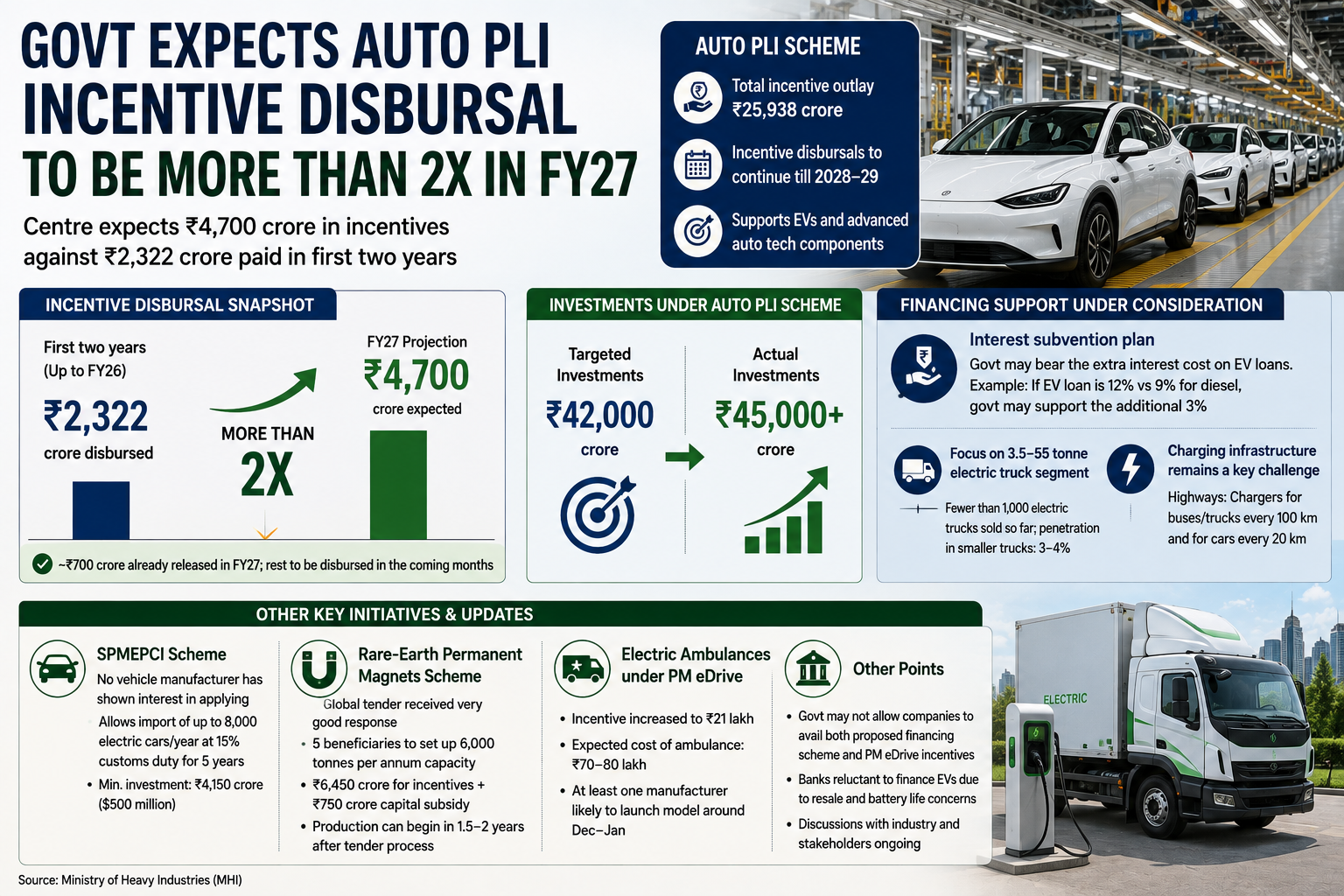
The Centre expects automotive PLI incentive disbursals to more than double to ₹4,700 crore in FY27, supported by rising investments in EVs and advanced automotive technologies.
Key Highlights:
- Auto PLI incentives may reach ₹4,700 crore in FY27.
- About ₹2,322 crore was paid in the first two years.
- Around ₹700 crore has already been released in FY27.
- Auto PLI scheme has a total outlay of ₹25,938 crore.
- Actual investments have crossed ₹45,000 crore against ₹42,000 crore targeted.
- Government is considering financing support for electric buses and trucks.
- Fewer than 1,000 electric trucks have been sold in the 3.5–55 tonne segment.
- EV charging infrastructure remains a key challenge for heavy vehicles.
New Delhi, August 11: The Ministry of Heavy Industries expects incentive disbursals under the automotive production-linked incentive (PLI) scheme to more than double in FY27, with around ₹4,700 crore likely to be paid to eligible companies during the year.
The expected FY27 payout is more than twice the approximately ₹2,322 crore disbursed during the first two years of the scheme. Around ₹700 crore of the FY27 allocation has already been released, with the remaining amount expected to be disbursed in the coming months.
The automotive PLI scheme has a total incentive outlay of ₹25,938 crore and was introduced to support companies manufacturing electric vehicles and advanced automotive technology components, including traction motors and angle encoders. The scheme, initially planned for five years, was later extended by one year, with incentive disbursements continuing until 2028-29.
The scheme had initially targeted investments of ₹42,000 crore. However, actual investments have already crossed ₹45,000 crore, indicating stronger-than-targeted investment activity in the sector.
Separately, the Ministry of Heavy Industries is considering a financing mechanism to address difficulties faced by electric bus and truck operators in securing loans. According to a ministry official, banks remain cautious about financing electric heavy vehicles because the resale market is still developing and there is uncertainty around battery life.
One proposal under consideration is interest subvention, under which the government could cover part of the additional interest cost of electric vehicle loans. For example, if financing an electric vehicle costs 12% compared with 9% for a diesel vehicle, the government could potentially support the additional 3 percentage points.
The proposed financing mechanism is expected to focus on the 3.5–55 tonne electric truck segment, where EV adoption remains extremely low. Fewer than 1,000 electric trucks in this category have been sold in India so far, while smaller electric trucks have an estimated penetration of 3–4%.
Charging infrastructure is another major challenge for the electrification of buses and trucks. The ministry is discussing the issue with charge-point operators and exploring ways to make heavy-duty charging infrastructure financially viable and attract greater private investment.
Under Ministry of Power guidelines, highways are expected to have charging facilities for buses and trucks every 100 km, while chargers for cars are expected every 20 km.
The ministry is also working to promote domestic manufacturing of rare-earth permanent magnets, which are important components in electric motors. Under the scheme, five beneficiaries will be selected to establish 6,000 tonnes per annum of manufacturing capacity, supported by ₹6,450 crore in sales-linked incentives and ₹750 crore in capital subsidies.
The government is also seeking to promote electric ambulances under the PM eDrive scheme. The incentive available for electric ambulances has been increased to ₹21 lakh, although no manufacturer has started production so far. The ministry expects at least one manufacturer to launch an electric ambulance model around December or January.