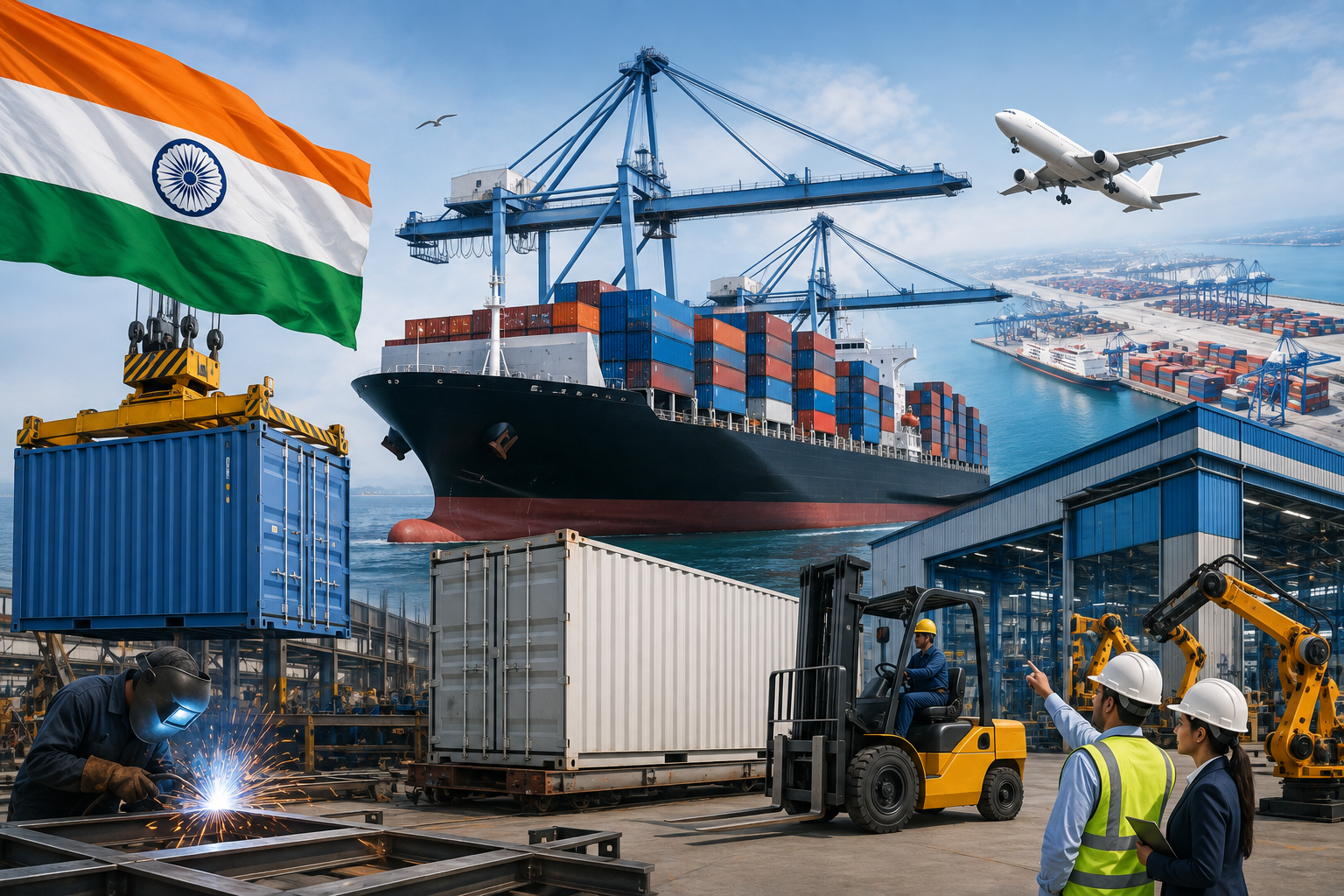
The proposed Container Manufacturing Assistance Scheme aims to sharply expand domestic production and reduce India’s dependence on nearly 2 million imported empty containers every year.
The five-year initiative will support new factories, expansion of existing units, technology, skilling and testing infrastructure while creating thousands of jobs.
Highlights
- CMAS has a proposed outlay of ₹10,000 crore over five years.
- India currently imports nearly 2 million empty containers annually.
- Domestic manufacturing capacity is targeted to rise to around 7.5 lakh TEUs per year.
- Scheme will support both new Greenfield plants and expansion of Brownfield units.
- CMAS could generate around 3,000 direct and more than 50,000 indirect jobs.
- Bharat Container Shipping Line envisages around ₹99,149 crore investment in 51 container vessels and domestic container procurement.
India is preparing to significantly expand its domestic shipping container manufacturing capacity under the proposed ₹10,000 crore Container Manufacturing Assistance Scheme (CMAS), as the government looks to reduce import dependence and strengthen the country’s maritime supply chain.
Announced in the Union Budget 2026-27, CMAS will provide financial and institutional support for five years to establish new container manufacturing facilities and expand existing units.
India currently imports nearly 2 million empty containers every year to meet domestic requirements and for repositioning purposes. According to the PIB backgrounder, this dependence makes container availability vulnerable to global market fluctuations, supply-chain disruptions and freight-rate volatility.
The government now aims to build a globally competitive domestic manufacturing ecosystem. Under CMAS, India’s annual container manufacturing capacity is targeted to increase to around 7.5 lakh Twenty-foot Equivalent Units (TEUs), approximately 10 times the existing production capacity.
The scheme will provide capital assistance for setting up new Greenfield manufacturing facilities and support the expansion of existing Brownfield units. Operational support will also be provided to improve the competitiveness of domestic manufacturers, along with assistance for testing infrastructure, skilling and capacity building.
The initiative could also create significant employment opportunities. The government expects around 3,000 direct jobs and more than 50,000 indirect jobs across container manufacturing and allied industries. Ancillary sectors such as corten steel, corner castings and wooden frames are also expected to benefit.
India has already achieved an important manufacturing milestone. In July 2026, the country’s first domestically manufactured EXIM shipping container for global shipping company A.P. Moller-Maersk was rolled out at the Maersk-CONCOR Inland Container Depot in Dadri, Uttar Pradesh.
The container was manufactured according to internationally recognised ISO standards and the International Convention for Safe Containers. Maersk subsequently placed an order for another 1,000 Made-in-India shipping containers with DCM Shriram Group.
CMAS is also being linked with India’s wider maritime expansion. The proposed Bharat Container Shipping Line envisages investments of around ₹99,149 crore for fleet development involving 51 container vessels of different sizes and domestic container procurement.
The government has separately announced a ₹70,000 crore Shipbuilding Financial Assistance Package, while major port projects including Vadhavan Port and the International Container Transshipment Port at Galathea Bay are progressing.
Together, these initiatives are aimed at building an integrated maritime ecosystem covering container manufacturing, shipbuilding, ports, shipping services and multimodal logistics while improving India’s long-term competitiveness in global trade.