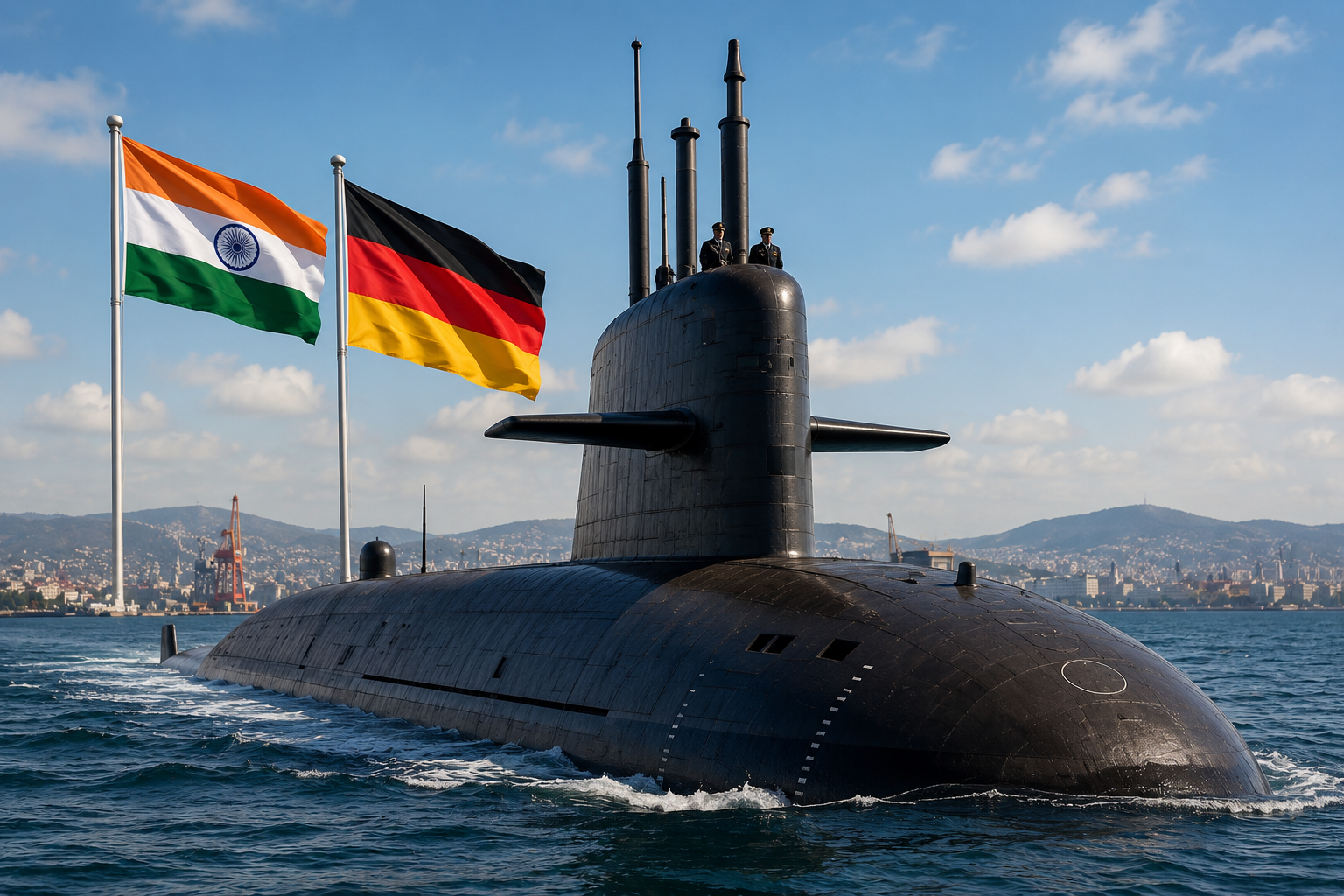
The agreement will pave the way for six next-generation conventional submarines to be built in India.
German Ambassador Philipp Ackermann said both sides are hopeful of signing the deal very soon.
Highlights
- India and Germany are expected to sign the Project-75I submarine deal very soon.
- The agreement is estimated at 8 billion euros (over Rs 90,000 crore).
- The project involves construction of six next-generation conventional submarines for the Indian Navy.
- Germany’s TKMS and Mazagon Dock Shipbuilders are expected to execute the project.
- German Ambassador Philipp Ackermann said the deal could be signed as early as next month.
- The project is expected to strengthen India’s indigenous defence manufacturing and naval capabilities.
India and Germany are set to take a major step forward in defence cooperation with the expected signing of the long-awaited Project-75I submarine agreement in the coming weeks.
German Ambassador to India Philipp Ackermann on Thursday expressed confidence that the deal would be signed very soon, possibly as early as next month. He made the remarks while speaking to reporters on the sidelines of an industry event organised by the Indo-German Chamber of Commerce (IGCC) in New Delhi.
The proposed agreement, valued at around 8 billion euros (more than Rs 90,000 crore), is aimed at strengthening the Indian Navy with six next-generation conventional submarines. The submarines are expected to be built in India under the country’s indigenous manufacturing programme, giving a significant boost to the domestic defence sector.
Under the project, Germany’s defence major ThyssenKrupp Marine Systems (TKMS) is expected to partner with India’s state-owned Mazagon Dock Shipbuilders Ltd. (MDL) for the design, technology transfer and construction of the submarines.
Project-75I is one of India’s biggest naval modernisation programmes and is intended to enhance the Navy’s underwater warfare capabilities amid evolving maritime security challenges in the Indo-Pacific region. The submarines are expected to feature advanced stealth technology, modern combat systems and improved endurance, making them significantly more capable than existing conventional submarines.
The agreement also aligns with the government’s ‘Make in India’ initiative by promoting indigenous defence manufacturing, technology transfer and skill development. Once signed, the project is expected to create significant opportunities for India’s defence ecosystem while further deepening strategic and defence ties between New Delhi and Berlin.