
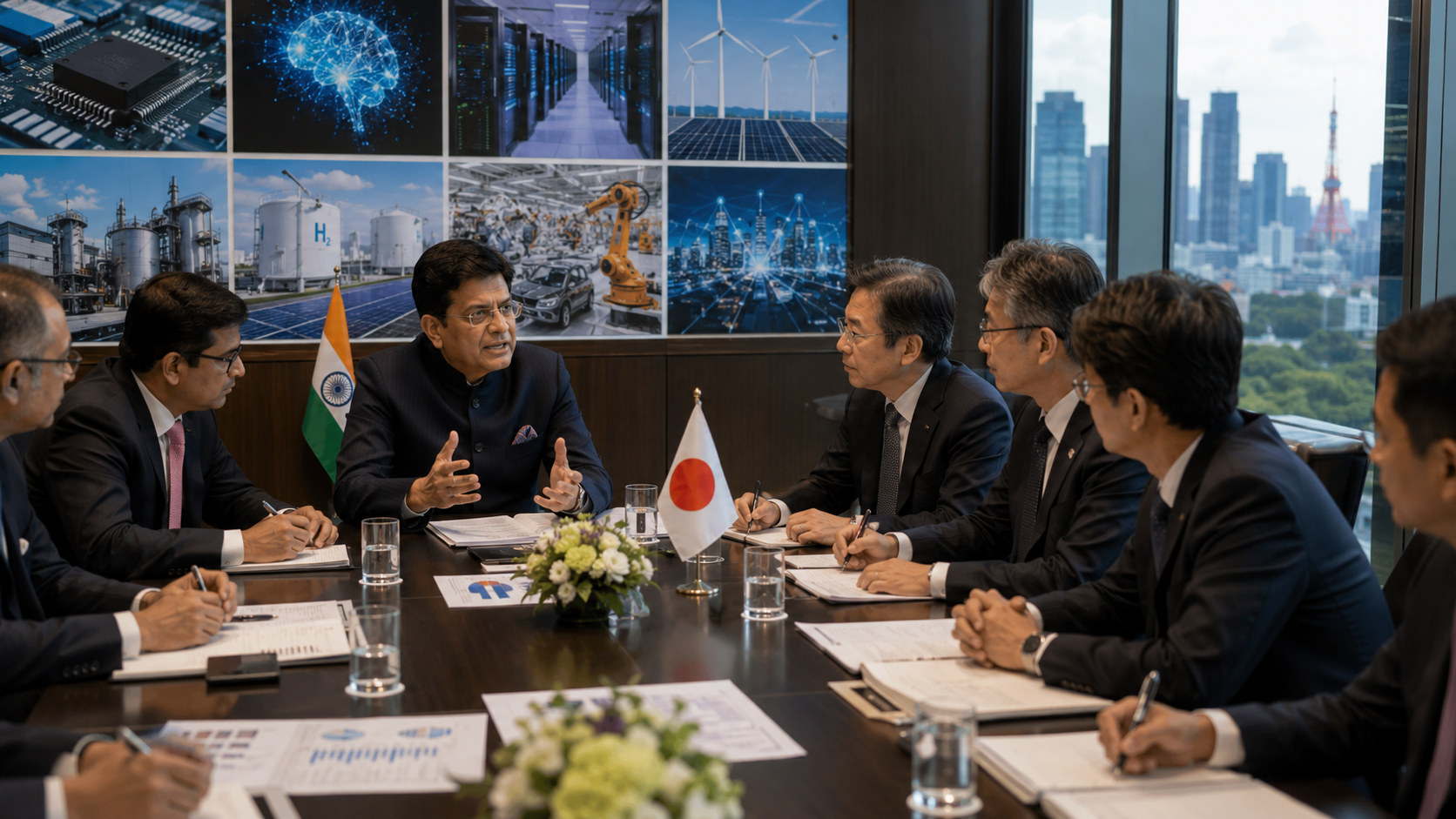
Goyal Seeks Greater Japanese Institutional Capital
Key Highlights:
- Piyush Goyal held discussions with leading Japanese financial institutions in Tokyo.
- Japanese institutions expressed strong long-term confidence in India’s growth prospects.
- India is targeting a USD 30 trillion economy by 2047.
- Semiconductors, AI, data centres, clean energy and advanced manufacturing were highlighted as major investment opportunities.
- Japanese investors sought easier profit repatriation and improved access to Indian capital markets.
- GIFT City was discussed as a potential gateway for international capital.
- India and Japan aim to mobilise 10 trillion yen of Japanese private investment over the next decade.
News Story:
New Delhi, August 25: India-Japan investment ties gained further momentum as Union Commerce and Industry Minister Piyush Goyal held discussions in Tokyo with senior leaders of Japan’s leading financial and investment institutions to strengthen long-term capital flows and expand Japanese participation in India’s growth story.
The meeting brought together senior representatives of MUFG, Development Bank of Japan (DBJ), Mizuho, Morgan Stanley, Nomura and Nippon Life. Discussions focused on India’s economic outlook, emerging investment opportunities and measures to further facilitate Japanese institutional investment.
Goyal highlighted the strength and resilience of the Indian economy, noting that India recorded 7.7 per cent growth last year despite global uncertainties. He said India is working towards becoming a USD 30 trillion economy by 2047.
The Minister also pointed to India’s strong banking sector, robust capital adequacy, low levels of non-performing assets, expanding middle class and rising disposable incomes as key foundations for sustained economic growth.
Emerging investment opportunities
Goyal highlighted significant opportunities for Japanese investors in semiconductors, artificial intelligence, data centres, renewable energy, green hydrogen, advanced manufacturing and digital infrastructure.
He noted that India’s expanding renewable-energy capacity and national power grid provide a strong foundation for energy-intensive digital industries. The country’s semiconductor mission is also expected to create new manufacturing and technology opportunities.
Calling Japan a trusted partner, Goyal said India is committed to becoming a global manufacturing, technology and investment hub. He also emphasised the country’s focus on intellectual property protection, high-quality talent, policy reforms and an increasingly conducive business environment.
Japanese institutions expand India presence
Japanese financial institutions highlighted their growing engagement with India and expressed strong confidence in its long-term growth prospects.
MUFG highlighted its investment of around USD 4 billion in Shriram Finance, along with expanding interests in renewable energy and hydrogen. DBJ outlined its dedicated India strategy and growing interest in property development, venture capital and other long-term investments.
Mizuho highlighted improving profitability among Japanese companies operating in India and the expansion of its operations, including its Global Capability Centre in Pune.
Morgan Stanley described India as one of its most important global locations, with more than 19,000 employees, and highlighted the shift of its Indian operations towards higher-value capital markets and financial services activities.
Nomura highlighted its long-standing presence in India and its role in connecting Japanese companies and global industries with Indian opportunities, including through capabilities in artificial intelligence and cybersecurity.
Nippon Life emphasised the importance of long-term “patient capital” and highlighted the strong returns generated by its Indian operations.
Investors seek smoother capital flows
The discussions also focused on measures to facilitate greater Japanese institutional investment in India.
Participants highlighted the importance of simplifying profit-repatriation processes, improving access to Indian capital markets and ensuring greater regulatory predictability for long-term investors.
While Japanese institutions reiterated their positive long-term outlook on India, they noted that currency movements and certain regulatory and policy considerations can influence short-term investment decisions.
Goyal welcomed the feedback and reiterated the government’s commitment to continuously improving the ease of doing business and creating a more seamless investment environment.
GIFT City gains strategic importance
The meeting also explored the potential of GIFT City as a gateway for international capital into India and as a platform for facilitating greater cross-border investment flows between Japan and India.
Goyal stressed that India is seeking more than capital, with a focus on long-term partnerships that bring technology, innovation, manufacturing capabilities, employment and integration with global value chains.
He highlighted opportunities across new and emerging sectors as well as established businesses requiring modernisation and technological upgrading.
The discussions assume significance as India and Japan aim to mobilise 10 trillion yen of Japanese private investment into India over the next decade.
The engagement reaffirmed the confidence of leading Japanese financial institutions in India’s long-term growth prospects and highlighted significant potential for expanding bilateral investment, technology and business linkages.
The meeting marks another important step towards deepening the India-Japan economic partnership and unlocking greater flows of long-term Japanese institutional capital into India’s next phase of growth.