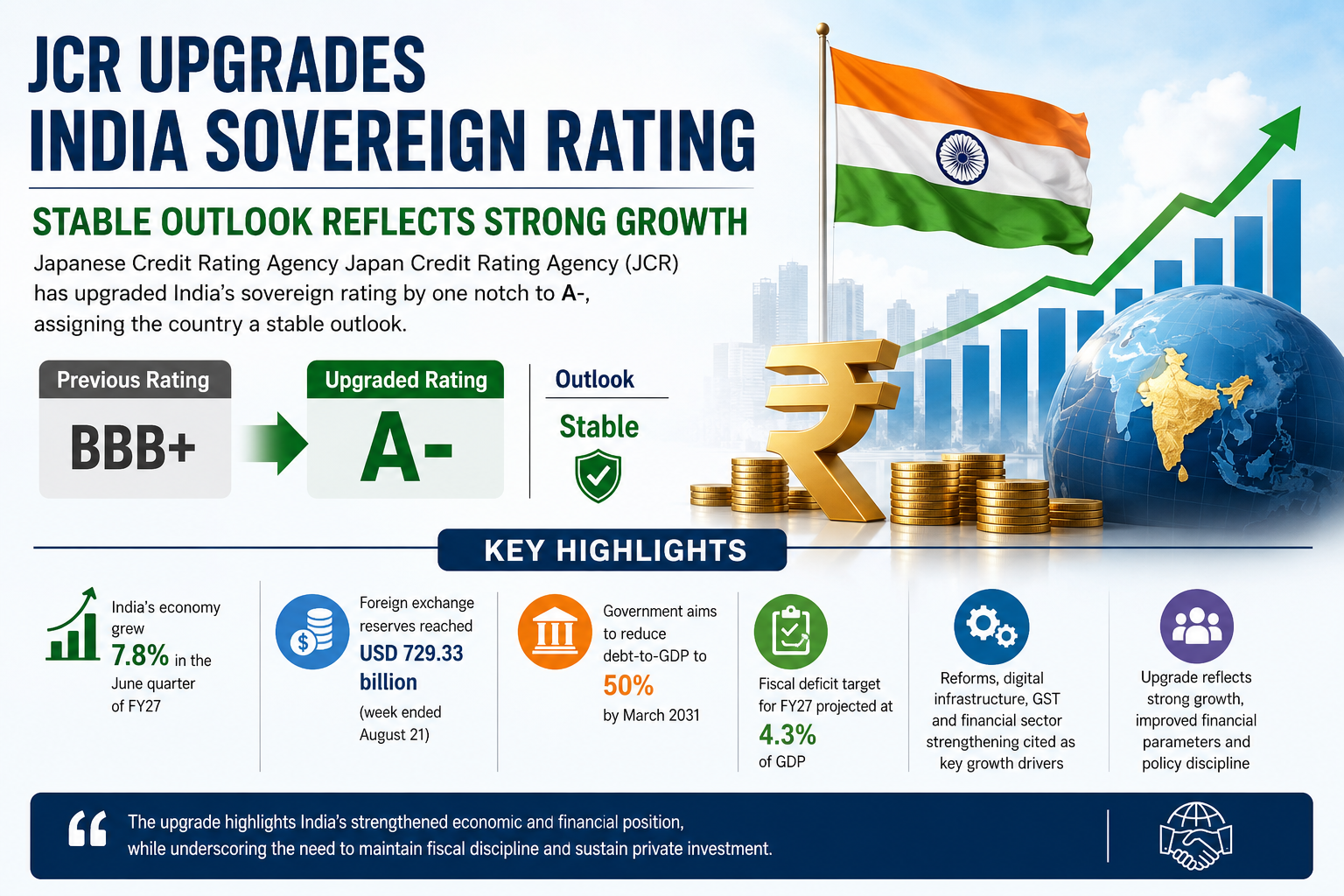
Stable Outlook Reflects Strong Growth
Key Highlights
- JCR upgraded India’s sovereign rating to A-.
- The outlook has been maintained at stable.
- The previous rating was BBB+.
- JCR cited solid economic growth and improved financial parameters.
- India’s economy grew 7.8% in the June quarter of FY27.
- Foreign exchange reserves reached USD 729.33 billion.
- The government aims to reduce debt-to-GDP to 50% by March 2031
Japanese credit rating agency Japan Credit Rating Agency has upgraded India’s sovereign rating by one notch to A-, assigning the country a stable outlook.
The agency cited India’s solid economic growth, stronger financial parameters and improvements in the foundations supporting long-term economic development.
JCR had previously assigned India a BBB+ rating. The upgrade places the country in a higher rating category and reflects the agency’s assessment that India has strengthened its economic and financial position.
JCR said India, with a population exceeding 140 crore and nominal GDP of approximately USD 3.9 trillion, is expected to maintain a high growth rate of more than 6% during the current fiscal year.
The agency noted that the Indian economy has maintained growth of around 7%, supported by robust private consumption and public investment.
Economic reforms and policy measures have also strengthened the country’s growth foundations. JCR specifically pointed to digital public infrastructure and the implementation of the Goods and Services Tax as important developments.
The agency also highlighted improvements in the financial position of the non-banking financial sector, saying these developments have contributed to greater soundness across the financial system.
India’s economy grew 7.8% in the April-June quarter of FY27, exceeding the Reserve Bank of India’s earlier growth estimate of 7%. The economy had also expanded 7.8% during FY26.
JCR acknowledged that India continues to face structural fiscal challenges. These include elevated fiscal deficits, fiscal transfers aimed at reducing disparities among states and the potential impact of electoral cycles on fiscal management.
However, the agency noted that the government has restrained growth in current expenditure, including subsidies, while placing greater emphasis on capital expenditure, particularly infrastructure investment.
According to JCR, this shift has improved the quality of fiscal expenditure.
The government has also established a medium-term objective of placing central government debt on a declining path as a percentage of GDP. The FY27 Budget estimated the debt-to-GDP ratio at 55.6%, compared with 56.1% at the end of FY26.
The government has set a longer-term objective of reducing the debt-to-GDP ratio to 50% by March 2031.
The fiscal deficit target for FY27 has been projected at 4.3% of GDP under the Budget estimates, although the revised GDP series affects the corresponding ratio calculation.
JCR said India’s external position also remains relatively strong. The country’s current account deficit remains contained, supported by a surplus in services. Foreign exchange reserves are ample and significantly exceed short-term external debt.
India’s foreign exchange reserves reached a record USD 729.33 billion in the week ended August 21.
The rating agency said it will continue to monitor whether government capital expenditure can stimulate private investment and reduce the economy’s dependence on government spending while maintaining strong growth.
The upgrade follows recent assessments by other major rating agencies. S&P and Fitch had both maintained India’s investment-grade rating last month, citing the strength and dynamism of the economy, policy stability and infrastructure investment.
The latest JCR decision could strengthen international investor confidence in India’s sovereign credit profile while highlighting the importance of maintaining fiscal discipline and sustaining private-sector investment.