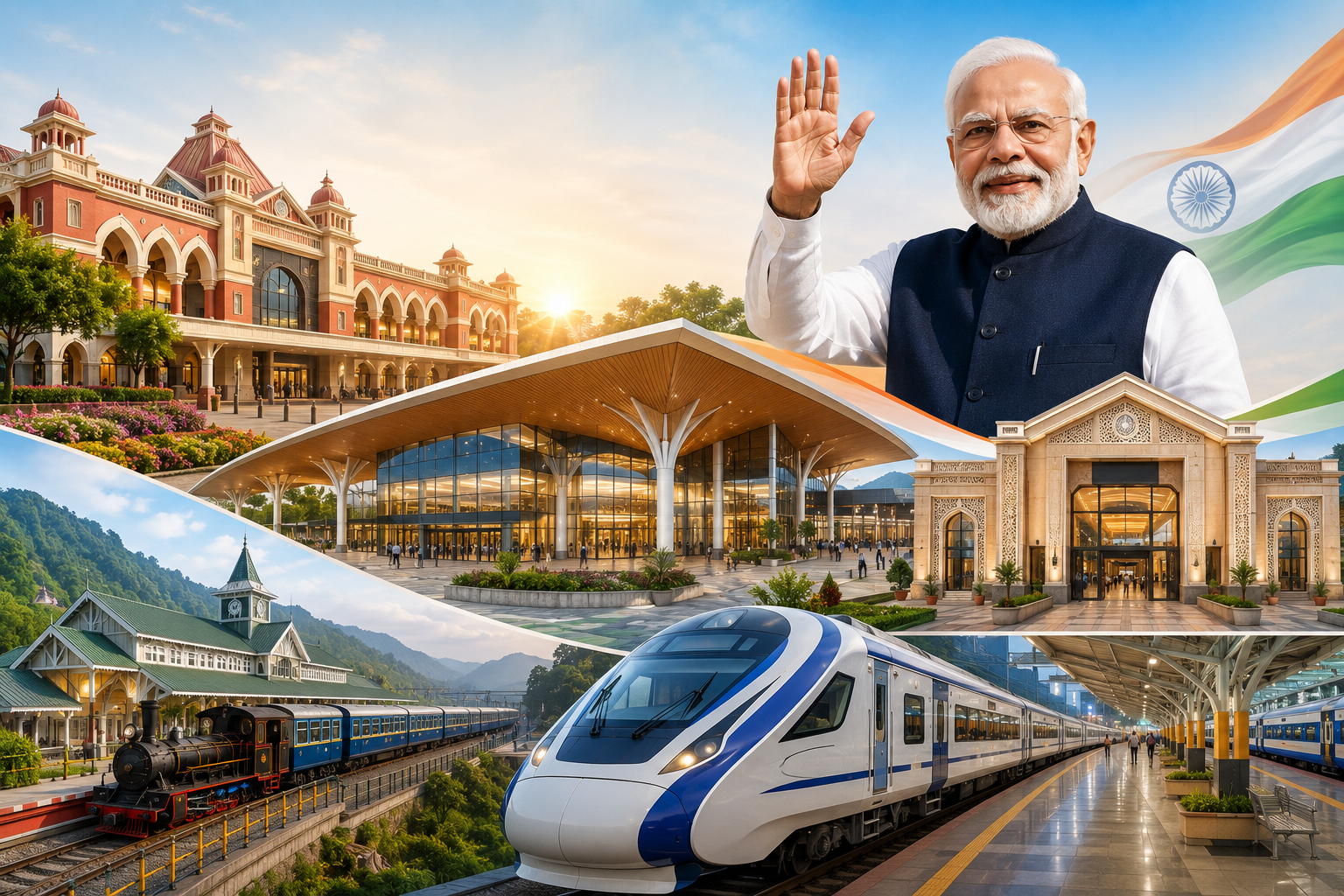
The redeveloped railway stations are spread across 20 states and have been upgraded at a combined cost of around ₹1,570 crore.
The stations combine modern passenger facilities, improved accessibility and architecture inspired by local heritage.
Highlights
- Prime Minister Narendra Modi dedicated 75 redeveloped railway stations to the nation.
- The stations are located across 20 states and were upgraded under the Amrit Bharat Station Scheme.
- Around ₹1,570 crore was spent on the latest batch of station redevelopment projects.
- Modern waiting areas, better access, signage and passenger information systems have been added.
- Station designs reflect local architecture, culture, handicrafts and regional heritage.
- A total of 261 stations have been completed under the scheme so far.
Prime Minister Narendra Modi has dedicated 75 redeveloped railway stations across India to the nation under the Amrit Bharat Station Scheme. The latest batch covers 20 states and has been completed at a combined cost of approximately ₹1,570 crore.
The stations have been transformed into modern, passenger-friendly transit hubs with improved facilities, better accessibility and upgraded infrastructure. Their designs also incorporate local architecture, cultural traditions and regional heritage.
This is the second major nationwide inauguration of redeveloped railway stations under the scheme. Earlier, on May 22, 2025, the Prime Minister inaugurated 103 redeveloped Amrit Bharat stations across 18 states and Union Territories.
The latest projects include stations in Andhra Pradesh, Assam, Bihar, Chhattisgarh, Gujarat, Haryana, Himachal Pradesh, Jharkhand, Karnataka, Kerala, Madhya Pradesh, Maharashtra, Odisha, Punjab, Rajasthan, Tamil Nadu, Telangana, Uttar Pradesh, Uttarakhand and West Bengal.
Madhya Pradesh received the highest number of redeveloped stations in this batch, with 13 projects. Rajasthan received eight stations, while Odisha and Uttar Pradesh received seven stations each. Kerala received six stations.
Several stations have been designed around the cultural identity of their regions. Mangalagiri station reflects the heritage of the Panakala Narasimha Swamy Temple, while Sanchi station draws inspiration from the area’s Buddhist heritage. Jaisalmer station reflects Rajasthan’s Golden Fort and desert architecture.
Similarly, Badami station has been inspired by the historic cave temples, Porbandar station celebrates Mahatma Gandhi’s legacy, and Sri Anandpur Sahib station reflects Sikh heritage.
Passenger facilities have also been significantly improved. The redevelopment includes modern station buildings, upgraded waiting halls, wider foot-over-bridges, better parking and circulating areas, improved signage and passenger information systems.
Special emphasis has been placed on accessibility for Divyangjan passengers through ramps, tactile paths, lifts and other barrier-free facilities. Executive lounges and sustainable infrastructure have also been developed at selected stations.
The Amrit Bharat Station Scheme was launched in December 2022 as a long-term programme to modernise railway stations through phased master planning. The objective is to develop stations as integrated city centres rather than limiting projects to cosmetic upgrades.
According to the Ministry of Railways, redevelopment work has been completed at 261 stations so far. The scheme covers 1,340 railway stations across India, while work at the remaining stations is progressing at different stages.