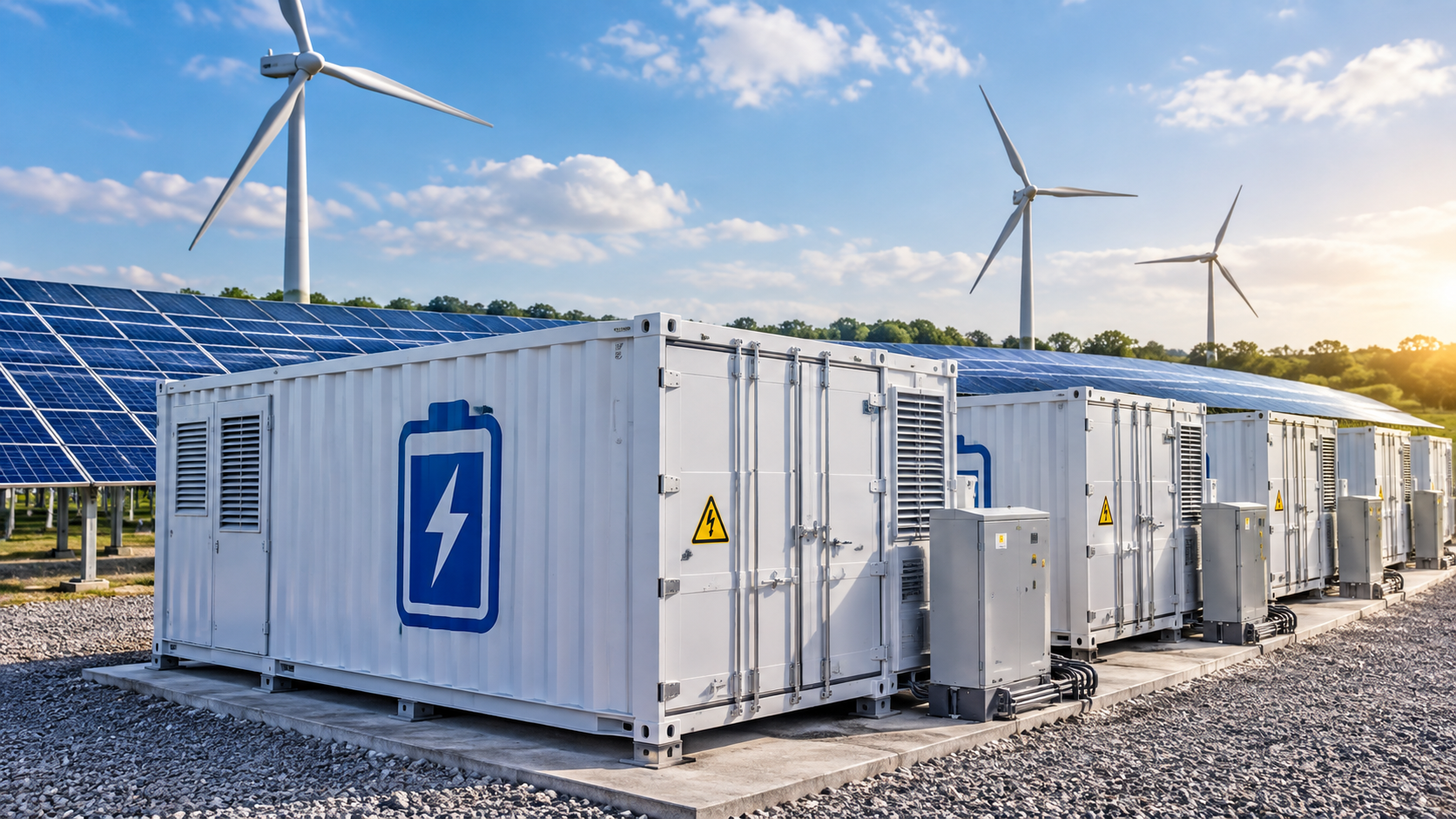
Industry says lower GST on battery storage containers will reduce costs and speed up clean energy deployment.
Developers believe the move will improve the commercial viability of renewable energy projects.
Highlights
- Renewable energy developers have sought a 5% GST on Battery Energy Storage Systems (BESS).
- Currently, standalone and containerised BESS attract 18% GST.
- Industry says battery storage should receive the same tax treatment as solar modules.
- Lower GST could reduce energy storage costs and improve project viability.
- India is projected to require 411.4 GWh of energy storage capacity by 2032.
- The proposal is expected to accelerate renewable energy deployment across the country.
India’s renewable energy industry has urged the government to reduce the Goods and Services Tax (GST) on Battery Energy Storage Systems (BESS) from 18% to 5%, arguing that the current tax structure is slowing the adoption of energy storage projects and increasing costs.
The National Solar Energy Federation of India (NSEFI) has submitted a representation to the Ministry of New and Renewable Energy, requesting that standalone utility-scale and containerised battery storage systems be taxed at the same concessional 5% GST rate that applies to renewable energy equipment such as solar modules.
According to the industry body, battery energy storage is becoming increasingly important for integrating renewable power into the electricity grid. Storage systems help manage fluctuations in solar and wind generation, ensuring a stable power supply even when renewable energy production declines.
The federation estimates that reducing GST on BESS could lower the levelised cost of storage (LCOS) by around ₹0.25–₹0.41 per unit, making renewable energy projects more commercially viable. It has also argued that BESS should be treated as a power generation asset, similar to solar panels and wind turbines.
Battery containers account for nearly 85–90% of the total cost of a battery energy storage project. Industry experts believe that reducing GST would encourage faster deployment of storage infrastructure and simplify project implementation by allowing BESS projects to be treated as composite renewable energy contracts.
The Central Electricity Authority (CEA) has projected that India will require 411.4 GWh of energy storage capacity by 2032, including 236.22 GWh from battery energy storage systems and 175.18 GWh from pumped storage projects.
The industry also estimates that lowering the GST rate could generate a long-term economic benefit of nearly ₹24,000 crore, outweighing the estimated GST revenue forgone. Developers believe the tax reduction would strengthen India’s clean energy transition while supporting the country’s ambitious renewable energy targets.