Consumption Remains Strong Despite Uncertainty
Key Highlights
- FMCG demand has remained resilient despite geopolitical and cost pressures.
- Rural demand is improving, supported by stronger consumption and better incomes.
- FMCG volume growth reached 6.8% in April-June, compared with 3.6% in the previous quarter.
- Air-conditioner sales surged 20-25% year-on-year during the March-June heatwave period.
- Washing-machine demand grew around 10-12%, while refrigerators increased about 8-10%.
- Companies are protecting entry-level price points while shifting consumers towards premium products.
- Industry executives expect consumption momentum to remain strong despite continuing volatility.
India’s consumption engine continues to show resilience despite a challenging economic environment, with rural demand recovering and urban consumers maintaining spending on both everyday products and discretionary goods.
The latest trends highlighted in the newspaper report suggest that the consumer sector has been able to absorb pressure from rising input costs, geopolitical uncertainty and uneven demand conditions. While companies continue to face challenges related to raw materials, logistics and pricing, demand for essential products and several consumer durable categories has remained relatively firm.
Rural demand shows signs of recovery
Rural consumption has emerged as one of the key positive developments for the FMCG industry.
The report highlights that rural demand has been supported by broader consumption at the grassroots level, with new revenue sources and improved purchasing capacity helping narrow the gap between rural and urban consumption.
FMCG companies have increasingly focused on expanding their reach in smaller towns and villages while maintaining affordable product offerings. Better distribution networks and greater availability of branded products have also helped strengthen rural consumption.
According to the data highlighted in the report, FMCG volume growth increased to 6.8% in April-June, compared with 3.6% in the preceding quarter. The improvement indicates that consumer demand has remained relatively robust despite cost pressures.
Urban demand gaining momentum
Urban consumption is also showing signs of strengthening, particularly in consumer durables.
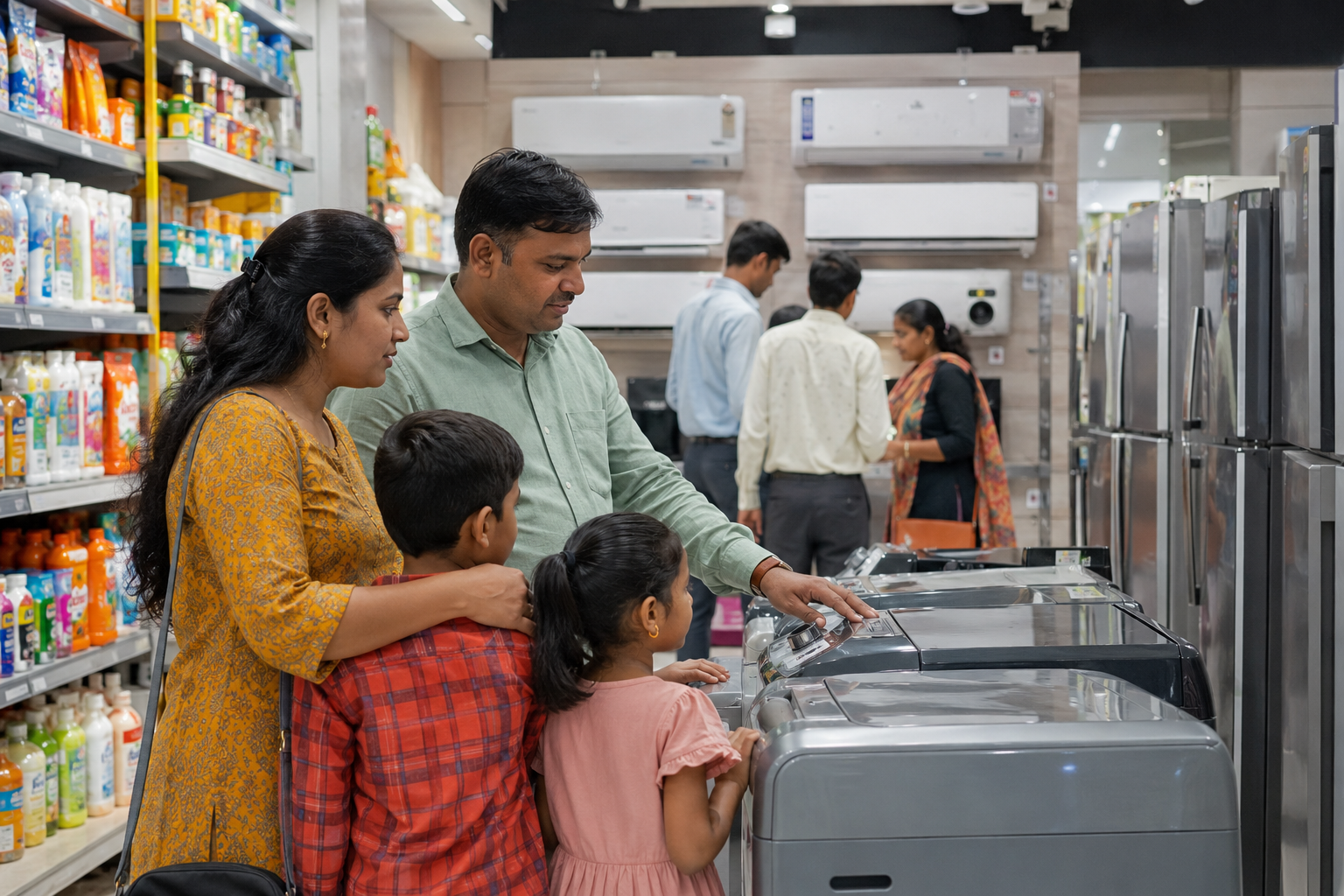
The report points to strong demand for air conditioners during the March-June period, when an intense heatwave boosted purchases. Air-conditioner sales reportedly grew by around 20-25% year-on-year, while washing-machine demand increased approximately 10-12% and refrigerator sales rose around 8-10%.
The strong performance of cooling products demonstrates how weather conditions can significantly influence discretionary consumer spending. A prolonged period of high temperatures encouraged households and businesses to accelerate purchases of cooling equipment.
The broader consumer-durables market is also benefiting from improving product availability, financing options and changing consumer preferences.
Companies protect affordable segments
Despite stronger demand, FMCG companies continue to remain cautious about pricing.
Companies have been protecting entry-level price points and increasingly using consumer promotions to maintain affordability. At the same time, premiumisation is becoming an important growth driver as consumers with higher purchasing power move towards better-quality and feature-rich products.
This combination allows companies to address two different parts of the market: price-sensitive consumers looking for value and affluent consumers willing to spend more on premium products.
Industry executives quoted in the report noted that premiumisation is becoming increasingly visible across categories, particularly among urban consumers.
Geopolitical uncertainty remains a concern
The recovery is taking place against the backdrop of continued global uncertainty.
West Asian tensions, including risks surrounding key shipping routes, have the potential to affect commodity prices, freight costs and supply chains. Higher costs can eventually put pressure on manufacturers and consumers.
Companies have therefore been attempting to protect margins through cost management, pricing strategies and changes in product mixes.
The report suggests that businesses are also becoming more cautious about passing the entire increase in input costs on to consumers, particularly in price-sensitive segments.
Consumer durables benefit from replacement demand
The consumer-durables industry is receiving additional support from replacement demand.
As household incomes improve and consumers increasingly seek better features, older appliances are being replaced with newer and more energy-efficient models.
Air conditioners, refrigerators and washing machines are among the categories benefiting from this trend. The increasing penetration of modern appliances in smaller cities and towns is also creating additional growth opportunities for manufacturers.
Industry executives expect the demand environment to remain constructive, although they acknowledge that volatility in commodity prices and geopolitical conditions could create fresh challenges.
Premiumisation becomes a major trend
Another important trend emerging across the consumer sector is premiumisation.
Consumers are increasingly looking beyond basic products and showing greater interest in premium variants, enhanced features and more convenient experiences. This trend is particularly visible in urban markets, where higher-income consumers have greater purchasing power.
Companies are responding by expanding premium portfolios while continuing to maintain affordable options for mass-market consumers.
The strategy is helping manufacturers balance volume growth with better margins.
Outlook remains cautiously positive
The overall consumer outlook remains positive, although the industry continues to face risks.
Rural demand is improving, urban consumption is gaining momentum and consumer-durable categories are benefiting from replacement and weather-driven demand. At the same time, geopolitical tensions, commodity prices and inflation remain important variables for businesses.
The report suggests that India’s consumption story is increasingly becoming more broad-based, with rural markets recovering while urban consumers contribute through discretionary and premium spending.
If rural income growth remains supportive and urban demand continues to hold up, FMCG and consumer-durable companies could maintain their growth momentum in the coming quarters.
For now, the resilience of everyday consumption and the renewed strength in consumer durables indicate that Indian households are continuing to spend despite an uncertain global environment.