Seeks Uniform Protest Rules
Key Highlights
- Supreme Court said peaceful protest is a constitutionally protected right.
- The court observed that agitation alone cannot justify police excess or lathi-charge.
- Judges stressed that the lives of both protesters and police personnel are equally important.
- The Bench called for uniform nationwide protocols to regulate peaceful demonstrations.
- Petitions cited alleged police excesses during protests in Delhi and Bihar.
- The Centre assured the court it would assist in framing a balanced approach.
- The Supreme Court will hear all related petitions together in the next hearing.
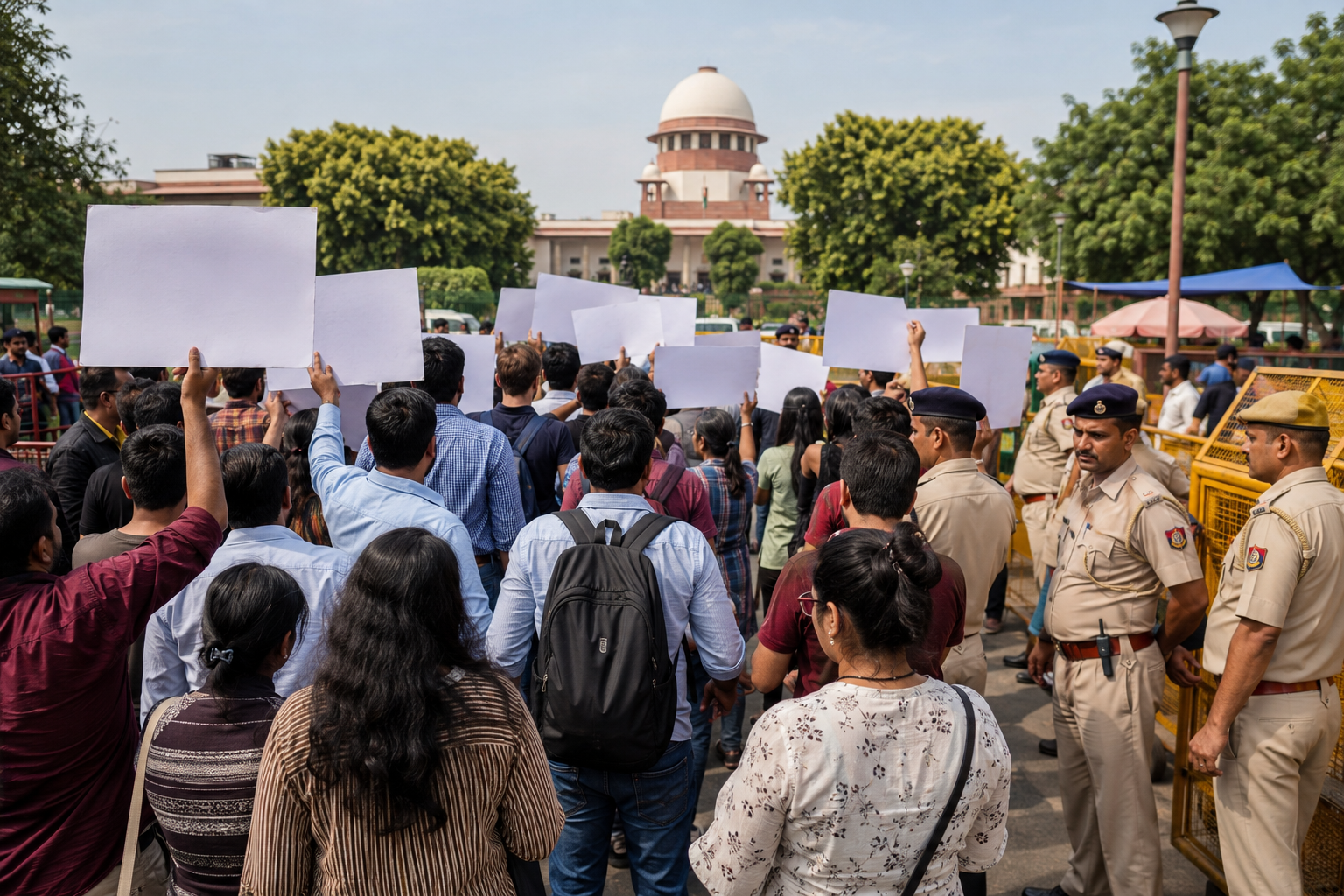
The Supreme Court on Monday reiterated that the right to hold peaceful protests is a fundamental constitutional guarantee and observed that police excesses cannot be justified simply because a public demonstration is taking place.
A Bench led by the Chief Justice of India, along with two other judges, made the observations while hearing a batch of petitions seeking uniform nationwide guidelines to ensure peaceful protests can be conducted without unnecessary restrictions or excessive use of force.
During the proceedings, the Bench emphasized that democratic societies require both the protection of citizens’ rights and responsible conduct during public demonstrations. The court noted that while maintaining law and order is essential, the use of force should not become the default response to protests.
The judges also underlined that every human life carries equal value, including that of protesters and police personnel deployed to maintain public order. The Bench stressed that peaceful assemblies should be managed through well-defined procedures rather than ad hoc responses.
The petitions before the court referred to allegations of excessive police action during recent protests in Delhi and Bihar. Petitioners argued that a uniform national framework is needed to ensure that citizens can exercise their constitutional rights while allowing authorities to address genuine security concerns and prevent violence by anti-social elements.
The Supreme Court observed that there should be a clear and consistent protocol governing public protests across the country, including designated spaces, crowd management procedures, and safeguards against unnecessary restrictions or excessive force.
Representing the Union government, the Solicitor General assured the court that the Centre would assist in the matter objectively. The Bench directed that all petitions related to the issue be heard together during the next hearing.
The case is expected to play an important role in shaping future guidelines on balancing the constitutional right to peaceful protest with public order and law enforcement responsibilities.