Sovereign AI stack strengthens India
Key Highlights
- Vice President C. P. Radhakrishnan launched GNANI AI’s sovereign AI stack, Gnani Artha.
- The launch took place at Uprashtrapati Bhavan in New Delhi.
- Gnani Artha combines Evon 3.3, a large language model, with the Plexus AI platform.
- The initiative focuses on strengthening India’s indigenous AI and technological capabilities.
- The Vice President highlighted sovereign AI as important for technological and strategic autonomy.
- AI-based interpretation is set to expand across India’s Scheduled Languages.
- The launch supports India’s broader vision of technological self-reliance and Viksit Bharat @ 2047.
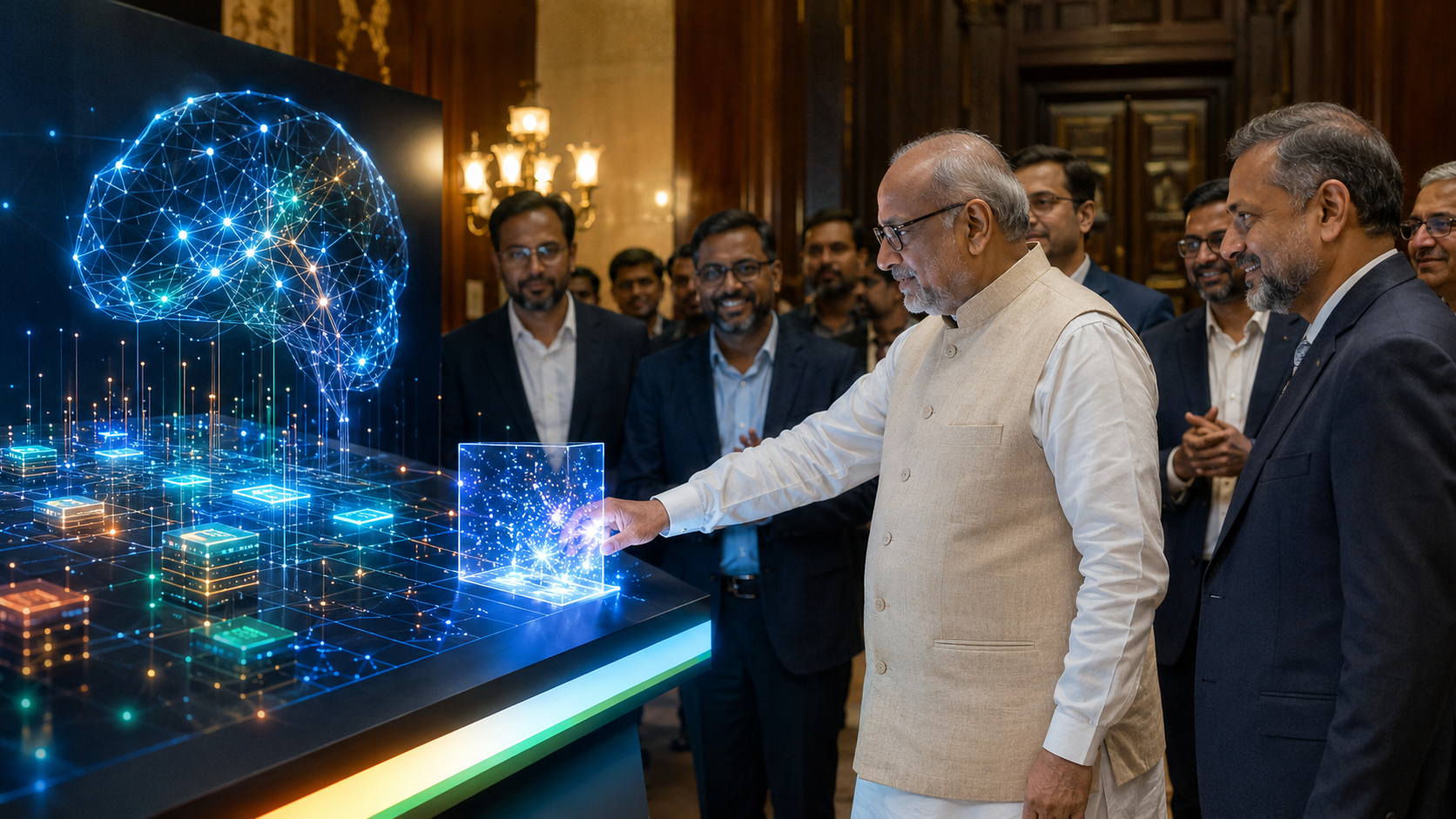
New Delhi, August 29, 2026: Vice President C. P. Radhakrishnan has launched Gnani Artha, a sovereign artificial intelligence stack developed by GNANI AI, at Uprashtrapati Bhavan in New Delhi.
Gnani Artha combines Evon 3.3, a large language model developed by the company, with Plexus, a platform designed to connect artificial intelligence capabilities with real-world work, institutions and practical applications.
Speaking at the launch, Radhakrishnan said the combination of Evon 3.3 and Plexus reflected the growing strength of India’s technology ecosystem and demonstrated the ability of Indian engineers to develop advanced and frontier technologies.
He stressed that India must continue building indigenous technological capabilities rather than remaining dependent only on technologies developed elsewhere.
“We should not be consumers always; we need to create, so that others can consume,” the Vice President said while highlighting the importance of technological innovation and self-reliance.
Radhakrishnan also said artificial intelligence could create new employment and economic growth opportunities. Drawing comparisons with the growth of India’s information technology industry, he noted that earlier concerns about computers replacing jobs were eventually followed by the creation of new industries and employment opportunities.
The Vice President highlighted government initiatives, including the IndiaAI Mission and Centres of Excellence for Artificial Intelligence, as important drivers for strengthening India’s AI ecosystem.
He said technological capability would play an important role in India’s journey towards Viksit Bharat @ 2047, with advanced technologies expected to become increasingly important for economic growth, strategic independence and global competitiveness.
Highlighting the use of artificial intelligence in Parliament, Radhakrishnan referred to the Digital Sansad portal, which provides access to parliamentary debates and documents in multiple Indian languages.
He also noted that simultaneous AI-based interpretation in eight languages had been introduced during the recently concluded Session. The interpretation capability is expected to be extended further to cover all Scheduled Languages.
The Vice President also discussed India’s semiconductor ambitions, saying the country had the potential to become a major player in chip manufacturing. He said the sector had gained renewed momentum in recent years as India works to strengthen its semiconductor ecosystem.
Radhakrishnan congratulated GNANI AI CEO Ganesh Gopalan and Co-Founder and CTO Ananth Nagaraj on the launch of Gnani Artha.
The launch of the sovereign AI stack represents another development in India’s broader push towards technological self-reliance, indigenous innovation and the creation of advanced technologies capable of competing globally.