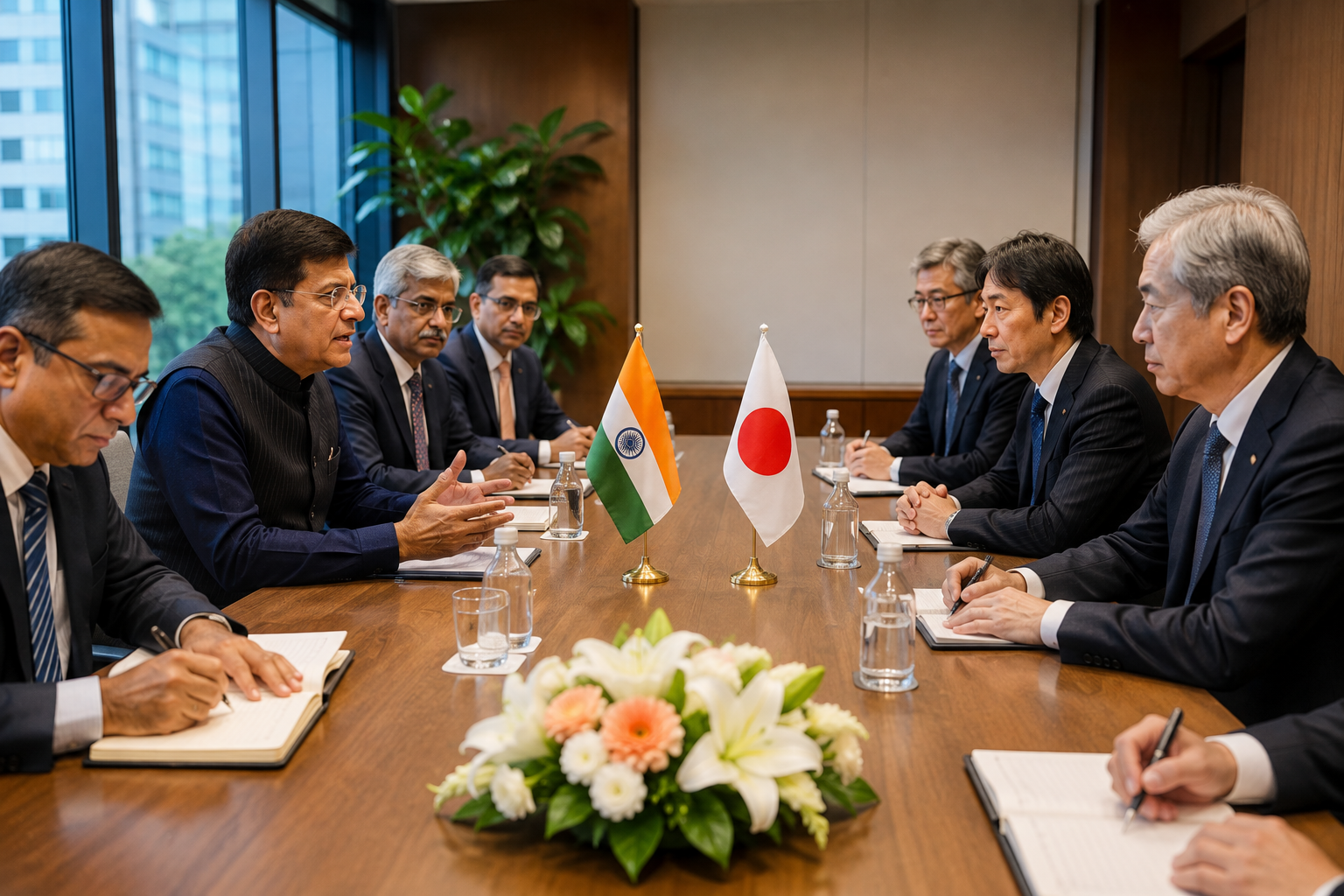
Commerce Minister Piyush Goyal met major Japanese financial institutions in Tokyo to seek greater long-term institutional investment in India.
Semiconductors, AI, data centres, clean energy and advanced manufacturing emerged as key investment opportunities.
Highlights:
- Piyush Goyal met senior representatives of MUFG, DBJ, Mizuho, Morgan Stanley, Nomura and Nippon Life in Tokyo.
- India is seeking greater long-term Japanese institutional capital across emerging and established sectors.
- Semiconductors, AI, data centres, renewable energy, green hydrogen and digital infrastructure were highlighted as major opportunities.
- India and Japan aim to mobilise 10 trillion yen of Japanese private investment into India over the next decade.
- MUFG highlighted its investment of around $4 billion in Shriram Finance.
- Japanese institutions sought easier profit repatriation, better capital-market access and greater regulatory predictability.
- GIFT City was discussed as a potential gateway for increasing cross-border investment between India and Japan.
India has invited greater participation from Japanese institutional investors as the two countries look to deepen their long-term economic and investment partnership, with opportunities emerging across semiconductors, artificial intelligence, clean energy and digital infrastructure.
Commerce and Industry Minister Piyush Goyal held discussions in Tokyo with senior representatives of major Japanese financial and investment institutions, including MUFG, Development Bank of Japan, Mizuho, Morgan Stanley, Nomura and Nippon Life.
The discussions focused on India’s economic outlook, investment opportunities and measures that could make it easier for Japanese institutional capital to enter the country.
Goyal highlighted India’s economic fundamentals and said the country recorded 7.7% growth last year despite global uncertainties. India is working towards becoming a $30 trillion economy by 2047.
He also pointed to the strength of the banking system, capital adequacy, low non-performing assets, an expanding middle class and increasing disposable incomes as factors supporting long-term economic growth.
The minister identified semiconductors, artificial intelligence, data centres, renewable energy, green hydrogen, advanced manufacturing and digital infrastructure as major areas for Japanese investment.
Japanese financial institutions, meanwhile, expressed confidence in India’s long-term growth potential.
MUFG highlighted its investment of around $4 billion in Shriram Finance and its growing interest in renewable energy and hydrogen. Development Bank of Japan outlined opportunities in property development, venture capital and other long-term investments.
Mizuho highlighted improving profitability among Japanese companies operating in India, while Morgan Stanley said India is one of its most important global locations, employing more than 19,000 people.
Nomura highlighted opportunities involving AI and cybersecurity, while Nippon Life stressed the importance of long-term “patient capital” and pointed to returns generated by its Indian operations.
The discussions also addressed challenges faced by foreign investors. Participants highlighted the need to simplify profit repatriation, improve access to Indian capital markets and provide greater regulatory predictability.
GIFT City was discussed as a possible gateway for international capital and greater cross-border investment flows between India and Japan.
Goyal said India is looking beyond capital alone and wants partnerships that can bring technology, innovation, manufacturing capabilities, employment and stronger integration with global value chains.
The discussions come as India and Japan work towards their objective of mobilising 10 trillion yen of Japanese private investment into India over the next decade.