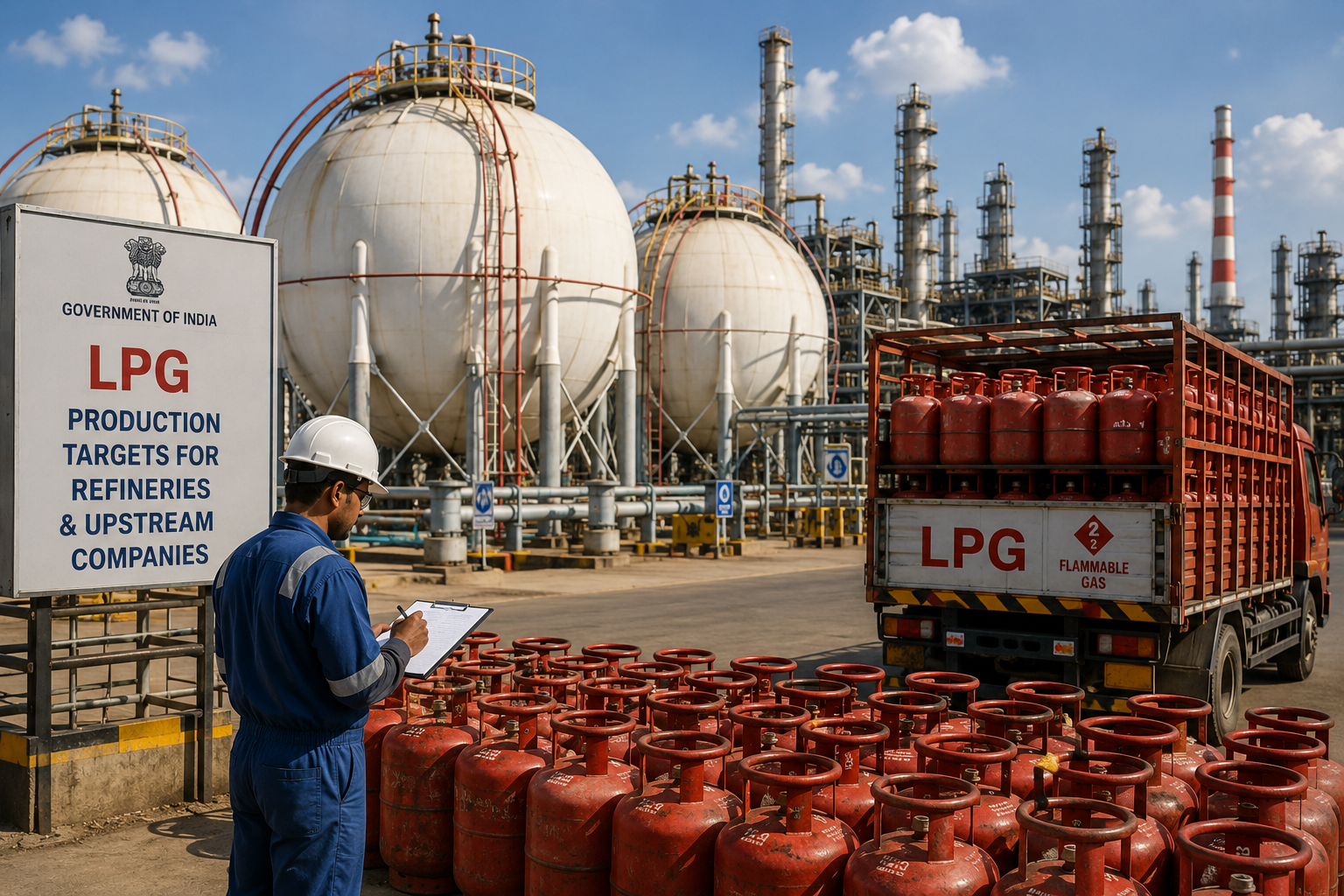
India has created a refinery-wise LPG production framework to strengthen domestic supplies during future disruptions.
Reliance Industries’ Jamnagar refinery has been assigned the largest production capacity of up to 18,000 tonnes per day.
Highlights
- Government fixes LPG production benchmarks for 21 refineries and upstream companies.
- Combined production potential has been set at 63,810 tonnes per day.
- Reliance’s Jamnagar DTA refinery gets the largest target of 18,000 tonnes daily.
- Public-sector refineries together have been assigned 31,470 tonnes per day.
- Nayara Energy’s Vadinar refinery can be asked to produce 4,480 tonnes daily.
- Production targets will be activated during LPG supply constraints.
The government has introduced a new LPG production framework for refineries and upstream companies as part of efforts to strengthen India’s domestic cooking gas supply and reduce the impact of future import disruptions.
According to an order issued by the Ministry of Petroleum and Natural Gas on August 13, maximum LPG production levels have been specified for 21 public- and private-sector refineries and upstream companies.
Together, these facilities have been assigned production potential of 63,810 tonnes of LPG per day, which is more than double India’s domestic LPG production during FY2025-26 and equivalent to around 70 per cent of the country’s current daily consumption.
The prescribed production levels will be activated whenever the country faces a supply constraint.
Reliance Industries has been assigned the largest individual quota. Its 33-million-tonne-per-year domestic tariff area refinery at Jamnagar, Gujarat, can be directed to produce up to 18,000 tonnes of LPG per day.
However, no target has been set for Reliance’s separate export-focused refinery at the Jamnagar complex.
Eighteen refineries operated by public-sector oil companies have collectively been assigned a production level of 31,470 tonnes per day. Nayara Energy’s Vadinar refinery has been assigned 4,480 tonnes per day, while upstream companies including ONGC and GAIL have a combined target of 6,460 tonnes per day.
India consumed around 33.2 million tonnes of LPG in FY2025-26, or approximately 91,000 tonnes per day. Domestic production stood at around 13.1 million tonnes, while more than 21 million tonnes were imported.
The government’s move follows supply disruptions during the West Asia conflict, which highlighted India’s high dependence on imported LPG.
During the earlier crisis, domestic LPG production was temporarily increased to around 55,000 tonnes per day as refiners were asked to maximise output.
Under the new standing framework, companies will also need to maintain adequate LPG storage, transportation and evacuation infrastructure. Refiners have been asked to consider technically and economically viable upgrades, including naphtha-to-LPG conversion and refinery-unit modifications.
The production schedule will be updated twice every year, on January 1 and July 1, to account for new refineries, additional capacity and infrastructure upgrades.