
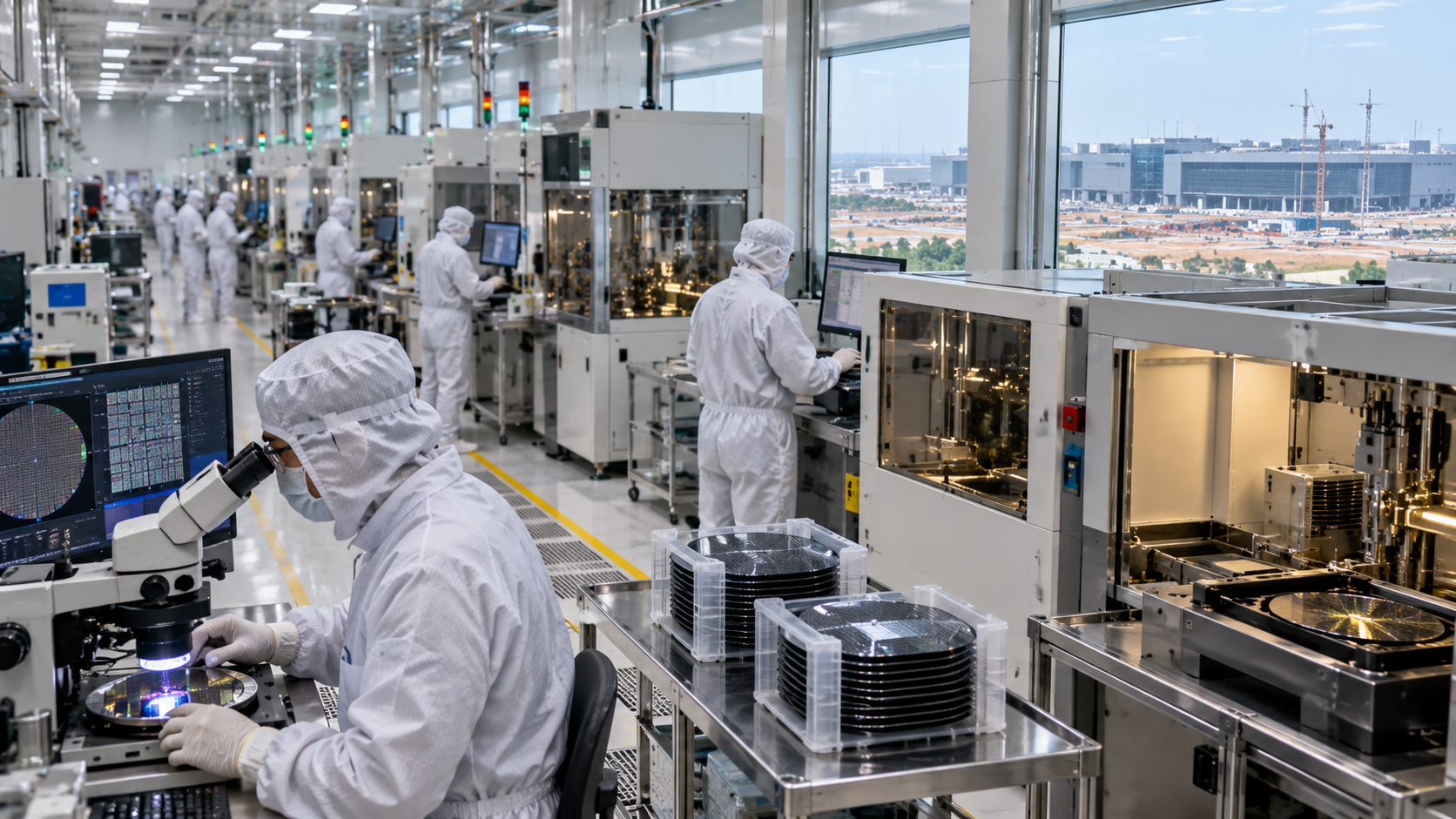
Tata Electronics Says Key Chip Projects Remain on Track
Key Highlights
- Tata Electronics CEO Randhir Thakur said India’s semiconductor journey looks strong, supported by policy continuity under Semicon 2.0.
- Tata Electronics is investing a combined $14 billion in semiconductor projects in Gujarat and Assam.
- Its Dholera semiconductor fab involves an investment of around ₹91,000 crore ($11 billion).
- The Dholera 300-mm fab is planned to manufacture chips across 28nm to 110nm technology nodes.
- Tata Electronics is investing another $3 billion in its semiconductor packaging facility at Jagiroad, Assam.
- Both the Dholera and Jagiroad projects are progressing according to timelines committed to the government.
- Thakur said the Dholera fab will require an ecosystem of around 450 suppliers.
- Tata Electronics has signed multiple MoUs aimed at strengthening equipment, infrastructure, materials and talent capabilities for its semiconductor operations.
India’s semiconductor manufacturing journey looks strong, with policy continuity under the government’s Semicon 2.0 programme providing an important roadmap for the sector, according to Tata Electronics CEO and Managing Director Randhir Thakur.
Tata Electronics is developing India’s first commercial semiconductor fabrication plant at Dholera in Gujarat and an indigenous semiconductor assembly and testing facility at Jagiroad in Assam. Together, the two projects involve an investment of about $14 billion.
Thakur said continuity in semiconductor policy is particularly important because the industry requires long-term planning, investment and technology roadmaps. He described the transition from the earlier semiconductor programme to Semicon 2.0 as encouraging for companies investing in the sector.
Tata Electronics’ Dholera fab is being developed with an investment of around ₹91,000 crore, or $11 billion. The 300-mm facility is expected to manufacture semiconductor chips using technology nodes ranging from 28nm to 110nm.
The chips are intended for applications across automotive systems, consumer electronics, computing and data storage, wireless communications and artificial intelligence.
The company is separately investing around $3 billion in its semiconductor packaging facility at Jagiroad in Assam.
Thakur said both projects are progressing according to the timelines committed to the government.
Building the supporting supply chain will also be a major part of Tata Electronics’ semiconductor expansion. Thakur said the Dholera fab alone would require an ecosystem of approximately 450 suppliers.
Partnerships being developed by the company span semiconductor equipment, infrastructure, gases and chemicals as well as talent development, helping establish the broader ecosystem required to operate advanced chip manufacturing facilities in India.
Tata Electronics is also focusing on developing domestic semiconductor skills. Thakur said partnerships involving Indian institutions and companies would help orient young talent towards semiconductor manufacturing technologies and develop capabilities at the grassroots level.
He also highlighted the connection between semiconductor hardware and the rapid expansion of artificial intelligence, noting that advances in computing hardware have helped enable the development of increasingly sophisticated AI applications and models.
With the Dholera and Jagiroad projects progressing, Tata Electronics expects to continue investing in semiconductor manufacturing as it works to establish a wider domestic ecosystem capable of serving customers across global industries.