CEA Backs E10 Alongside E20
Key Highlights
- Chief Economic Adviser V Anantha Nageswaran has backed restoring E10 petrol for older vehicles.
- The proposal would allow E10 alongside the existing E20 fuel.
- Around 75–80 million older two-wheelers built before BS-IV are estimated to remain on Indian roads.
- The proposal focuses particularly on older carburettor-equipped vehicles.
- The authors have urged caution before increasing ethanol blending beyond E20.
- Potential future blends such as E27 and E30 could increase pressure on agricultural feedstocks.
- Higher ethanol demand could create food, feed and water trade-offs.
- Maize is a key concern because it is used for both ethanol and animal feed.
- The proposal also highlights the potential impact of water-intensive crops such as sugarcane.
New Delhi, August 17: Chief Economic Adviser V Anantha Nageswaran and Department of Economic Affairs consultant Akash Poojari have proposed bringing back E10 petrol for older vehicles while retaining E20 for newer vehicles, amid an ongoing debate over ethanol-blended fuel in India.
In a column published in The Indian Express, the authors also urged policymakers to carefully assess the food, feed and water implications before considering ethanol blends higher than 20 per cent.
Their proposal comes as India debates the long-term impact of its ethanol-blending programme and the compatibility of higher ethanol blends with older vehicles.
E10 For Older Vehicles
The immediate recommendation from Nageswaran and Poojari is to restore E10 petrol as an option for older two-wheelers.
They estimate that around 75 million to 80 million older two-wheelers built before BS-IV and equipped with carburettors are still operating on Indian roads.
According to the authors, carburettor-equipped vehicles may face specific challenges with higher ethanol blends because older carburettors cannot automatically adjust the fuel-air mixture for the additional oxygen associated with ethanol.
This could potentially result in the engine operating with a leaner mixture and running hotter.
Older rubber and other fuel-system components may also not have been designed to withstand higher ethanol concentrations.
E10 And E20 Could Coexist
The proposal does not call for abandoning E20 for the broader vehicle fleet.
Instead, the authors suggest allowing E10 alongside E20 for older vehicles while the legacy fleet is gradually retrofitted with ethanol-compatible components.
They argue that retrofitting is technically possible and relatively inexpensive on an individual vehicle basis, but implementing it across tens of millions of vehicles would take considerable time.
An E10 option could therefore provide older vehicle owners with an alternative during the transition.
Food Versus Fuel Debate
The bigger concern raised by the authors relates to what could happen if India moves beyond E20.
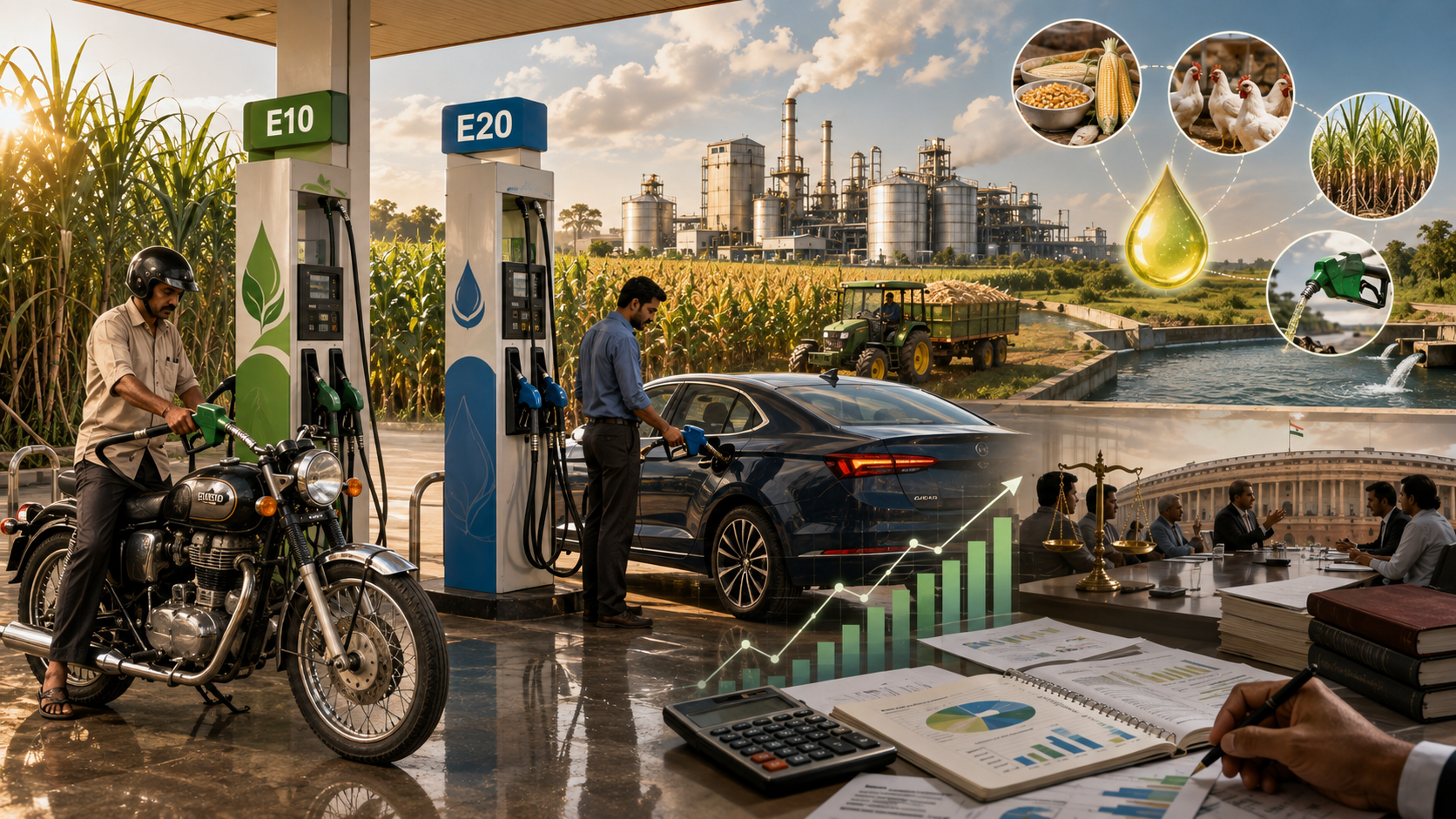
India produces ethanol from sugarcane, maize, rice and other agricultural feedstocks. As ethanol demand increases, these crops face additional demand from distilleries.
That creates a direct economic trade-off because the same agricultural output can be used for fuel, food, animal feed and industrial purposes.
The issue becomes particularly important for maize.
Maize is increasingly used as an ethanol feedstock but is also a major input for poultry and livestock feed. Greater demand from ethanol producers could therefore affect its availability and price for other industries.
Higher Blends Could Increase Pressure
The authors have specifically raised concerns about potential future blends such as E27 and E30.
Moving to higher blending levels would require significantly greater quantities of ethanol and could increase demand for agricultural feedstocks.
If more crops are diverted towards fuel production, farmers may need to increase overall production to maintain supplies for food and feed markets.
Otherwise, higher demand from ethanol producers could put upward pressure on agricultural prices and production costs.
Water Use Adds Another Concern
The debate also extends beyond food and fuel to water.
Nageswaran and Poojari argue that policymakers need to consider the water required to grow the crops used to produce ethanol, rather than focusing only on the water consumed by ethanol-processing facilities.
This is particularly relevant to sugarcane, which is a water-intensive crop.
The authors caution that committing agricultural land and water resources to fuel production could be difficult to reverse once cropping patterns, investment and distillery capacity become established.
Government Continues To Back E20
The government has defended its ethanol-blending programme on the grounds that it can reduce crude oil imports, save foreign exchange and create additional markets for agricultural producers.
India reached its 20 per cent ethanol-blending target earlier than originally planned, strengthening the case for E20 as the country’s current fuel policy.
The government has also maintained that testing has not established evidence of widespread engine damage from E20.
At present, E20 remains the government’s policy, with no announced decision to move beyond the 20 per cent blend.
Balancing Energy And Agriculture
The proposal from the CEA and his colleague adds another dimension to India’s ethanol debate.
While ethanol blending can support energy security and reduce dependence on imported crude oil, higher blending targets could also create pressure on agricultural resources.
The authors therefore argue that future decisions should account for the complete economic cost of ethanol production, including land use, water consumption and competing demand for food and animal feed.
For older vehicles, their recommendation is straightforward: restore E10 alongside E20. For the broader ethanol programme, they advocate caution before India commits further agricultural resources to fuel production.