Recognition Gap May Cost Agriculture Up to ₹2 Lakh Crore Annually
Key Highlights
- About 50.5 per cent of women working in agriculture are classified as unpaid helpers on family farms.
- The corresponding share among men is significantly lower at 21.7 per cent.
- The recognition and resource-access gap could be costing India ₹1.2-2 lakh crore in agricultural output annually.
- Agriculture employs 64.4 per cent of India’s working women, rising to 76.9 per cent among rural working women.
- Women now account for roughly 48 per cent of India’s agricultural workforce.
- Women hold only 13.96 per cent of operational agricultural holdings and operate 11.72 per cent of farmed area.
- Women-run farms can be 24 per cent less productive than comparable male-run farms because of unequal access to resources, according to the report.
- Women agricultural workers are paid 20-30 per cent less than men for the same work.
- The report recommends improving recognition, agricultural credit, technology access and women-led Farmer Producer Organisations.
New Delhi, August 19: Half of India’s women working in agriculture are not officially classified as farmers, creating a recognition and resource-access gap that could be costing the country between ₹1.2 lakh crore and ₹2 lakh crore in agricultural output every year, according to a report by agri-commerce platform Arya.ag.
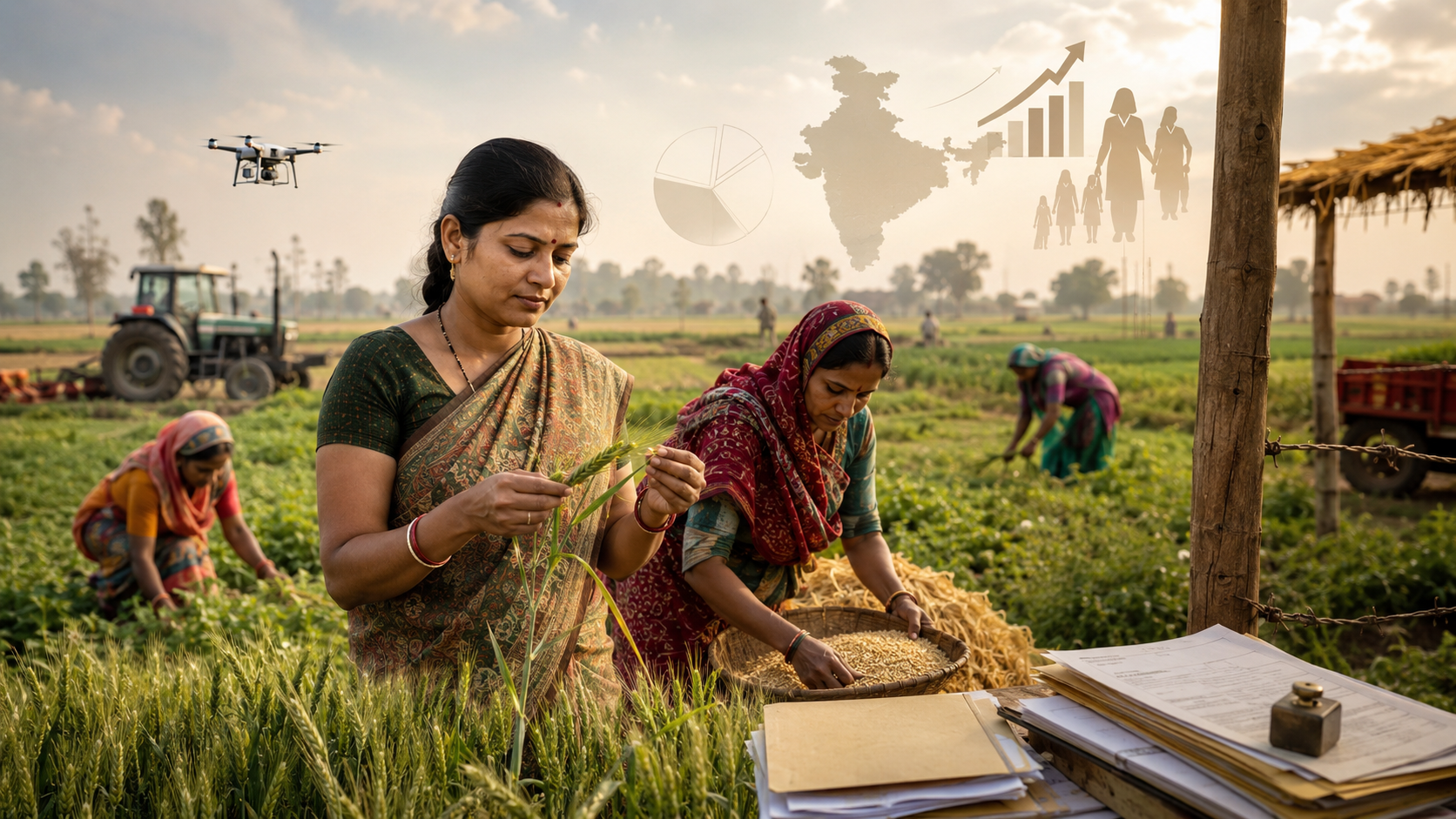
The report, titled Her Harvest 2026: The Hidden Cost of Women’s Invisible Work in Indian Agriculture, found that 50.5 per cent of women engaged in agriculture are recorded as unpaid helpers on family farms, compared with 21.7 per cent of men.
The distinction has significant consequences because women who are not classified as cultivators can face difficulties accessing agricultural credit, extension services, procurement systems, input subsidies and government scheme benefits that are linked to land ownership records.
Recognition gap carries economic cost
The report estimated that unequal access to productive agricultural resources could be costing India’s economy ₹1.2-2 lakh crore annually.
The estimate applies the Food and Agriculture Organization’s assessment that unequal access to productive resources can reduce agricultural output by 2.5-4 per cent to India’s agricultural Gross Value Added of ₹48.7 lakh crore.
The report stressed that the productivity gap does not arise because women are inherently less efficient farmers, but because they often operate with fewer productive resources.
Its findings draw on public datasets and institutional sources including PLFS 2023-24, Agriculture Census 2015-16, FAO, ILO, Government of India sources, IFC and Arya.ag disclosures.
Agriculture employs 64.4% of working women
Agriculture remains India’s single largest source of employment for women.
About 64.4 per cent of working women in the country are engaged in agriculture, up from 57 per cent in 2017-18.
Among rural working women, the proportion rises further to 76.9 per cent.
The report noted that as men migrate to urban areas in search of non-farm employment, women have increasingly assumed responsibility for the day-to-day operation of farms.
Their formal recognition, however, has not increased at the same pace.
Women now represent roughly 48 per cent of India’s agricultural workforce, compared with about 30 per cent in 2017-18.
Women control much less agricultural land
Despite their growing contribution to agricultural labour, women continue to control a relatively small proportion of farmland.
Women hold only 13.96 per cent of India’s operational agricultural holdings and operate about 11.72 per cent of the country’s farmed area.
The report described this as a roughly four-fold gap between the agricultural labour contributed by women and the land they control.
Limited control over land can have consequences beyond ownership itself because formal land records are often linked to access to institutional finance, government programmes, agricultural inputs and other services.
Productivity and wage gaps persist
The report found that farms operated by women can be 24 per cent less productive than comparable male-operated farms of the same size.
It attributed this difference primarily to unequal access to credit, inputs and other productive resources rather than differences in farming ability.
Women agricultural workers also earn 20-30 per cent less than men for the same work, according to the report.
Closing these gaps could therefore have implications for both household incomes and India’s overall agricultural productivity.
How India compares globally
India’s 13.96 per cent share of operational holdings controlled by women is close to the global average of approximately 14.5 per cent.
It is also broadly comparable with the United States, where women were sole holders of 13.7 per cent of farms in the last comparable census cited by the report.
Women in India operate 11.72 per cent of agricultural land, compared with 8.5 per cent in Brazil and 7 per cent in the US.
However, neighbouring Nepal is considerably ahead. Women there hold 32.4 per cent of agricultural holdings and operate 22.3 per cent of agricultural area.
The corresponding share of agricultural holdings is 31.5 per cent in Italy and 31.6 per cent across the European Union, according to the report.
Alternatives to land ownership
The report acknowledged that closing India’s land-title gap could require long-term and generational changes, but argued that women’s access to agricultural resources need not wait for ownership patterns to change.
Storage infrastructure, warehouse-receipt finance, Farmer Producer Organisations and agricultural technology can provide women with some of the recognition, financing and market access traditionally associated with formal land ownership.
Arya.ag said it operates across 21 states, working with more than 8.5 lakh farmers and around 12,000 warehouses.
Women-led FPOs on its platform have grown 128 per cent over the past two years, with more than 50,000 women directly engaged.
Its AryaShakti initiative, operated with Friends of Women’s World Banking, supports 10,000 farming households through women-led FPOs. A $2.5-million partnership with IFC also provides pre- and post-harvest financing to smaller women-led enterprises.
Report calls for ‘labour to leadership’ shift
Arya.ag Managing Director and CEO Prasanna Rao said providing women farmers with access to finance, storage, technology and organised markets can generate benefits extending beyond individual farmers to households, communities and the broader agricultural economy.
With 2026 designated as the International Year of the Woman Farmer, the report called for shifting the approach towards women’s participation in agriculture from welfare to productivity and from labour to leadership.
It recommended formally recognising women as farmers, expanding agricultural credit facilities for them, widening access to drones, advisory services and market technologies, and developing women-led FPOs as long-term market institutions.