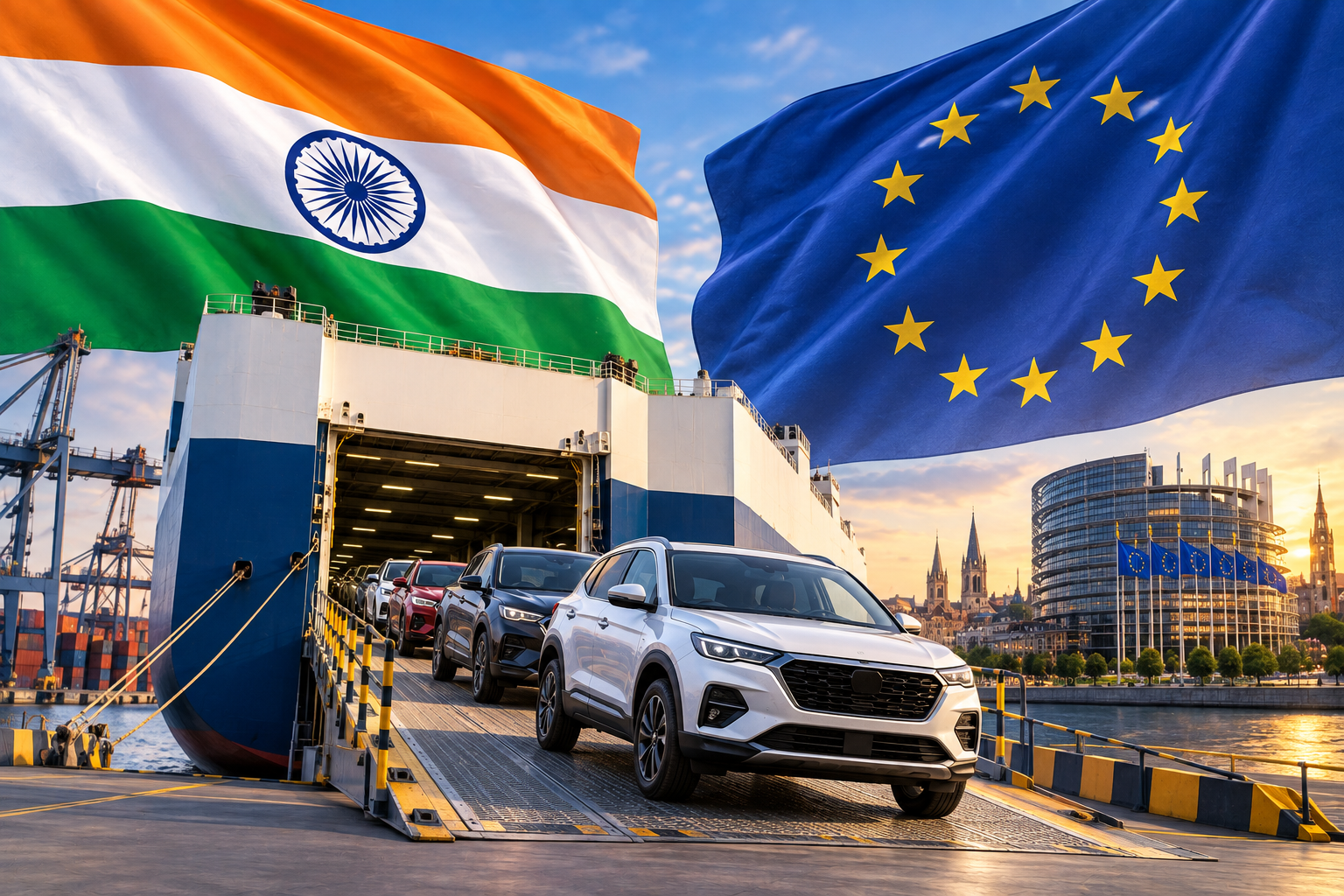
Indian automakers could get wider access to the European market under the proposed India-EU free trade agreement, with concessional tariffs on up to 2.5 lakh cars initially and the quota rising to 4 lakh units by the 10th year.
Highlights
- EU may allow 2.5 lakh Indian-made passenger cars annually at a concessional tariff.
- Annual quota could rise to 4 lakh units by Year 10.
- Initial duty on eligible ICE and hybrid cars will be 8%, falling to zero by Year 5.
India-EU FTA Could Open Bigger European Market for Indian Carmakers
Indian automakers could get significantly improved access to the European market under the proposed India-EU free trade agreement, with the European Union agreeing in the draft pact to allow up to 2.5 lakh Indian-made passenger cars annually at a concessional tariff.
The annual quota is expected to increase gradually and reach 4 lakh units by the 10th year of implementation. Vehicles exported beyond the quota will attract the standard Most Favoured Nation duties.
The initial tariff-rate quota will cover Indian-origin internal combustion engine cars and hybrid electric vehicles priced up to €50,000 on a CIF basis. These vehicles will face an 8% import duty in the first year.
The tariff is proposed to decline progressively to 6% in Year 2, 4% in Year 3, 2% in Year 4 and zero by Year 5.
For conventional and hybrid vehicles priced above €50,000, there will be no quota ceiling. Duties on these higher-value vehicles will instead be reduced gradually from 8% in the first year to zero by the 10th year.
Electric and alternative-fuel vehicles will come under a separate quota structure, with tariff relief beginning from Year 5.
For battery electric and plug-in hybrid vehicles priced below €40,000, the initial quota will be 27,500 units at an 8% duty. This will expand to 60,500 units by Year 9, when the tariff is expected to fall to zero, and later rise to 1.25 lakh units from Year 14.
Vehicles in the €40,000–€60,000 segment will start with a quota of 16,250 units in Year 5 and reach 75,000 units by Year 14. Premium EVs priced above €60,000 will begin with a quota of 6,250 units and rise to 25,000 units from Year 14.
The deal is also expected to provide tariff concessions for several Indian agricultural and processed food exports, including grapes, dried onions, cucumbers, gherkins, rum and ghee.
India and the European Union concluded FTA negotiations on January 27. The agreement is expected to be formally signed later this year and come into force in 2027.