Counterfeiting is increasingly becoming a business and consumer-trust challenge in India, with 89% of consumers having unknowingly purchased a fake product, according to data cited by the Trade Promotion Council of India.
Counterfeiting is emerging as a wider economic risk for brands as fake products affect not only sales but also consumer confidence, product safety and brand reputation. According to the ASPA-CRISIL State of Counterfeiting in India 2025 report cited by the Trade Promotion Council of India, 89% of Indian consumers have purchased a counterfeit product without realising it was fake. Consumers also perceive that nearly 29% of products sold in local markets are counterfeit.
The problem has implications for the value companies build around their brands. Consumers typically rely on packaging, logos, retailers and previous experiences when deciding whether a product is genuine. Counterfeit products can weaken that confidence when consumers associate the quality or safety of a fake product with the original brand.
Globally, trade in counterfeit goods is valued at USD 467 billion, according to OECD data cited in the article. In India, reported counterfeit cases have increased by about 3.4% annually since 2018.
Healthcare illustrates the potential consumer risk. The article states that 80% of people believe fake medicines have increased during the past 12 months, but only 52% check whether medicines are genuine before purchasing them. Online commerce has added another distribution channel for counterfeits, with 53% of consumers reporting encounters with fake products through online platforms. For healthcare products, the figure rises to 60%.
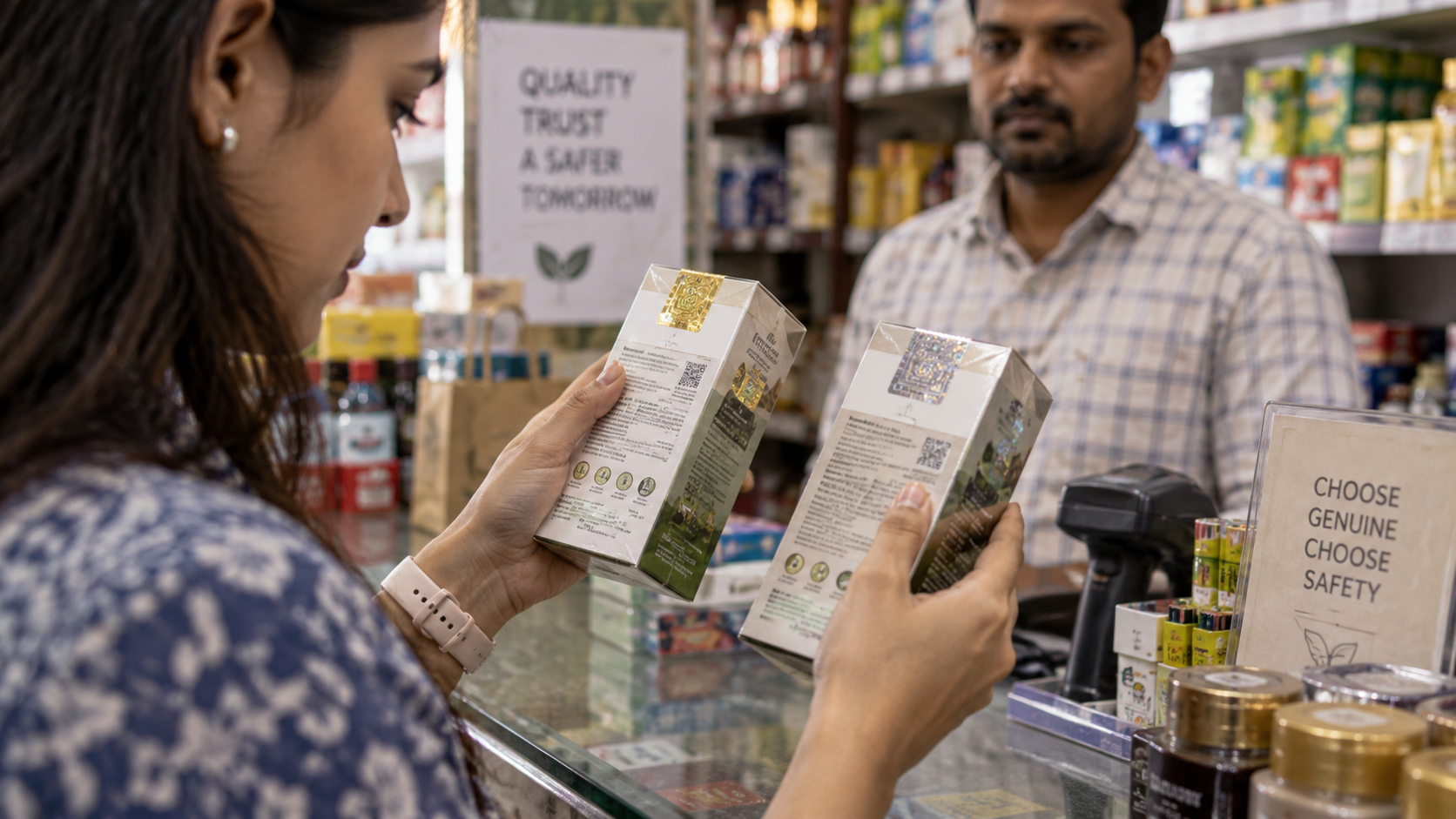
Anti-counterfeiting systems increasingly combine different levels of physical authentication. Visible features such as security holograms can provide an immediate authenticity cue, while covert elements including fine-line patterns and microtext can support verification by trained personnel. Forensic features provide an additional hidden layer for brands, investigators and enforcement agencies.
Digital traceability can complement these physical protections. Serialized QR codes can give individual products a digital identity that can be scanned to verify information and monitor movement through the supply chain. Pairing these codes with physical security features provides an additional layer because QR codes themselves can potentially be copied.
Digital systems can also identify unusual activity. Multiple scans of the same product code from different locations or unexpected scanning patterns can be flagged for investigation, helping brands identify possible duplication, diversion or other suspicious activity.
Packaging itself remains an important trust signal. According to the data cited in the article, 61% of FMCG shoppers judge whether a product is genuine based on packaging and printing quality, while 42% think to check for a hologram.
Combining physical authentication with digital traceability can therefore allow companies to verify products across manufacturing, distribution, retail and online channels. The approach turns brand protection from a packaging feature into a broader system for product authentication and supply-chain monitoring.
The article is a joint knowledge initiative by the Trade Promotion Council of India and Holostik, which provides product-authentication and anti-counterfeiting technologies.