Shipping disruptions threaten India’s basmati rice exports to West Asia

Escalating geopolitical tensions in West Asia are beginning to disrupt India’s basmati rice exports to West Asia, a trade worth nearly US$6 billion annually and heavily dependent on Gulf markets. With security concerns around the Strait of Hormuz pushing up freight and insurance costs and delaying shipments, exporters are facing mounting uncertainty while farmers in Punjab and Haryana watch domestic prices soften. The situation highlights the risks of concentrated market dependence in one of India’s most valuable agricultural export sectors.
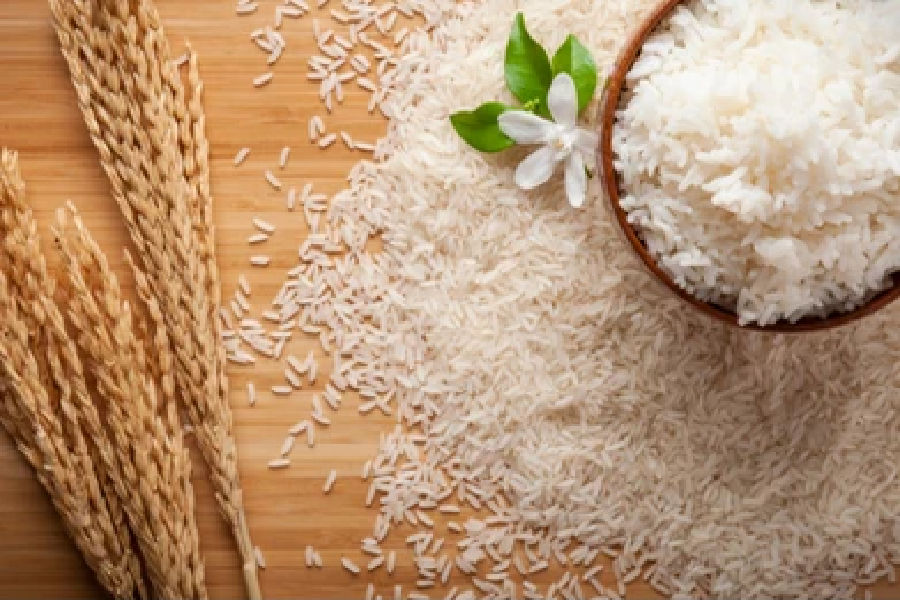
Rice_TPCI by Shutterstock

Rising geopolitical tensions in West Asia are starting to cast a shadow over global trade flows, with India’s basmati rice sector emerging as one of the industries at risk. As the standoff involving Iran, Israel and the United States intensifies, concerns are growing among Indian exporters and farmers.

The worry stems from India’s heavy reliance on Middle Eastern markets, which account for a significant share of the country’s basmati shipments. Disruptions in shipping and delays in payments have created fresh uncertainty for exporters and farmers, putting exports under strain.

Strong export growth but heavy dependence on West Asia

Basmati rice accounts for roughly 20% of India’s total agricultural exports and command strong demand in international markets. Notably, the country exports more than 75% of the basmati production.

India’s total basmati rice (HS code 10063020) exports have witnessed a steady rise over the past few years, reflecting strong global demand for the premium grain. Export earnings stood at US$ 4 billion in 2020–21, before declining slightly to US$ 3.5 billion in 2021–22. The following years saw a sharp recovery, with exports increasing to US$ 4.8 billion in 2022–23 and further rising to US$ 5.8 billion in 2023–24. The upward trend continued in 2024–25, when total basmati rice exports reached US$ 5.9 billion, the highest level during the period under review.

For 2025–26 (April–December), basmati rice exports from India, have reached US$ 4.1 billion, indicating sustained demand in international markets.
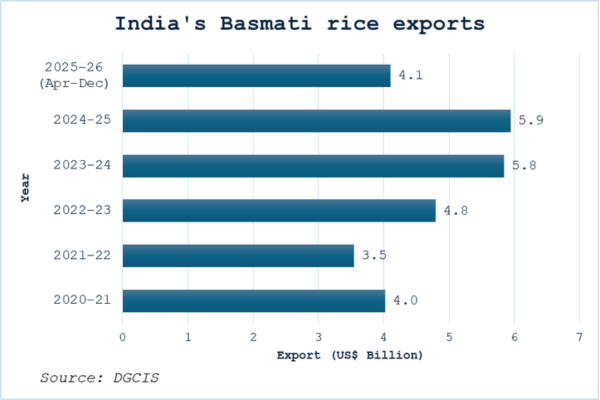
India's Basmati rice exports_TPCI

In 2024–25, Saudi Arabia was the biggest importer, purchasing basmati rice worth about US$ 1.20 billion. It was followed by Iraq, which imported around US$ 0.85 billion, and Iran, with imports valued at approximately US$ 0.75 billion. Other significant markets included the United Arab Emirates and the Yemen, each importing basmati rice worth about US$ 0.36 billion during the year.  The US, UK, Kuwait, Oman, and Netherlands, were among other major export destinations for India’s basmati rice. In all, the Middle East accounts for nearly 72% of India’s basmati rice exports, underscoring the region’s importance to the country’s agricultural trade.
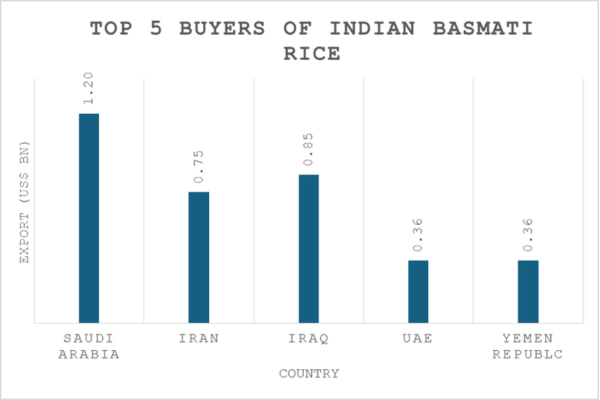
Top buyers of Indian basmati rice_TPCI

Notably, Iran was once the largest buyer of Indian basmati rice. In 2018–19, it imported more than 14,83,697 metric tonnes of basmati from India. However, imports have gradually declined over the years due to economic challenges and weakening purchasing power in the country. By 2024–25, Iran’s imports had fallen to around 8,55,133 tonnes, reflecting a significant drop from earlier levels.

Impact on farmers and domestic basmati prices

Domestic basmati rice prices have declined by ₹400–500 per tonne following the recent air strikes in west Asia, reversing the optimism seen last month. The earlier surge had been triggered by a major export agreement with Government Trading Corporation of Iran, under which India was set to ship around 1.5 lakh metric tonnes of basmati rice to Iran. The announcement had lifted prices by ₹4–5 per kg, but the current geopolitical tensions have since pushed the market back into a downturn.

A prolonged disruption in exports could push domestic basmati prices lower, putting significant pressure on farmers’ incomes. The impact would be particularly severe in Punjab and Haryana, where thousands of households depend on basmati cultivation for their livelihood.

Nearly 75% of India’s premium aromatic basmati exports originate from Punjab and Haryana. According to government estimates, Punjab accounts for about 40% of the exports, while Haryana contributes roughly 35%, highlighting their dominant role in the country’s basmati rice supply. Continued uncertainty may further depress prices, intensify financial stress for exporters, and lead to losses for farmers as well as millers.

Basmati trade faces headwinds as gulf shipping disruptions mount

Amid fears of broader regional instability and possible disruptions to shipping through the Strait of Hormuz, the Indian Rice Exporters Federation (IREF) has advised its members to avoid entering into new cost, insurance and freight (CIF) contracts for shipments to Iran and other Gulf markets. Under CIF arrangements, exporters bear the responsibility for freight, insurance, and related costs until the cargo reaches the buyer’s port.  Instead, the federation has urged exporters to prefer free-on-board (FOB) contracts wherever possible, ensuring that freight, insurance, and associated risks are handled by the overseas buyers.

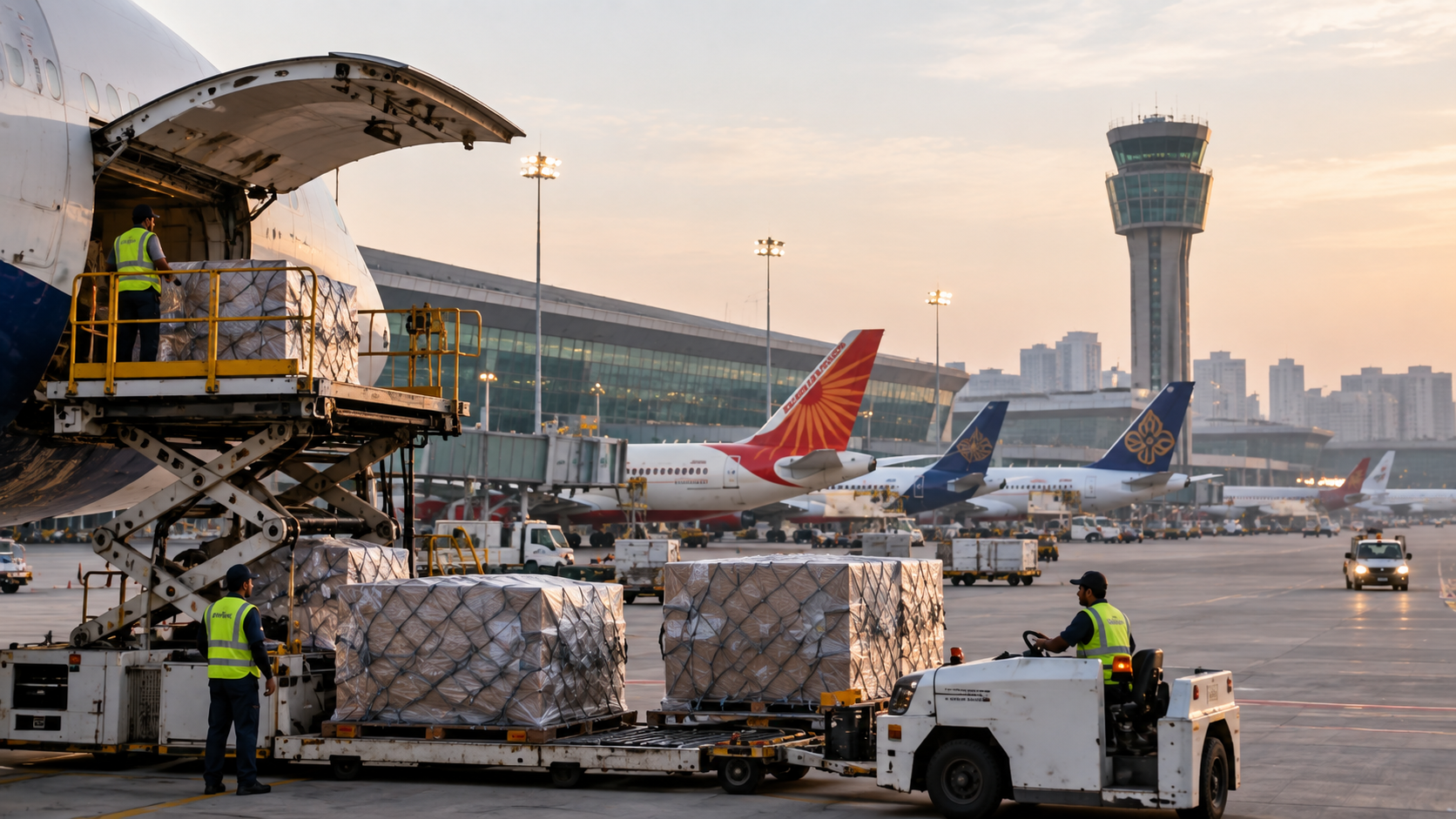
Shipping disruptions have left a large volume of India’s basmati rice exports in limbo, with trade bodies estimating that nearly 4,00,000 metric tonnes are affected. Approximately 2,00,000 tonnes are currently at sea, while another 2,00,000 tonnes are stuck at Indian ports, awaiting clearance or transport.

Disruptions along major maritime routes, especially near the Strait of Hormuz, have severely affected cargo movement. Security concerns have slowed shipping activity, while freight rates have surged and insurers have sharply increased premiums or withheld coverage for vessels entering high-risk areas. With shipments becoming costlier and riskier, exporters have largely paused new consignments and fresh trade deals have slowed significantly.

Furthermore, exporters say payments worth hundreds of crores of rupees remain outstanding. Since a significant share of basmati trade is conducted on credit, the delays have begun to strain cash flows across the industry. Exporters have approached key central agencies—including the Agricultural and Processed Food Products Export Development Authority (APEDA), the Directorate General of Foreign Trade (DGFT), and the Ministry of Commerce and Industry—seeking relief from port charges and raising concerns over what they describe as arbitrary insurance premiums imposed by shipping companies.

The rating agency Crisil noted that sectors with significant exposure to West Asia — such as basmati rice exporters, fertiliser producers, diamond polishing units, airlines, and travel operators — could face short-term disruptions if geopolitical tensions persist or intensify.

Industries reliant on imported liquefied natural gas (LNG), along with those closely tied to global crude oil prices, may also encounter higher costs and potential operational pressures.

Amid the ongoing uncertainty, exporters, farmers, and traders remain on edge, closely tracking developments and hoping the situation stabilises before any long-term damage is inflicted on the sector.

Read more

Rice exporters seek urgent relief as Iran crisis disrupts exports, shipping

India’s rice exports surged to near record highs…….

FAQ

  1. Why are India’s basmati rice exports facing uncertainty?
    India’s basmati rice exports are facing uncertainty due to rising geopolitical tensions in West Asia involving Iran, Israel and the United States. These tensions have disrupted shipping routes, increased freight and insurance costs, and delayed payments, creating challenges for exporters and traders.
  2. Why is West Asia important for India’s basmati rice trade?
    West Asia is a crucial market for Indian basmati rice, accounting for nearly 72% of total exports. Countries such as Saudi Arabia, Iraq, Iran, the United Arab Emirates and Yemen are among the largest buyers of the premium grain.
  3. How have geopolitical tensions affected shipping and logistics?
    Security concerns near the Strait of Hormuz have slowed shipping activity. Freight rates have risen sharply and insurers have increased premiums or withheld coverage for vessels entering high-risk areas, making shipments more expensive and risky for exporters.
  4. What impact could export disruptions have on farmers in India?
    A prolonged disruption in exports could push domestic basmati prices lower, affecting farmers’ incomes. The impact would be particularly severe in Punjab and Haryana, which together account for nearly 75% of India’s basmati exports.
  5. What steps are exporters taking to manage the current situation?
    Exporters have been advised by the Indian Rice Exporters Federation to avoid cost, insurance and freight (CIF) contracts and instead prefer free-on-board (FOB) terms, shifting freight and insurance responsibilities to overseas buyers to reduce financial risk.

 

Previous Post
Next Post

Most Recent Posts

  • All Post
  • 8th Pay Commission
  • Aadhar
  • Aditya Birla Capital
  • Advertising Standards
  • Affordable Housing
  • Agriculture
  • Agriculture & Food
  • AI in Healthcare
  • AI Technology
  • Airlines
  • alcohol industry
  • Android
  • APEDA
  • Apple
  • Artificial Intelligence
  • Ashwini Vaishnaw
  • Asset Management
  • Atmanirbhar Bharat
  • Audio Devices
  • Audio Products
  • Auto Industry
  • Automobile
  • Automobiles
  • Automotive
  • Automotive Industry
  • Aviation
  • Bain Healthcare Report 2026
  • Bank
  • Banking
  • Banking Technology
  • Battery Industry
  • Beverage Industry
  • Beverages
  • Bihar
  • biotechnology
  • Bitcoin
  • BMW Group India
  • Brand Insight
  • BRICS
  • Bullion Market
  • Business
  • Business & Economy
  • Business & Trade
  • Business Leadership Post COVID-19
  • Business News
  • Business Terminology
  • Business Utilities
  • Buyback
  • Capital Goods
  • Capital Markets
  • CarsBusiness
  • CBIC
  • CCI
  • Child Investment
  • China
  • China technology news
  • Citizen Services
  • Clean Energy
  • Clean Technology
  • Cloud Computing
  • coal
  • Commerce
  • Commerce and Industry
  • Commercial Real Estate
  • Commercial Vehicles
  • Commodities
  • Communications
  • Companies
  • Competition Law
  • Compliance
  • Computer Accessories
  • connected cars
  • Consumer Affairs
  • Consumer Electronics
  • Consumer Finance
  • Consumer Goods
  • Consumer Health
  • Consumer Markets
  • Consumer News
  • Consumer Protection,
  • Consumer Rights
  • Consumer Spending
  • Consumer Trends
  • Content Creation
  • Copper
  • Corporate
  • corporate affairs
  • Corporate Earnings
  • Corporate Governance
  • Corporate News
  • Corporate Social Responsibility
  • Cost of Living
  • Country
  • CRED
  • Credit Cards
  • CREDIT RATING
  • Crude Oil
  • Cryptocurrency
  • CSR
  • Culture
  • Currency
  • Customs Duty
  • Cyber Security
  • Cybersecurity
  • Dairy Industry
  • Data & Analytics
  • Defence
  • Delhi Government
  • Delhi-NCR
  • Demographics
  • Derivatives
  • DGCA
  • DGFT
  • DigiLocker
  • Digital Assets
  • Digital Economy
  • Digital Health India
  • Digital Identity
  • Digital India
  • Digital Infrastructure
  • Digital passport for robots
  • Digital Payments
  • Digital Platforms
  • digital services
  • Diplomacy
  • Dixon Technologies
  • DPIIT
  • E Commerce
  • E-commerce
  • E-Governance
  • Ease of Doing Business
  • Economic Growth
  • Economy
  • Edible Oil Industry
  • Editor Choice
  • EdTech
  • Education
  • Electric Mobility
  • Electric Vehicles
  • Electronics
  • Employment
  • ENERGY
  • Engineering
  • Entertainment
  • Environment
  • EPFO
  • Ethanol Economy
  • EV Industry
  • EV Technology
  • Exports
  • EXTER
  • Farmers
  • Fashion
  • FINANCE
  • Finance Ministry,
  • Financial Marketing
  • Financial Markets
  • Financial News
  • Financial Planning
  • Financial Results
  • Financial Services
  • Fintech
  • FnTech
  • Food & Beverage
  • Food & Beverages
  • Food Exports
  • Food Industry
  • Food Manufacturing
  • Food Processing
  • Food Regulations
  • food safety
  • Foreign Exchange
  • Foreign Investment
  • Foreign Policy
  • Foreign Trade
  • Forex Reserves
  • fssai
  • FTA
  • Fuel
  • Fuel Prices
  • Future Energy
  • Gadgets
  • Gadgets & Apps
  • Gaming
  • GDP
  • Generative AI Healthcare
  • Geopolitics
  • GI Products
  • Global Brand Alliance
  • Global Economy
  • Global Markets
  • Global Politics
  • Global Tech
  • Global Trade Policy
  • Global Trends\
  • Gold
  • Gold Market
  • Gold Prices
  • Gols & Silver
  • Government
  • Government & Policy
  • Government Affairs
  • Government Bonds
  • Government Data
  • Government Initiatives
  • Government Policy
  • Government Policy & Regulation
  • Government Scheme
  • Government Schemes
  • Government Services
  • Green Energy
  • Green Mobility
  • GroupGlobal
  • GST
  • GST Council
  • GST Counsil
  • Hair Care
  • Hardware
  • Hatchback Segment
  • Health Supplements,
  • Horticulture
  • Housing
  • HSBC
  • Human Resources
  • humanoid robot market
  • Hyundai
  • IBT Infographics
  • iinvestment
  • Imports & Exports
  • Income Tax
  • India
  • India Auto Market
  • India Business News
  • India Inc
  • India News
  • India Retail
  • India-Canada Relations
  • India-China
  • India-Japan Relations
  • India-Russia Relations
  • India-South Korea Relations
  • India-US Relations
  • Indian Economy
  • Indian Navy
  • Industrial Pollution
  • Inflation
  • Infra
  • Infrastructure
  • Innovation
  • Instagram
  • Insurance
  • international
  • International Affairs
  • International Cooperation
  • International Relations
  • International Trade
  • Internet & Connectivity
  • Internet Policy
  • Internet Regulation
  • Interview
  • Investing
  • Investment News
  • Investments
  • iPhone News
  • IPO
  • IT Industry
  • Jewellery
  • Jio Platforms
  • JioBlackRock
  • Jobs & Careers
  • Joint Ventures
  • Kim Kardashian
  • Labour
  • Latest
  • Launches
  • Leadership
  • Leaderspeak
  • Lending
  • Lifestyle
  • Lifestyle Tech
  • List
  • Loans & Credit
  • Local News
  • Logistics
  • LPG
  • Luxury Cars
  • Machinery
  • Macroeconomics
  • Macroeconomy
  • maharashtra
  • Maharashtra News
  • Make in India
  • Makhana
  • Managed Workspaces
  • Manufacturing
  • Market Outlook
  • Markets
  • Maruti Suzuki
  • Mergers & Acquisitions
  • Meta
  • Microsoft
  • Middle East
  • Mobile Apps
  • Mobile Industry
  • Mobile Launch
  • Mobility
  • Monetary Policy
  • Monsoon
  • MoSPI
  • MSME
  • Mutual Funds
  • Nano Tech
  • National
  • National news
  • NEET 2026
  • NewsElectric
  • NewsTata
  • NPCI
  • NPS Vatsalya
  • Office Market
  • Oil & Gas
  • Oil and Gas
  • Others
  • OTT
  • Packaged Drinking Water
  • Packaged Foods
  • Packaging Industry
  • Packaging Innovation
  • Passenger Vehicles
  • Paytm
  • Pension & Retirement
  • Pensions
  • Personal Care
  • Personal Finance
  • Perspectives
  • Petroleum
  • PFRDA
  • Pharmaceuticals
  • PM Modi
  • PMAY-G
  • PMAY-U
  • PMAY,
  • PMI
  • policy
  • Population
  • PORTS
  • Positive News
  • PPF
  • Precious Metals
  • Pricing
  • Product Labeling
  • Product Labelling
  • Product Launch
  • Property Market
  • PSU
  • PSU Banks
  • Public Health
  • Public Policy
  • Public Safety
  • Public Sector
  • Public Services
  • Public Welfare
  • Quarterly Results
  • Railways
  • Rajasthan
  • Raksha Bandhan
  • Raksha Bandhan Gifts
  • Rare Earths
  • Ratings Agencies
  • RBI
  • Real Estate & Realty Sector
  • Recycling
  • Regulation
  • Regulatory Action
  • Regulatory Affairs
  • Regulatory Updates
  • REIT
  • Reliance Industries
  • Renewable Energy
  • RERA
  • Research
  • Retail
  • Retirement Planning
  • Road Infrastructure
  • Robotics & Automation
  • robotics standards
  • Rupee
  • Rural Development
  • Rural Housing
  • SAIL
  • Salaries
  • Samsung
  • Savings
  • Science & Technology
  • Sebi
  • Security
  • Semiconductor
  • Semiconductors
  • Services Sector,
  • SHIPPING
  • Silver Prices
  • Skill Development
  • Skills Development
  • Small Business
  • Smart Devices
  • Smart Home
  • Smart Mobility
  • Smartphones
  • Social Impact
  • Social Media
  • Society
  • Software Development
  • Solar Energy
  • Space Technology
  • Startups
  • Statistics
  • Steel Industry
  • Stock Market
  • stocks
  • streaming
  • Sugar Industry
  • Sukanya Samriddhi Yojana
  • Sustainability
  • SUV
  • Tamil Nadu Pollution Board
  • Tariffs
  • Tariffs & Duties
  • Tata Group
  • Tata Motors
  • Tata Sons
  • Tax Planning
  • Taxation
  • Tech
  • Tech Branding
  • Technology
  • Telecom & Technology
  • Telecom Industry
  • Top Story
  • Tourism
  • Trade
  • Trade Agreement
  • Trade Basket
  • Trade Partner
  • Trade Policy,
  • Transportation
  • Travel
  • Trending
  • Two-Wheelers
  • UIDAI
  • UPI
  • Urban Development
  • US-Iran Conflict Economic Impact
  • US–India Relations
  • Uttar Pradesh
  • Vaccines
  • VehiclesLuxury
  • vivo
  • Wastewater Management
  • Water Quality,
  • Wealth Management
  • Wearables
  • Wellness
  • WhatsApp
  • Wheat
  • Workplace
  • World
  • World News
  • Worldview
  • Yamaha
  • zLead Slider
    •   Back
    • Healthcare
    • Auto
    • Fmcg
    • Hospitality
    •   Back
    • Cash Crop
    • Organic
    • New Era Agri
    • Processed Food
    •   Back
    • Construction
    • Power
    • Mining
    • Telecom
    •   Back
    • ENERGY
    •   Back
    • Export/Import
    • Trade Deal
    • Trade Fair
    •   Back
    • Policies
    • Industry
    • Finance
    •   Back
    • Others technology
    • Mobile phone
    • Gadgets
    •   Back
    • Manufacturing
    • Services
    • Startup

India Business & Trade is a national media platform decoding the ideas, decisions and shifts shaping India’s growth story—across plicy, business, global commerce and a rapidly evolving marketplace.

Reach Us

India Business & Trade
M-62, Saket, New Delhi-110064, India

Subscribe To Newsletter

Stay ahead in the dynamic world of trade and commerce with India Business & Trade’s weekly newsletter.

Copyright © 2026 India Business & Trade. All Rights Reserved


Fatal error: Uncaught TypeError: Unsupported operand types: string * int in /var/www/sites/indiabusinesstrade.in/wp-content/plugins/royal-elementor-addons/admin/includes/wpr-templates-modal-popups.php:192 Stack trace: #0 /var/www/sites/indiabusinesstrade.in/wp-content/plugins/royal-elementor-addons/admin/includes/wpr-templates-modal-popups.php(128): WprAddons\Admin\Includes\WPR_Templates_Modal_Popups::get_template_settings() #1 /var/www/sites/indiabusinesstrade.in/wp-content/plugins/royal-elementor-addons/admin/includes/wpr-templates-modal-popups.php(106): WprAddons\Admin\Includes\WPR_Templates_Modal_Popups::render_popup_content() #2 /var/www/sites/indiabusinesstrade.in/wp-content/plugins/royal-elementor-addons/admin/includes/wpr-templates-modal-popups.php(64): WprAddons\Admin\Includes\WPR_Templates_Modal_Popups::display_popups_by_location() #3 /var/www/sites/indiabusinesstrade.in/wp-includes/class-wp-hook.php(341): WprAddons\Admin\Includes\WPR_Templates_Modal_Popups->render_popups() #4 /var/www/sites/indiabusinesstrade.in/wp-includes/class-wp-hook.php(365): WP_Hook->apply_filters() #5 /var/www/sites/indiabusinesstrade.in/wp-includes/plugin.php(522): WP_Hook->do_action() #6 /var/www/sites/indiabusinesstrade.in/wp-includes/general-template.php(3224): do_action() #7 /var/www/sites/indiabusinesstrade.in/wp-content/plugins/royal-elementor-addons/admin/templates/wpr-canvas.php(64): wp_footer() #8 /var/www/sites/indiabusinesstrade.in/wp-includes/template-loader.php(132): include('...') #9 /var/www/sites/indiabusinesstrade.in/wp-blog-header.php(19): require_once('...') #10 /var/www/sites/indiabusinesstrade.in/index.php(17): require('...') #11 {main} thrown in /var/www/sites/indiabusinesstrade.in/wp-content/plugins/royal-elementor-addons/admin/includes/wpr-templates-modal-popups.php on line 192