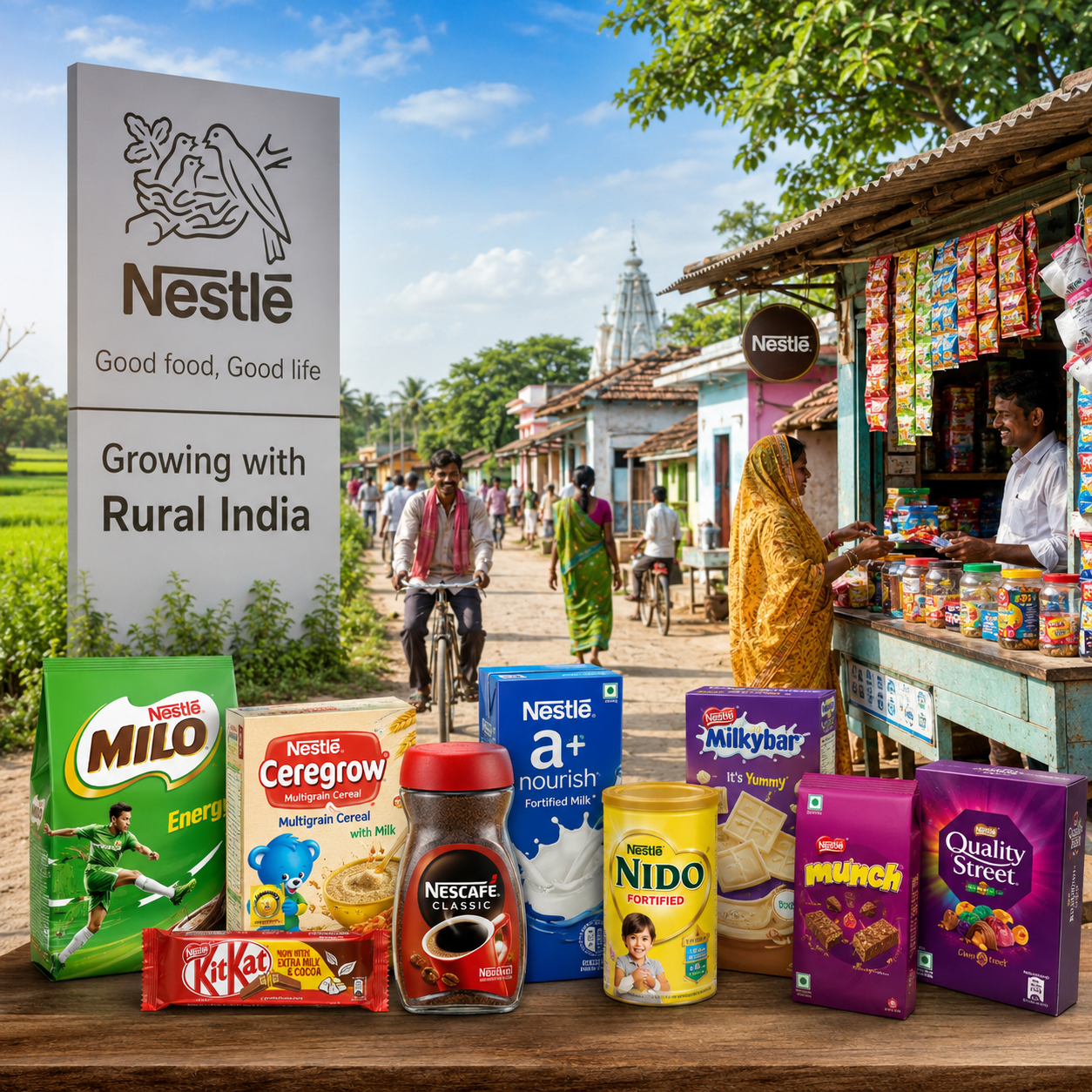
The FMCG giant plans to drive long-term growth through deeper rural penetration, wider distribution, Tier-II and Tier-III expansion, and continued investments despite inflationary challenges.
- Nestlé India sees rural and semi-urban markets as its biggest long-term growth opportunity.
- Company added 5.2 lakh retail outlets since April 2023 to expand reach.
- Domestic sales touched a record ₹23,071.5 crore in FY26.
- Around ₹2,000 crore committed for capacity expansion and new projects.
- Focus remains on penetration-led growth, premiumisation and Tier-II & Tier-III markets.
New Delhi, July 3: Nestlé India is placing its long-term growth strategy firmly on India’s rural and semi-urban markets, where rising aspirations and evolving consumption patterns are expected to drive the next phase of demand. Speaking at the company’s 67th Annual General Meeting (AGM), Chairman and Managing Director Manish Tiwary said India continues to offer enormous growth potential, but success will depend on understanding the country’s highly diverse consumer base.
Tiwary emphasized that India cannot be viewed as a single market. Instead, it consists of multiple consumer segments shaped by income levels, geography, language, food preferences and purchasing habits. He said Nestlé’s strategy is built around understanding these differences and delivering products that meet the specific needs of consumers across regions.
The company acknowledged that FY26 was a challenging year for India’s consumption economy. Rising food inflation affected household spending, prompting consumers to change pack sizes, reduce purchase frequency and alter category preferences. Rural demand improved gradually but remained closely linked to monsoon performance and farm incomes, while urban consumption showed mixed trends across different income groups.
Global challenges, including higher energy prices, freight disruptions and geopolitical uncertainties, also increased input costs during the year. Despite these headwinds, Nestlé India recorded its highest-ever domestic sales of ₹23,071.5 crore, supported by double-digit volume-led growth and gains in market share.
According to Tiwary, the company’s long-term strategy focuses on increasing household penetration rather than relying only on higher prices. Nestlé has expanded its distribution network significantly by adding around 5.2 lakh retail outlets across urban, semi-urban and rural markets since April 2023, enabling more consumers to access its product portfolio.
The company is also making strategic investments in Tier-II and Tier-III cities, where consumption is growing faster than in many metropolitan areas. Alongside expanding distribution, Nestlé is investing in premium products, technology and manufacturing capacity to meet future demand.
Over the past two years, Nestlé India has committed nearly ₹2,000 crore in capital expenditure, including investments in its confectionery and food businesses as well as a new greenfield manufacturing facility in Odisha.
With rural incomes expected to improve over the long term and aspirations continuing to rise, Nestlé believes India’s smaller towns and villages will play a pivotal role in shaping the country’s next wave of consumer growth.