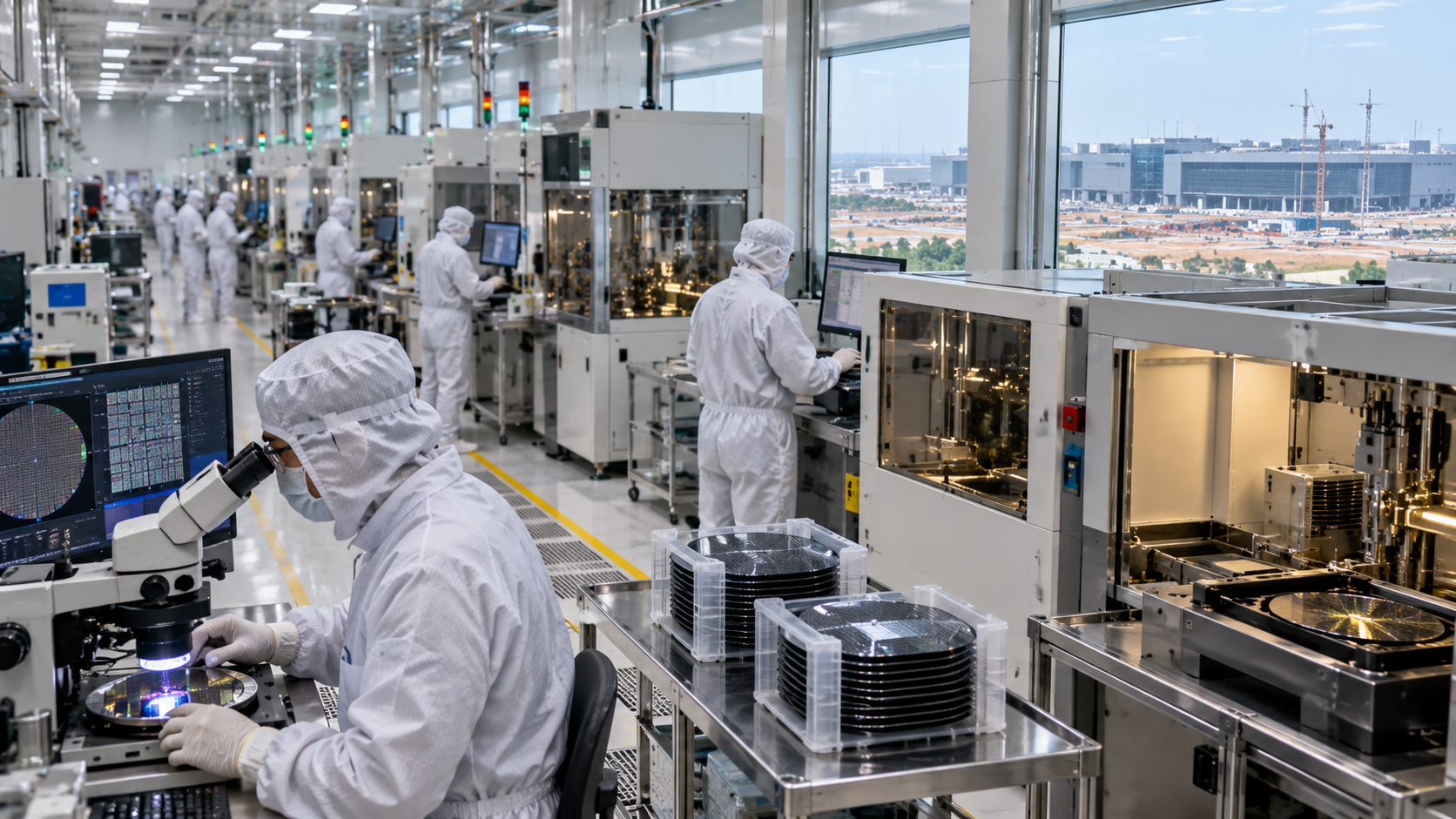

As artificial intelligence reshapes the global economy, compute infrastructure is emerging as the most valuable strategic resource, with the US and China competing for technological and economic leadership.
Key Highlights
- Compute power is emerging as a strategic global resource.
- AI infrastructure may become as important as oil once was.
- Relative compute capacity matters more than absolute capacity.
- China’s open-weight AI models are challenging US dominance.
- AI services were expected to become a major US export industry.
- The AI productivity revolution is still in its early stages.
- Chip manufacturing and data centers are replacing oil fields as strategic assets.
- Future economic leadership may depend on compute infrastructure.
Artificial intelligence is rapidly changing the way nations compete, leading many experts to describe compute infrastructure as the “new oil” of the digital economy. Unlike traditional natural resources, however, compute cannot simply be accumulated and stored. Its value depends on continuous technological advancement, making relative leadership more important than absolute capacity.
The emergence of frontier AI models has significantly increased demand for high-performance computing. Countries that maintain leadership in advanced chips, cloud infrastructure and large-scale data centres are expected to play a dominant role in the next phase of global economic growth. As AI models become more sophisticated, the amount of computing power required to train and deploy them continues to increase.
The United States has been viewed as the global leader in AI infrastructure, supported by advanced semiconductor technology and leading AI companies. Many analysts believe the country hoped to transform AI into a major export industry by offering advanced models through cloud-based services. Such an approach could have created a new source of long-term economic growth.
However, China’s rapid progress in developing capable and lower-cost open-weight AI models is changing the competitive landscape. Instead of relying entirely on proprietary American AI services, many countries can now deploy powerful open-source models on their own infrastructure. While advanced semiconductor manufacturing remains concentrated among a few global players, competition in the AI software layer has intensified considerably.
Another important aspect of the AI revolution is its current economic impact. Despite rapid adoption, AI has yet to deliver productivity gains at the scale many expected. This situation resembles the “productivity paradox” observed during the early computer era, when businesses widely adopted computers but meaningful productivity improvements took years to materialise because organisations had not yet redesigned their workflows.
Today, much of AI is still being used as an assistant layered onto existing business processes rather than fundamentally transforming how organisations operate. Many experts believe the true economic value of AI will emerge only when businesses rebuild operations around AI-native systems instead of treating AI as an add-on tool.
As global competition shifts from energy resources to digital infrastructure, strategic assets such as semiconductor fabrication plants, hyperscale data centres and advanced computing capacity are becoming increasingly important. The countries that successfully build and maintain leadership in compute infrastructure are likely to shape the next generation of technological innovation, economic growth and geopolitical influence.