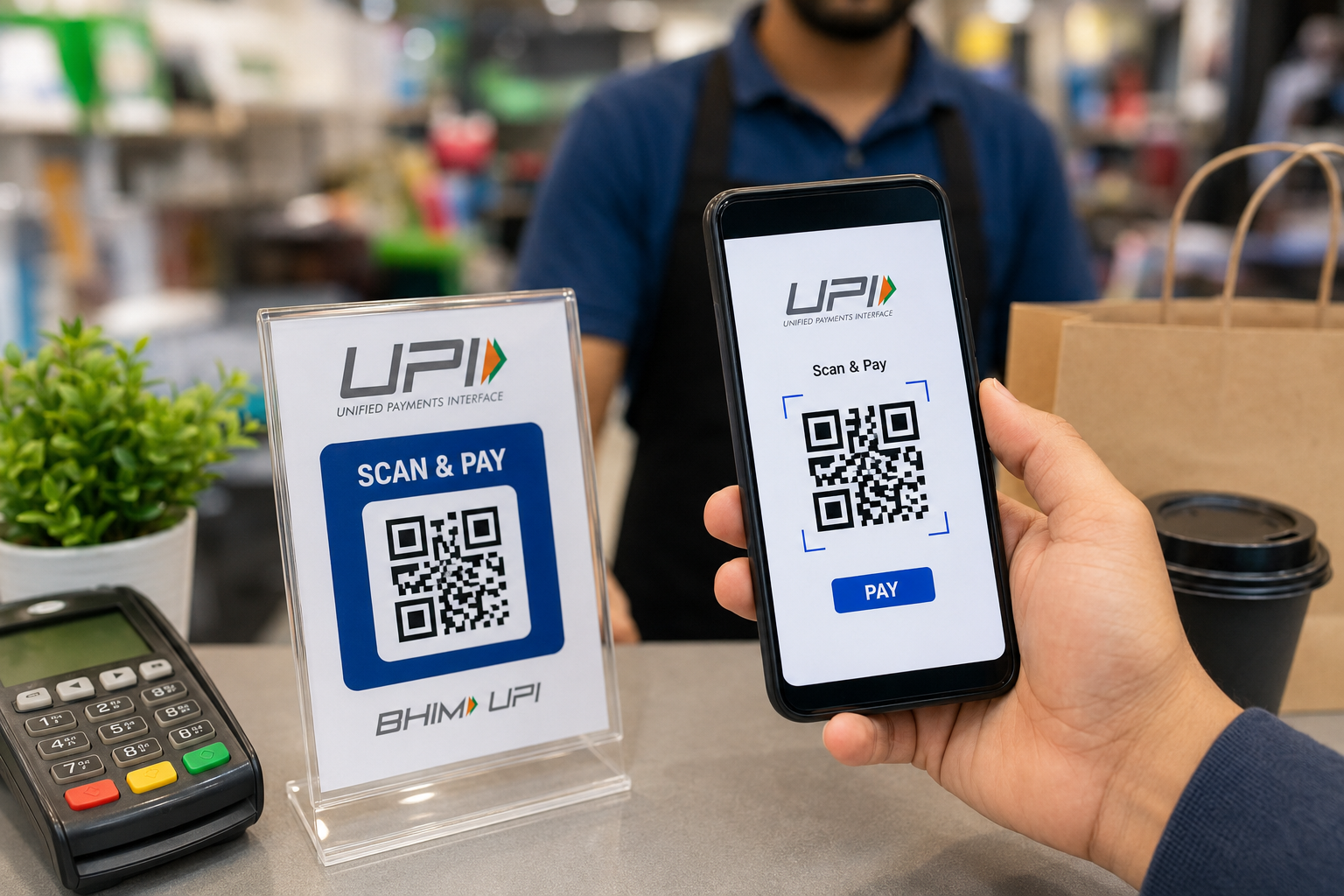
The government is reportedly considering bringing back a limited Merchant Discount Rate on high-value UPI transactions. The proposed charge may apply only to large merchants, while ordinary users and small shopkeepers are expected to remain unaffected.
Highlights
- MDR may return on selected UPI transactions.
- The proposal may cover payments above ₹2,000.
- Only large merchants could be brought under the charge.
- Businesses with annual turnover above ₹1–1.5 crore may be covered.
- The proposed MDR rate could be between 5 and 7 basis points.
- No final decision has been taken by the government yet.
The central government is reportedly examining a proposal to reintroduce the Merchant Discount Rate, or MDR, on certain UPI transactions.
However, the proposed charge may not affect ordinary customers or small shopkeepers. According to reports, it could be limited to large businesses and higher-value transactions.
MDR is the fee paid by a merchant to banks or payment service providers for processing digital payments. It helps cover expenses related to transaction processing, payment infrastructure, network maintenance and settlement.
Under the proposal being discussed, MDR may be imposed on merchants with annual turnover of around ₹1 crore to ₹1.5 crore or more. The charge could apply only when the value of a UPI transaction exceeds ₹2,000.
Reports suggest that the MDR rate may be kept between 5 and 7 basis points. One basis point is equal to 0.01 percentage point. This means the fee would remain relatively small, although it could become meaningful for businesses processing large numbers of transactions.
The government has not announced any final decision, and the proposal is currently at the discussion stage.
MDR on UPI and RuPay payments was removed in January 2020 to encourage people and businesses to adopt digital payment methods. Since then, UPI has become India’s most widely used digital payment system.
Banks and payment companies have repeatedly argued that processing billions of UPI transactions without MDR is becoming financially difficult. Although the government provides incentives to support the ecosystem, industry participants say that the assistance does not fully cover their operating costs.
This has led to discussions around introducing MDR in a limited manner, particularly for large merchants that have the capacity to absorb the fee.
The proposed structure seeks to protect customers and smaller businesses from additional costs while giving banks and payment companies a source of revenue to maintain and upgrade the UPI infrastructure.
UPI has recorded remarkable growth over the last decade. In the financial year 2016-17, the platform processed around 2 crore transactions. By 2025-26, the number had reportedly increased to nearly 242 billion transactions.
The total value of UPI payments also rose sharply, from about ₹0.07 lakh crore to nearly ₹314 lakh crore during this period.
In June alone, UPI processed approximately 22.72 billion transactions worth ₹28.92 lakh crore.
The rapid expansion highlights UPI’s importance to India’s digital economy. Any decision on MDR will therefore need to balance affordable payments for users with the financial sustainability of banks and payment companies.