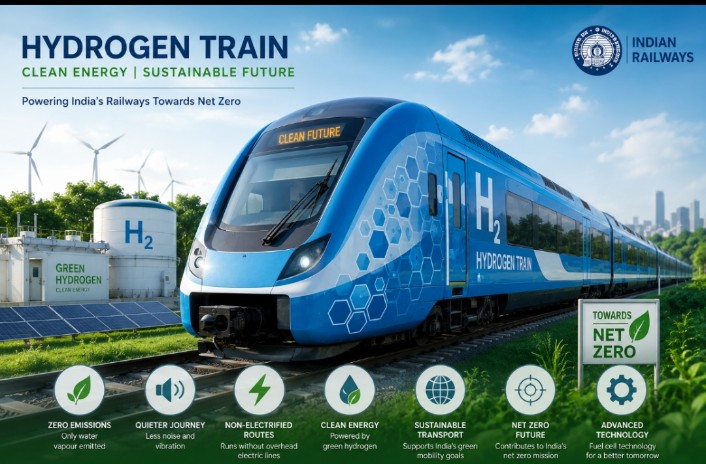
Hydrogen-powered trains offer cleaner travel, lower emissions and improved connectivity while supporting India’s green energy transition and sustainable railway network.
Highlights
- Produces only water vapour with zero tailpipe emissions.
- Offers quieter and smoother journeys than diesel trains.
- Can run on non-electrified railway routes.
- Reduces dependence on diesel fuel.
- Supports India’s Green Hydrogen Mission and net-zero goals.
- Encourages investment in hydrogen infrastructure and clean-energy jobs.
New Delhi:
India’s first hydrogen-powered train marks a major step towards sustainable transportation and modern railway technology. Beyond being a technological achievement, the new train is expected to deliver significant environmental, economic and passenger benefits.
Unlike conventional diesel trains, hydrogen trains use fuel cells to generate electricity by combining hydrogen with oxygen. The only by-product of this process is water vapour, making the technology virtually emission-free at the point of use. This helps reduce air pollution and carbon emissions while supporting India’s transition to cleaner energy.
Passengers are also expected to benefit from a quieter and smoother travel experience. Hydrogen-powered trains produce less engine noise and vibration than diesel locomotives, making journeys more comfortable, especially on long-distance routes.
Another key advantage is that hydrogen trains can operate on non-electrified railway lines without requiring overhead electric wires. This makes them ideal for remote and rural regions where railway electrification is difficult or expensive. As a result, Indian Railways can improve connectivity while reducing its dependence on fossil fuels.
The project is also expected to strengthen India’s green hydrogen ecosystem by encouraging investment in hydrogen production, storage, transportation and refuelling infrastructure. This could create new employment opportunities and support the growth of clean-energy industries across the country.
The initiative aligns with the National Green Hydrogen Mission and India’s target of achieving net-zero carbon emissions. As green hydrogen production expands and costs decline, hydrogen-powered trains could become an important part of India’s future railway network, offering passengers a cleaner, quieter and more sustainable mode of transport