The aluminium casting manufacturer plans to more than triple its turnover through higher exports, local production and capacity expansion.
Demand from energy, defence, railways and infrastructure sectors is expected to support the company’s next phase of growth.
Highlights
- Taural India plans to increase turnover from around ₹300 crore to ₹1,000 crore.
- The company has invested ₹500 crore in a new manufacturing plant at Supa, Maharashtra.
- Production capacity can rise up to four times with the new plant and optimised Chakan facility.
- Export contribution is expected to increase from 18% to around 30–32% of total sales.
- Railways and defence are emerging as major growth opportunities for aluminium components.
- Further expansion will be funded through internal accruals over the next three to four years.
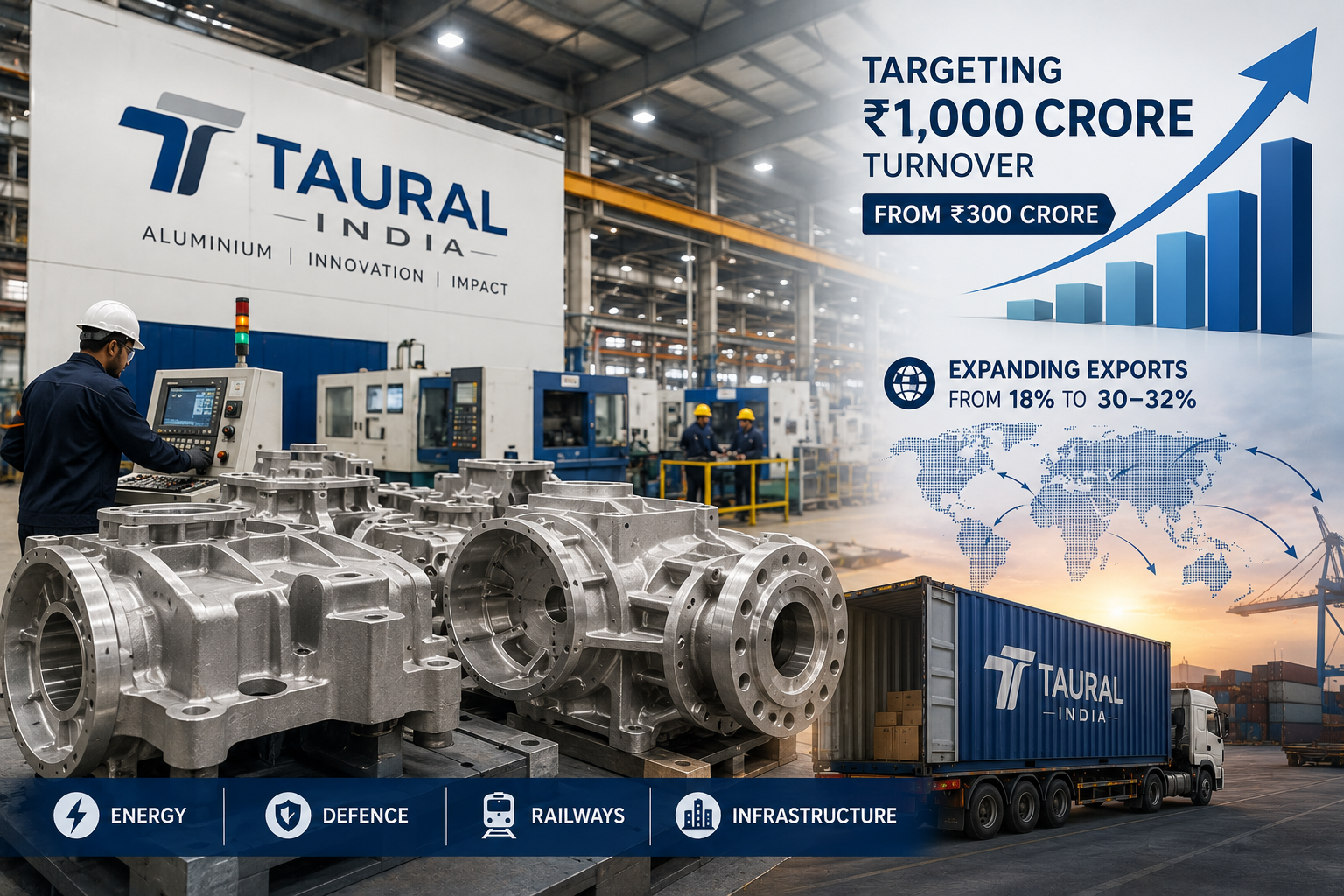
Taural India is aiming to increase its annual turnover to ₹1,000 crore from around ₹300 crore by expanding manufacturing capacity, increasing exports and tapping growing demand from sectors such as energy, defence, railways and infrastructure.
The company manufactures large and complex aluminium sand-cast components used by industrial and infrastructure companies. Taural India founder and CEO Bharat Gite said the company’s growth strategy will focus on localisation, customer-led innovation and the development of new applications for aluminium.
Taural India initially started operations in India to supply existing European customers in the energy sector, including Siemens, Hitachi Energy and General Electric. Its initial sales in the country were between ₹70 crore and ₹100 crore.
However, rising demand from domestic and Asian customers encouraged the company to expand production and make fresh investments.
The company has opened a new manufacturing facility at Supa in Maharashtra’s Ahilyanagar district after its existing Chakan plant reached full capacity. Taural India has invested ₹500 crore in the Supa plant.
The investment commitment was announced in January 2025 during the World Economic Forum in Davos in partnership with the Maharashtra government. The plant was built and made operational within a year.
According to Gite, the Supa plant, combined with the optimised Chakan unit, gives Taural India the ability to increase production by up to four times. Customers are already seeking volumes that are 50–70% higher than their current orders.
The company expects exports to increase from around 18% of sales at present to 30–32% in the coming years. Higher domestic demand, increased exports and additional production capacity are expected to help Taural India reach its ₹1,000 crore turnover target.
The ₹500 crore investment at Supa is expected to support revenue of around ₹700 crore. Further expansion required to reach ₹1,000 crore will be funded through internal accruals over the next three to four years.
Beyond the energy sector, Taural India is exploring localisation opportunities with global equipment manufacturers such as Hyosung Heavy Industries, Toshiba Energy Systems & Solutions and Mitsubishi Electric. It is also working with Indian companies, including BHEL and CG Power and Industrial Solutions.
The company sees significant opportunities in the railway sector, extending beyond engine blocks to the wider rail manufacturing ecosystem. Defence is another promising area, as the domestic localisation of aluminium components is still at an early stage.
Taural India also plans to use automation, process improvements, scanning and advanced testing to maintain product quality while increasing production volumes.