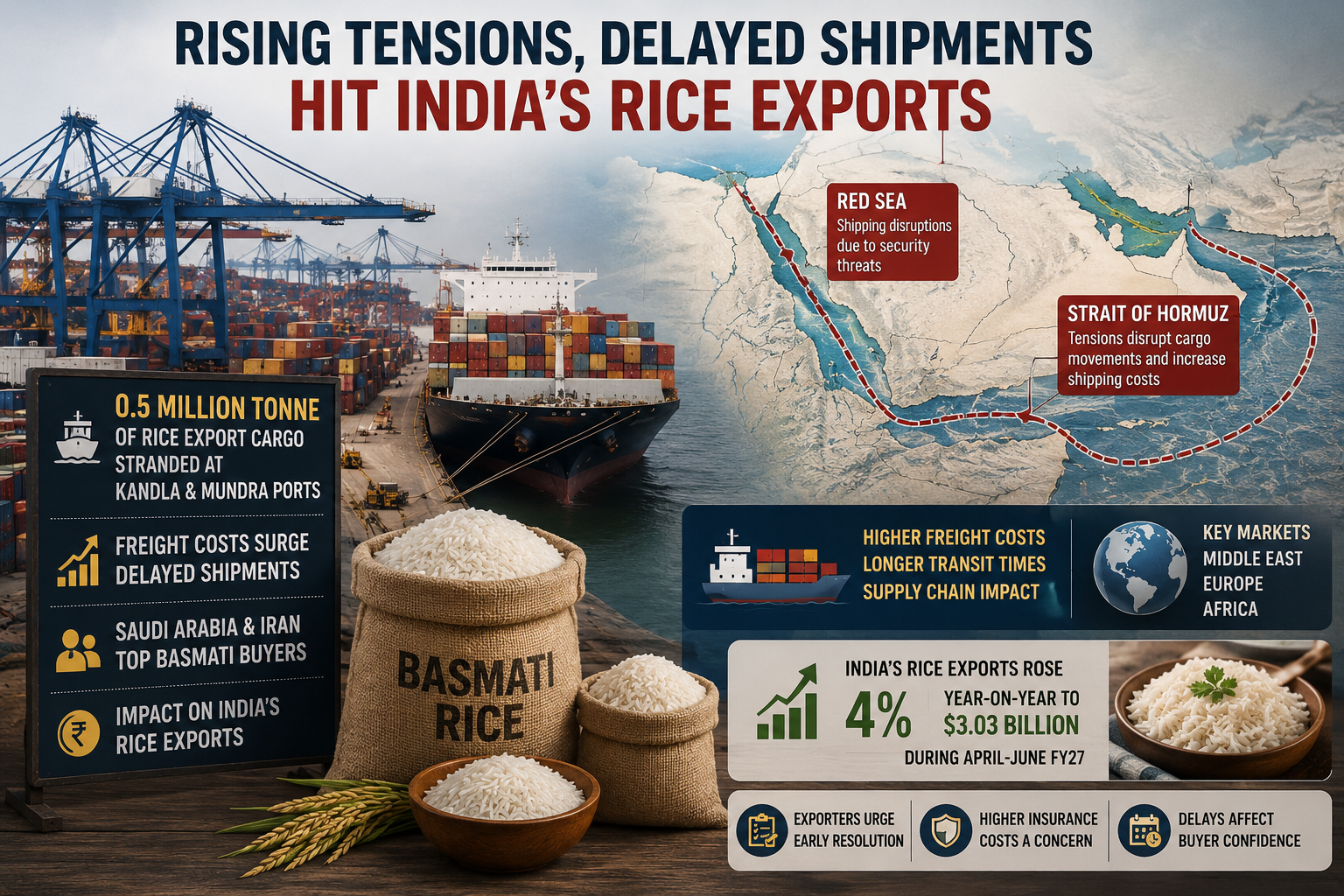
Rising tensions around the Red Sea and Strait of Hormuz are disrupting India’s rice exports, delaying shipments and increasing freight costs for exporters.
Highlights
- Around 0.5 million tonnes (MT) of rice export cargo is stranded at Kandla and Mundra ports.
- Security concerns in the Red Sea and Strait of Hormuz have disrupted shipping routes.
- Freight and insurance costs have surged, putting pressure on exporters’ working capital.
- Saudi Arabia and Iran, two of India’s biggest basmati buyers, could face supply disruptions.
- Exporters fear longer transit times may make Indian rice less competitive in key markets.
- Despite current disruptions, India’s rice exports grew over 4% year-on-year to $3.03 billion during April-June FY27.
India’s rice exporters are facing fresh challenges as geopolitical tensions in West Asia disrupt major global shipping routes through the Red Sea and the Strait of Hormuz. The disruptions have slowed cargo movement, pushed up freight costs and delayed deliveries to important overseas markets.
According to industry estimates, nearly 0.5 million tonnes of rice export cargo, including basmati rice, is currently stranded at Kandla and Mundra ports in Gujarat due to uncertainty over shipping schedules.
Exporters say the simultaneous disruptions around the Bab al-Mandab Strait and the Strait of Hormuz have created serious logistical challenges. Many shipping lines are taking longer routes to avoid conflict zones, increasing transportation costs and locking up exporters’ working capital as consignments remain delayed.
The impact is particularly significant because the Middle East is one of India’s largest markets for premium basmati rice. Saudi Arabia and Iran, together importing nearly 2 million tonnes annually, are among the biggest buyers. Longer delivery times and higher shipping costs could make Indian rice more expensive for customers in the Middle East and Europe.
Despite the ongoing disruption, India’s rice exports have remained resilient so far. During the April-June quarter of FY27, rice exports increased by more than 4% year-on-year to $3.03 billion, supported by steady global demand.
However, exporters warn that if shipping conditions do not improve soon, higher logistics costs and delayed deliveries could affect India’s competitiveness in international markets and put pressure on future export growth.