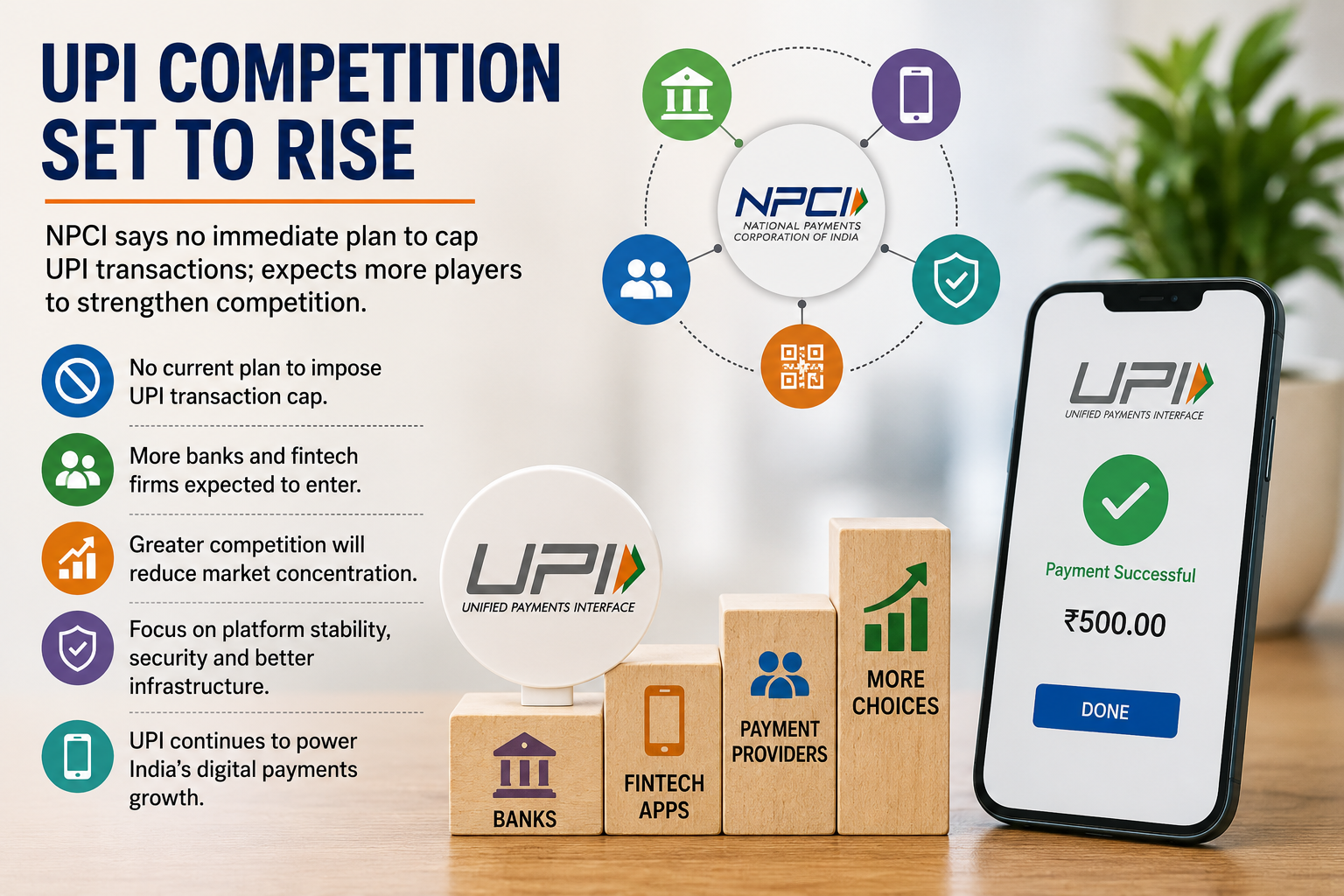
NPCI says it has no immediate plans to cap UPI transactions despite concerns over market concentration.
The body expects new players to strengthen competition and reduce dependence on a few dominant apps.
Key Highlights
- NPCI says there is no current plan to impose a UPI transaction cap.
- Market share limit of 30% remains under discussion, but implementation is on hold.
- More banks and fintech firms are expected to enter the UPI ecosystem.
- New entrants could increase competition and reduce concentration.
- NPCI is working to improve platform stability and payment infrastructure.
- UPI continues to witness rapid growth in digital payments across India.
The National Payments Corporation of India (NPCI) has clarified that it has no immediate plans to introduce a transaction cap on Unified Payments Interface (UPI), even as concerns continue over the dominance of a few major payment apps.
NPCI officials said the focus is currently on expanding the UPI ecosystem by encouraging more banks, fintech companies and payment service providers to participate. The organisation believes that greater competition will naturally reduce market concentration instead of relying solely on regulatory restrictions.
The clarification comes amid discussions around the proposed 30% market share cap for third-party UPI applications. The rule was introduced to prevent excessive dependence on a few platforms, but its implementation has been deferred multiple times to avoid disrupting India’s fast-growing digital payments ecosystem.
According to NPCI, new players are steadily entering the market, and several initiatives are underway to improve the reliability, scalability and security of UPI infrastructure. As competition increases, consumers are expected to get more choices, better services and continued innovation.
UPI has become India’s most widely used digital payment system, processing billions of transactions every month. The rapid adoption of QR-code payments, merchant acceptance and mobile banking has made UPI the backbone of the country’s digital economy.
Industry experts believe that instead of imposing immediate restrictions, expanding the ecosystem and strengthening infrastructure will help create a healthier and more competitive digital payments market.
NPCI also reiterated its commitment to ensuring that UPI remains secure, reliable and capable of supporting the growing volume of digital transactions across the country.